Jung Mi-jo reveals eye health issues, pausing painting due to light sensitivity
Singer Jung Mi-jo shares how aging-related light sensitivity has forced her to pause her lifelong passion for painting.
Singer Jung Mi-jo confessed that she has recently had to stop her painting work due to eye health issues. While she is remembered by the public as a long-time vocalist, painting has been an artistic pillar of her life just as much as music. Considering her life trajectory—spanning roles as a singer, painter, and art educator—this confession carries more weight than a simple health update.
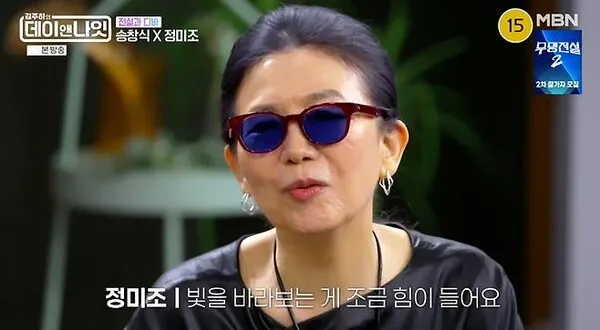
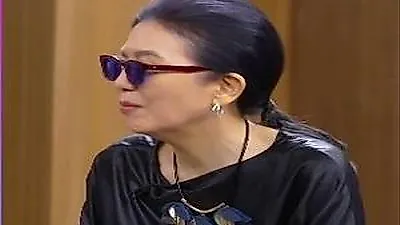
On the MBN program 'Kim Ju-ha's Day and Night' broadcast on the 5th, Song Chang-sik and Jung appeared ahead of their joint concert scheduled for October 16. During the appearance, Jung drew attention by wearing sunglasses.
Regarding her reason for wearing sunglasses, she explained, “Because aging has set in over the past few years, it has become difficult to look at light. There are many lights in broadcasting studios, so I had no choice but to wear sunglasses.”
Since studio lighting is often stronger than typical indoor environments, it can cause significant discomfort to those sensitive to light. Rather than providing a specific medical diagnosis, Jung attributed her difficulty with light to 'aging.' Therefore, rather than concluding this is a specific ophthalmic disease, it is more appropriate to view it as her expressing the visual discomfort she is experiencing.
The reason Jung's confession felt even more poignant is due to her dual artistic identity. When Song Chang-sik asked, “Are you not painting these days?” Jung replied, “That's why I haven't been able to paint lately.” She added, “I was still painting until a few years ago.”
Jung is known to be part of the class of '68 in the Department of Western Painting at Ewha Womans University. Unlike singers who approach painting as a hobby, she received formal art education and subsequently served as a professor of fine arts before retiring. In essence, she has built her own creative language across the different disciplines of music and fine arts throughout her life.
Her career also intersects with the unique landscape of Korean popular music history. Jung drew attention in the Korean music scene of the 1960s and 1970s with her original tone and musical sense, before later pursuing art study and education. By expanding her artistic interests into another field instead of continuously chasing mainstream popularity, she differentiated herself from the typical path required of female singers at that time.
Her career, oscillating between life as a singer and an artist, makes it difficult to define her work as a single professional category. While she dealt with sound through singing, she explored color and form through painting. Although the mediums differed, the essence of self-expression through creation remained the same.
For Jung, 'light' may be more than just a matter of the broadcasting environment. In painting, light is a core element that determines color, shading, space, and form. A painter observes light and reconstructs those changes on a canvas. Therefore, her statement that it has become difficult to look at light for long can be read as meaning her very environment as an artist has changed.
However, there is no need to interpret her remarks as meaning her creative activities have been permanently discontinued. Jung only stated that she is currently unable to paint; she did not suggest she would never return to the canvas. Adjusting one's method or environment in response to physical changes can be a natural part of the creative process for any artist.
In Jung's life, music and art have not been two disconnected careers but have composed a single artistic journey. In her youth, she met the public with her voice, and later, she spent her time in front of a canvas. The fact that an artist who has experienced both the lights on stage and the light on a canvas now finds strong light itself burdensome serves as a poignant reminder of the passage of time.
Particularly in an era where aging is a significant social topic, the aging of a famous artist should not be viewed simply as a 'star who could not overcome time.' An artist's body is a tool for creation and, simultaneously, a place where the traces of time accumulate. Changes in voice, vision, hearing, and physical strength inevitably affect the method of creation.
Jung's recent confession contains these natural traces of time. An artist who has sung and painted for a long time has calmly accepted her physical changes while disclosing that she must temporarily pause the work she loves.
Above all, Jung is still preparing to stand on stage. She will sing before an audience again through a joint concert with Song Chang-sik on October 16. While she may have paused in front of the canvas, she continues to meet her audience through the art of music.
Ultimately, Jung's appearance on the show cannot be explained by the simple frame of a 'singer who cannot paint due to aging.' It is the portrait of an artist who embraced both song and painting as her life, and who is now preparing for the stage even while navigating the physical limits of time.
Her confession that looking at light is no longer easy carries a heavy weight. For an artist, light is both the subject of creation and a reality that must be managed to sustain that creation. Jung is currently navigating that very boundary.
Related articles