
Armenian political debate turns into physical brawl on public television
A political debate on Armenian public broadcaster 1TV descended into physical violence and insults, sparking controversy after the station aired the pre-recorded footage without editing out the brawl.
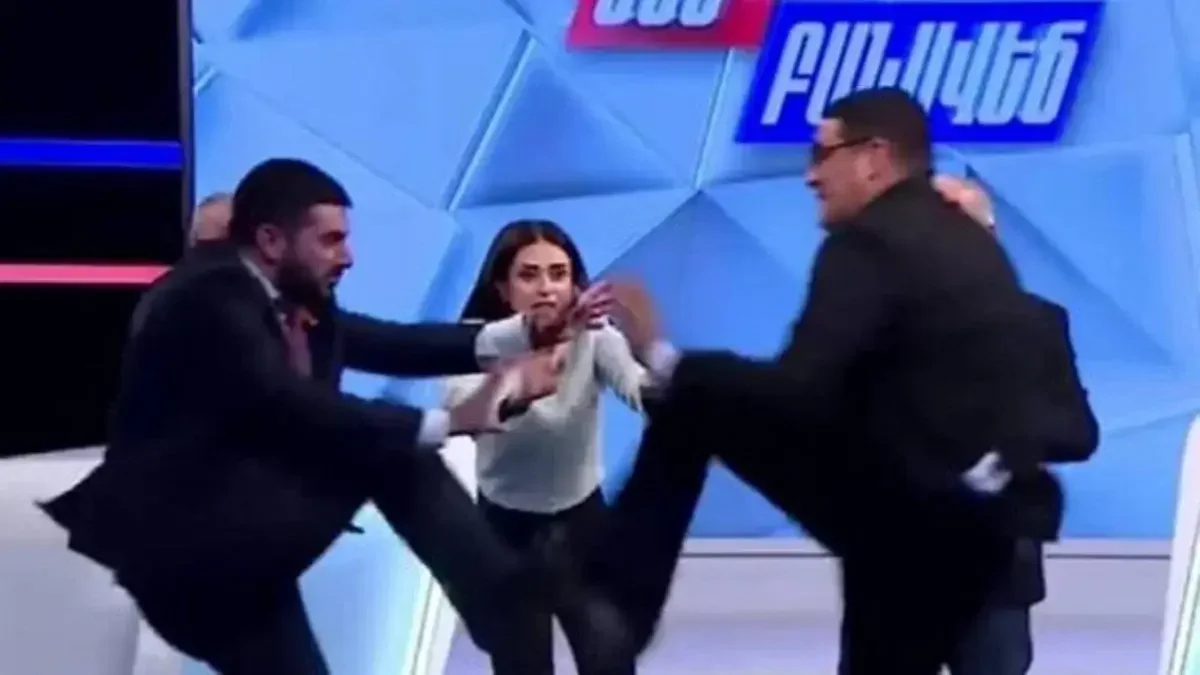
Journalist Boris Murazi and commentator Harutyun Mkrtchyan engaged in a physical fight during a pre-recorded episode of 'The Great Debate' on 1TV on the 15th. The broadcaster faced criticism for airing the unedited footage, which included profanity and a punch thrown by Murazi following personal allegations made by Mkrtchyan.
Participants in a political debate program on Armenian public broadcasting engaged in blatant personal attacks and profanity before escalating into a physical fight. Despite the program being pre-recorded, the broadcaster aired the verbal abuse and brawl scenes without any separate editing, sparking further controversy. The debate forum of the public broadcaster, intended to discuss differing political views, turned into a stage for intense physical conflict.
According to the British outlet The Sun and the local Armenian media CivilNet, journalist Boris Murazi and political commentator Harutyun Mkrtchyan clashed during the political debate program 'The Great Debate' on Armenian public broadcaster 1TV on the 15th (local time). While the broadcast featured a discussion regarding the political activities of the opposition and the possibility of solidarity between factions, the discussion soon devolved into an exchange targeting the participants' personal relationships and political identities.
The catalyst for the conflict was a question from Mkrtchyan. He reportedly asked Murazi a question suggesting there had been an inappropriate private relationship with former Armenian President Serzh Sargsyan. When remarks were made that appeared to target the other's private life rather than simply verifying political views, Murazi reacted strongly.
The exchange quickly escalated into blatant personal attacks. Mkrtchyan reportedly criticized Murazi's political beliefs and connections, calling him a "political prostitute." As expressions emerged that went beyond criticizing a political stance to defaming character, the two men unleashed harsh profanity and insulting words at each other. The points of debate vanished, leaving only emotional confrontation at the forefront.
Ultimately, the verbal clash led to physical violence. Murazi rose from his seat, approached Mkrtchyan, and swung a punch, leading to the two men becoming intensely entangled while throwing punches at one another. As the physical struggle continued, including grabbing the other's neck, the studio atmosphere instantly turned into chaos.
The host urgently intervened to try and stop the clash, but the situation did not calm down easily. The brawl only ended after the production crew and other participants stepped in to physically separate the two men. It was an unusual scene where participants engaged in public fistfights in a broadcast studio prepared to discuss political issues.
Following the broadcast, criticism was raised regarding the public broadcaster's decision on editing and airing. Although the program was produced via pre-recording rather than a live broadcast, the broadcaster aired the footage as is, without deleting or reducing the scenes of profanity and violence. Because scenes that could have been filtered out through prior editing were delivered entirely to viewers, a debate has emerged regarding the broadcaster's responsibility and the production standards for public content.
The Armenian Television and Radio Commission also expressed concern over the public broadcaster airing the scenes of verbal abuse and violence without editing. Local media CivilNet reported experts' observations interpreting this incident as a reflection of the deep-seated political polarization in Armenian society. The analysis suggests that political confrontation is coarsening the language of the public sphere, and that the reality where debates over policies and values are converted into hostility and violence toward individuals is being exposed through the broadcast.
Lee Chang-seok is the CEO and editor of Mediafine and writes for Mediafine Global, mainly covering K-Variety and also writing on K-pop, Celebrity and K-drama.



Comments 0
Comments are currently disabled.