
Defector Han Song Yi questions historical accuracy of 'The Assassin(s)'
North Korean defector Han Song Yi claims the film 'The Assassin(s)' features a narrative strikingly similar to North Korean propaganda films.
The historical distortion debate surrounding the film 'The Assassin(s)', which depicts the 1974 shooting of First Lady Yuk Young Soo, is taking an unexpected turn. North Korean defector and YouTuber Han Song Yi has claimed that the film's narrative is strikingly similar to works she encountered in North Korea. This has brought issues of the boundary between fact and fiction, the ethics of historical representation, and the nature of "historical memory" to the forefront.

On her YouTube channel, Han Song Yi TV, Han recently revealed that after watching 'The Assassin(s)', she was reminded of the North Korean film 'Nation and Destiny'. "I learned through 'Nation and Destiny' as propaganda in North Korea, but after coming to the Republic of Korea, the content was so different," she said. "Watching 'The Assassin(s)' this time, I was quite shocked because the story is so similar to what I saw in North Korea." While she praised the actors' performances, she expressed strong critical concerns regarding the film's historical interpretation.
Han's remarks are drawing attention because they move beyond a simple film review to touch upon the "politics of memory." If an individual learns history through a state-provided narrative and later encounters the same event through entirely different data and perspectives under a different system, determining the "truth" becomes complex. In historiography, collective memory is not merely an accumulation of objective facts, but a process constantly reconstructed through state power, education, media, and cultural content. Han's mention of the gap between her North Korean education and the historical records in the Republic of Korea symbolically illustrates this point.
The shooting of First Lady Yuk Young Soo on August 15, 1974, is a tragedy of modern history where actual facts and subsequent interpretations are deeply intertwined. At the time, Moon Se Gwang, a second-generation Korean resident in Japan, fired a gun at President Park Chung Hee, resulting in the death of Yuk. The special investigation team at the time announced that Moon attempted the assassination under instructions from North Korea via Chongryon; Moon was executed later that same year. However, various questions regarding the mastermind and the specific circumstances have persisted for decades.
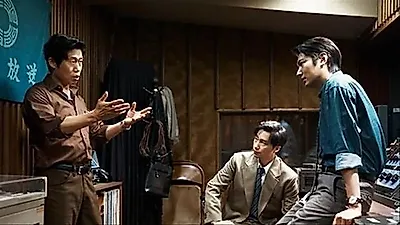
'The Assassin(s)' uses these unanswered questions as the starting point for its narrative. Rather than providing a definitive conclusion, director Hur Jin Ho chose to trace the mysteries surrounding the scene and the perspectives of those involved. Fictional characters, including detective Cheol Gu (Yoo Hae Jin), social affairs editor Jae Hwan (Park Hae Il), and rookie reporter Yeong Il (Lee Min Ho), investigate the hidden layers of the incident, with the story incorporating contemporary media censorship and the Declaration of the Practice of Free Press. The production team describes it as a mystery thriller that blends cinematic imagination with actual records.
The core of the controversy lies not just in whether a film can raise questions, but in how audiences distinguish between fiction and historical fact in films based on real-life events. While film is an art form that reconstructs reality through selection and dramatic causality, using real people and national tragedies as subject matter gives fiction the power to influence public memory. The conflict surrounding 'The Assassin(s)' arises where creative freedom meets the responsibility of historical representation. The production team has reiterated that the film is a creative work based on actual records and existing questions, intended to avoid presenting a specific political conclusion.
In the past, films depicting political events in Korean modern history, such as 'The Man Standing Next' and '12.12: The Day', have also sparked debates over the line between fact and dramatic reconstruction. Hive Media Corp is the production company behind these works. However, the controversy surrounding 'The Assassin(s)' is more complex, as it moves beyond reproducing known power dynamics to explore possibilities outside of official historical explanations through the lens of the mystery genre.
Han concluded by stating her view that "films that distort history should be expelled from the Republic of Korea." As this is her personal opinion, it remains distinct from a final judgment on historical fact. Ultimately, the debate highlights a larger question: how a society remembers historical events. The process of distinguishing between cinematic hypotheses and historical records serves as a vital function of public discourse. The debate over 'The Assassin(s)' extends beyond how accurately a film reproduces the past, questioning how we choose to remember and reinterpret history in the present.
Meanwhile, some observers have raised questions regarding Han's perspective, noting that many defectors hold far-right views and questioning the depth of her understanding of the Republic of Korea's history.


Comments 0
Comments are currently disabled.