
Jin Seon-kyu drives record viewership in '100 Days of Deception'
Actor Jin Seon-kyu has captivated viewers with his multidimensional portrayal of the ruthless villain Sato Shinichi in the tvN drama '100 Days of Deception.' The latest episode reached a record viewership of 10.7% as the character's violent nature and psychological control over his son took center stage.
The 10th episode of tvN drama '100 Days of Deception' reached a record 10.7% viewership rating on the 8th as Jin Seon-kyu's character, Sato Shinichi, navigated a crisis following an explosion at the Governor-General's Office.
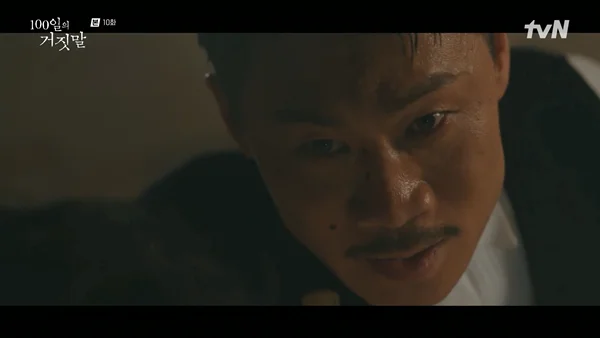
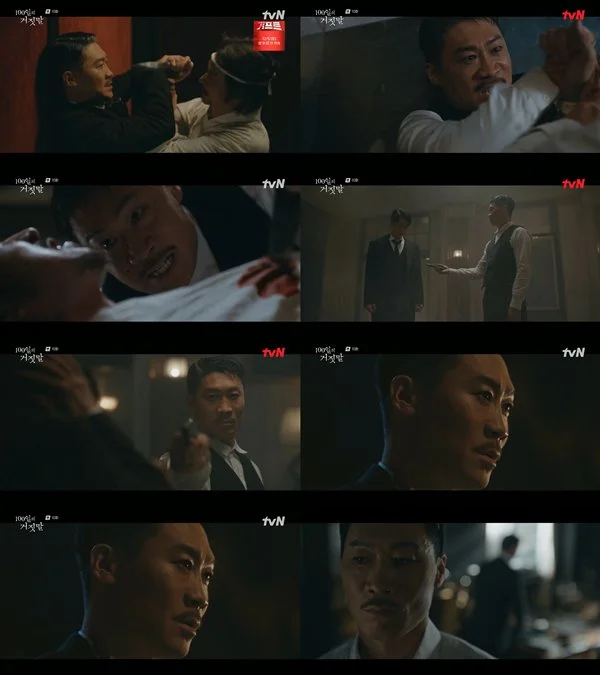
Actor Jin Seon-kyu has overwhelmed viewers with a multidimensional performance in the tvN drama '100 Days of Deception,' oscillating between brutal violence, cold survival instincts, and a distorted obsession with his son. Playing the top villain, Sato Shinichi, he maximized the character's terror through meticulousness, suppressing emotions even in the face of crisis to turn the tide. In particular, as his desire for suspicion and control over his son, Kim Tae-ung, also known as Sato Hideo (played by Park Jin-young), began to manifest fully, the rift in the father-son relationship heightened the tension of the drama.
In the 10th episode of the tvN 20th Anniversary Special Project '100 Days of Deception,' which aired on the 8th, Sato Shinichi was depicted navigating a crisis caused by an explosion at the Governor-General's Office and an attack targeting him through brutal responses and cold political calculations. The episode starkly contrasted his violence, which left no opening for opponents even when his own life was threatened, with a survival strategy that endured humiliation before power to ultimately maintain his position.
Sato Shinichi's cruelty was vividly revealed during a confrontation with Song Jeon (played by Jeon Yung-beop), a member of the National Salvation Corps who attacked him. Seizing a moment when his opponent faltered due to an explosion following an intense physical struggle, he immediately counterattacked and interrogated the fallen Song Jeon regarding the mastermind. However, Song Jeon resisted with the cry, "Long live Korean independence!" Sato Shinichi maintained a cold expression even in the face of the opponent's convictions, revealing his anger.
The situation turned even more chilling when Tae-ung arrived. After snatching the pistol he had handed to Kim Tae-ung, Sato Shinichi fired at Song Jeon. His act of pulling the trigger without a moment's hesitation, even with his son watching, extremely revealed the cruel nature of a powerful figure. The scene demonstrated that violence was not merely an expression of anger, but a means to subdue opponents and confirm his own dominance.
The warning he threw toward his son following the shooting formed another layer of terror for Sato Shinichi. Drawing a line by saying, "This is as far as I go in overlooking you," he firmly stated, "Don't forget. If I die, you are nothing." Beyond a warning that he would no longer tolerate his son's actions, it was a demand that forced the logic that his own existence and power constitute his son's identity. It clearly revealed a desire for dominance to subordinate his son under his influence rather than recognizing him as an independent individual.
Sato Shinichi showed a contradictory attitude, unable to cease his suspicion of his son yet ultimately refusing to let him go. The father-son relationship, where distrust and obsession operate simultaneously, was maintained by the logic of power and control rather than affection or trust. Jin Seon-kyu did not treat this complex inner state as simple villainous madness, but implemented it as psychological pressure from someone who suspects his opponent while refusing to relinquish control.
Sato Shinichi's political survival skills were highlighted before the Governor-General. When questioned regarding responsibility for the explosion at the Governor-General's Office, he knelt and bowed his head, claiming it was his own oversight. Although he clenched his fists in the face of insults calling him an outsider and orders to step down, instead of exploding with emotion, he sought ways to exploit the situation. His attitude of enduring humiliation before power stood in contrast to the cruelty he previously showed Song Jeon, revealing the dual nature of the character.
The question, "If I just step down, will the bomb that exploded at the Governor-General's Office also become a non-event?" was the moment Sato Shinichi's meticulous calculations began to work in earnest. He persuaded the Governor-General by mentioning the eyes of the international community and proposed a plan to cover up the infiltration of independence fighters and the explosion as an individual's spontaneous action. Although faced with the risk of taking responsibility and stepping down, he instead created a justification to lead the handling of the incident, thereby re-securing his position.
His remark to Fukuda (played by Kim Jung-hee), "Anger is momentary, and in the end, the recovery will be the issue," also encapsulated the essence of Sato Shinichi. His way of thinking, which focuses on results and the maintenance of power rather than being swayed by emotions, acted as a chilling survival strategy beyond cold realism. Jin Seon-kyu multi-dimensionally constructed the danger of the character Sato Shinichi by connecting moments of violence and moments of political negotiation with entirely different rhythms.
Jin Seon-kyu's passionate acting contributed to the rise in viewership for '100 Days of Deception.' The 10th episode aired that day recorded an average viewership rating of 10.7% based on nationwide households on paid platforms according to Nielsen Korea, breaking its own record. As the work entered double-digit viewership, the presence of Sato Shinichi, who leads the tension of the drama, became even more distinct.
From brutal violence and humiliation before power to the calculation of turning a crisis into an opportunity and the chilling desire for control over his son, Jin Seon-kyu is completing Sato Shinichi as an entity beyond a simple villain by condensing these opposing emotions and actions into one character. The 10th episode of '100 Days of Deception,' which recorded a 10.7% rating, raised expectations for the next development by simultaneously revealing the survival instinct of a wicked powerful figure and the destructive nature of human relationships hidden behind it.
Oh Seo-yoon reports for Mediafine Global, mainly covering K-Variety and also writing on K-drama, K-pop and K-movie.



Comments 0
Comments are currently disabled.