
Kim Hyang Gi hospitalized for malnutrition in 'Salon De Nabi'
In JTBC's 'Salon De Nabi,' Oh Gi Ppeum's sudden hospitalization reveals deep-seated family struggles and her complex relationship with her mother.
Kim Hyang Gi revealed wounds that an ordinary youth of her age would have tried hard to hide. As her character, living alone in a goshiwon, was rushed to the emergency room due to nutritional deficiencies, her long-veiled family history surfaced. It was a moment where the inner self of a person—clumsy in front of love and infinitely complex in front of family—was finally exposed.
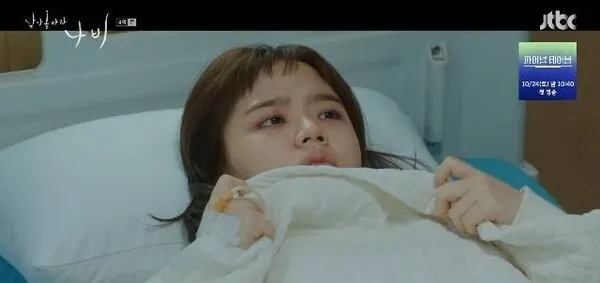
In the 4th episode of the JTBC weekend drama 'Salon De Nabi' aired on the 27th, Oh Gi Ppeum (Kim Hyang Gi) confessed her feelings to Park Mu Yeol (Park Jeong Woo), revealing her family history in the process. Previously, Oh Gi Ppeum had confessed, "I think I like you, Mu Yeol," but Park Mu Yeol cautiously rejected her, saying, "I'm a bit... when it comes to my first relationship." It was a scene that perfectly captured the clumsy grammar of a first love.
However, Oh Gi Ppeum's feelings were not easily settled. Misunderstanding that her confession had been leaked to the people at the hair salon, she cast aside her usual timid demeanor and publicly confronted Park Mu Yeol. She argued, "Whether you reject me or not is your freedom, but it's not right to joke around in front of many people," and even attempted to reveal the fact that she had confessed directly. Park Mu Yeol belatedly managed the situation, and Oh Gi Ppeum also apologized after realizing her misunderstanding.
Yet, Oh Gi Ppeum did not back down. When Park Mu Yeol tried to dismiss the confession as a mistake made while drinking, she stated her feelings once more: "It's not a mistake. It's real. I like you, Mu Yeol. I think I've liked you since the first time I saw you." Love sometimes makes people brave. Given that Oh Gi Ppeum, who usually could not even fully accept herself, did not deny her emotions in front of love, this confession carries a meaning beyond simple romance.
However, the reality she faced was far from a sweet romance. The next day, her mother visited from the countryside, appearing at the hair salon with hands full of food she had carefully prepared since dawn, and returned to her hometown after spending the night at Oh Gi Ppeum's goshiwon. After her mother left, Oh Gi Ppeum burst into tears upon finding a money envelope left behind without a word. Love is not always proven through warm words or hugs. For someone, a bag of side dishes and a silently left money envelope might be the most desperate language expressing concern for their existence.
Ultimately, Oh Gi Ppeum was taken to the hospital by ambulance due to stomach cramps and nutritional deficiency. To Park Mu Yeol, who accompanied her as a guardian, she revealed her hidden feelings. The single phrase, "Because she's not my biological mother," condensed the long-accumulated guilt and distance. Knowing he is a good person and wanting to do well herself, she had been blaming herself for being unable to naturally call her 'Mom.' Her words, "I really hate myself. It's natural that you hate me, Mu Yeol," go beyond family issues and approach a harsh self-denial.
What is even more significant is that the incident at the hospital became a catalyst for a small change in Oh Gi Ppeum. Having settled the hospital bills with the money her mother left, she found the courage to call and honestly state her preference for the first time, saying, "I can't eat *kimchi*." Though it seems like a trivial comment, it was a massive confession for Oh Gi Ppeum to break the boundaries of their relationship. The scene where she changed the contact name saved as 'Mother' to 'Mom' follows the same context. It reveals the fact that family is not completed only by blood ties, but is built through repeated choices of opening one's heart to each other.
A change was also detected in Park Mu Yeol's attitude. Concerned about Oh Gi Ppeum's nutritional status, he visited the goshiwon with herbal medicine and food from his home. Oh Gi Ppeum's question, "Why are you doing this to me?" implies that their relationship is moving from mere colleagues to the realm of emotion. The moment one discovers another's deficiency, human relationships finally enter a new layer of compassion and responsibility. Through Oh Gi Ppeum's clumsy love and imperfect family, 'Salon De Nabi' ultimately asks how people live by leaning on one another.


Comments 0
Comments are currently disabled.