
Park Wi faces scrutiny over past videos amid KTX accident backlash
Following YouTuber Park Wi's recent KTX controversy, his past social experiment videos are being re-examined over editing ethics and public portrayal.
"Was it the grandmother this time?"—Following YouTuber Park Wi's controversy surrounding the release of CCTV footage from a KTX accident, his past content related to public transportation is being re-examined. While these videos were previously praised as social experiment content that highlighted the mobility rights of people with disabilities, mixed evaluations are now emerging regarding whether his method of editing ordinary people into specific personas was appropriate following the recent controversy.
On the 14th, Park Wi suffered an accident while disembarking from a KTX, tripping over the foot of a social service agent who was supporting him using a ramp. He subsequently raised the issue by releasing CCTV footage of the accident via his personal channel 'Wheracle,' but faced backlash as the video included the appearance of the social service agent who was present at the scene.
Criticism arose regarding whether it was appropriate to publicly call out an individual's mistake through a channel with 1 million subscribers, given that the social service agent had apologized immediately after the accident. Park Wi eventually deleted the video and apologized, stating that his judgment had been shortsighted.
But the controversy did not stop there. As Park Wi's past videos, produced to inform the public about the reality of disabled people using public transportation, were reshared, perspectives emerged that linked his past editing methods to the current controversy.
In April 2021, Park Wi released a video titled "It only brings sighs...." It was social experiment content capturing the process of Park Wi, in a wheelchair, boarding a bus.
In the video, Park Wi requested a passenger sitting in the designated wheelchair seat to vacate the spot. The passenger initially asked questions while pointing to another elderly/disabled seat, but after confirming there was only one wheelchair seat, they yielded the spot. Afterward, the bus driver approached to install the wheelchair securing device.
The issue lay in the subtitles inserted into the video at the time. Park Wi used expressions such as "the driver who is finally arriving" for the bus driver, and described the atmosphere at the scene as "an air that has become somewhat uncomfortable." He then pointed out the reality that safety measures are not properly implemented by telling an acquaintance, "The driver is supposed to come and fasten the belt."
At the time, the video garnered significant attention, surpassing 5 million views. There were many positive responses, as it showed the physical constraints and safety issues faced by disabled people while using buses.
However, following the KTX incident, comments with different perspectives are appearing on the same video. Some argue that it was excessive to edit the scene where the bus driver stops operation and takes necessary measures for the wheelchair passenger with a negative nuance.
On the other hand, there is a counterargument that the core of the video at the time was not to criticize the bus driver personally, but to point out the need for a safe boarding system for wheelchair users.
Content related to the subway has also come under fire.
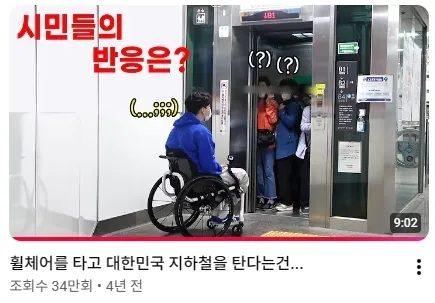
In 2022, through a video titled "Riding the Republic of Korea subway in a wheelchair is...", Park Wi revealed the entire process of boarding and disembarking the subway using a wheelchair. It was content intended to show the structural inconveniences faced by disabled people when using public transportation.
In the video, Park Wi encountered a grandmother while using a subway elevator. The grandmother showed signs of wanting to yield so that Park Wi could board first after spotting him, but Park Wi instead yielded to the grandmother, saying, "It's fine because I'm in a wheelchair anyway." He explained that he did so because he was worried the grandmother might feel sorry.
However, the part currently causing controversy is the thumbnail rather than the main video.
The thumbnail features the back of Park Wi looking at the grandmother who boarded the elevator first, accompanied by the text "What was the citizens' reaction?" Subtitles suggesting Park Wi was flustered were added to him, and expressions suggesting the grandmother was puzzled were added to her.
Criticism was raised because of the discrepancy between the actual context of the video and the thumbnail. While Park Wi actually declined the grandmother's gesture and showed consideration by letting her board first, the thumbnail leaves room for the situation to be perceived as if the grandmother did not yield to the wheelchair user.
Some netizens criticized this, stating, "It made the person who yielded look like a negative character." In particular, since elderly people can also be members of the transportation-vulnerable group who require consideration during movement, critics noted that creators must be cautious about consuming scenes that create a confrontational dynamic between the disabled and the non-disabled.
On the other hand, there is a counterargument that linking past content's editing style directly to the current KTX incident is an overinterpretation. Proponents of this view argue that the focus at the time was on delivering the social agenda of mobility rights, and that one should not judge the creator's intent based solely on thumbnails or specific subtitles without watching the entire video.
Ultimately, the core issue emerging from this controversy is not the social agenda of "mobility rights" itself. Rather, it is a question of media ethics: to what extent should individuals appearing in the field be used as subjects for content when highlighting the difficulties of the disabled, and is it justifiable to assign negative images to specific individuals through editing?
On platforms like YouTube, thumbnails and short subtitles are often consumed before the main video. Viewers may form an impression of the people involved based on just a few phrases and images without seeing the full context. This is a point where the public interest of highlighting the reality of the socially vulnerable inevitably clashes with respect for an individual's personality and portrait rights.
Park Wi has consistently produced content based on his experiences to raise awareness about the mobility rights and daily struggles of people with disabilities. In doing so, he has been credited with making visible the physical barriers and social inconveniences that the public had not previously recognized.
However, the recent debate surrounding the KTX accident demonstrates how delicate the line must be between raising public issues and publicly criticizing individuals. As past content is being resurfaced, the focus of the controversy is expanding beyond a simple accident to the overall way Park Wi reconstructs his experiences and the actions of others into content.
That said, the assessment that the editing of ordinary people in past videos was inappropriate is just one of many opinions currently circulating online, and it is difficult to conclude Park Wi's intentions or the facts based on this alone. To ensure that the important social agenda of mobility rights for the disabled is not consumed as a tool for attacking specific individuals, it is necessary to examine the full context of the videos and the circumstances at the time.
This debate ultimately boils down to a question of media ethics: in the process of publicizing the reality of the socially vulnerable, to what extent should the mistakes and actions of others be made public, and how should they be edited? This is why past content is receiving renewed attention following Park Wi's KTX accident.

Comments 0