
87-year-old Sa Mi-ja couple's memories: "Pro-Japanese collaborators faced hardship after liberation"
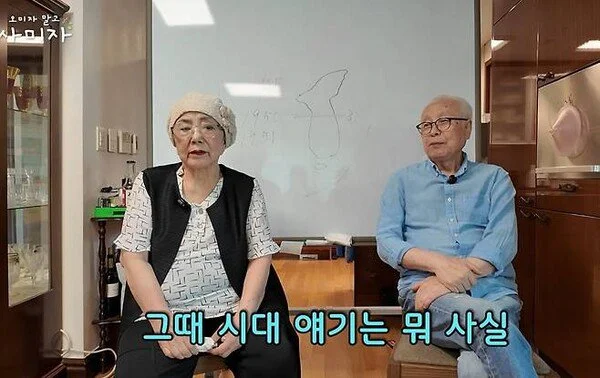
As controversies surrounding the pro-Japanese activities of ancestors continue in the entertainment industry, the memories of actress Sa Mi-ja and her husband, who directly experienced the Japanese colonial period and liberation, have drawn attention. Their vivid testimony includes not only the joy of liberation but also the oppression Koreans faced under Japanese rule and the atmosphere faced by those who participated in pro-Japanese activities immediately after liberation.
87-year-old Sa Mi-ja couple's memories: "Pro-Japanese collaborators faced hardship after liberation"
As controversies surrounding the pro-Japanese activities of ancestors continue in the entertainment industry, the memories of actress Sa Mi-ja and her husband, who directly experienced the Japanese colonial period and liberation, have drawn attention. Their vivid testimony includes not only the joy of liberation but also the oppression Koreans faced under Japanese rule and the atmosphere faced by those who participated in pro-Japanese activities immediately after liberation.
Recently, a video titled "The evil deeds of pro-Japanese collaborators and liberation experienced by Sa Mi-ja herself" was released on the YouTube channel 'Sa Mi-ja, Not Omija'. In the video, Sa Mi-ja and her husband Kim Gwan-su calmly shared their memories of the Japanese colonial period and the liberation on August 15, 1945, which they experienced firsthand as children.
Kim Gwan-su remembered the time of liberation as an eight-year-old child. He said he met liberation in his hometown, Ganghwado Island, stating, "Our house probably heard the news of liberation first in the vicinity." This was because his father was the postmaster at the time, and a telephone—one of only two or three in the entire Ganghwado Island—was installed in their house. He explained that it was an environment where they could receive outside news very quickly.
The memory of that day remains vivid even now. Kim Gwan-su recalled that around 1 p.m. on August 15, 1945, his father rushed home from the post office to deliver the news of liberation to his mother. Although it was difficult for him as a young child to understand the exact meaning of the word 'liberation,' he said he felt "that something good had happened" by watching his family's reaction. In essence, he is remembering a moment that later became a massive turning point in history through the eyes of a child.
However, school life before liberation was the exact opposite. Kim Gwan-su testified that they had to strictly use Japanese at school at the time, and even using Korean was not permitted. He said that if Korean accidentally slipped out and they were caught, they had to be punished, and sometimes even their parents were cautioned. He recalled it was an era where they had to bow down to the Japanese and could not do anything of their own volition without permission from the Japanese side.
The atmosphere in the village immediately after liberation was different. Regarding those who had engaged in severe pro-Japanese activities, Kim Gwan-su said, "People with very great sins faced hardship." However, he added that since they were people who had lived face-to-face in the same neighborhood for a long time, they could not have responded to everyone in an extreme manner. This part offers a glimpse into the complex atmosphere of the society at the time, where the joy of liberation and anger toward the past were mixed together.
Sa Mi-ja also recalled what happened within the Korean people during the Japanese colonial period. She remembered that many of the Japanese police were actually Koreans, saying, "Because they knew all the Korean language, they would report everything, saying, 'That person is participating in the independence movement.'" She explained that because they knew the language and circumstances of their own people, there were cases where they were used to monitor and report independence movements or anti-Japanese activities. Sa Mi-ja recalled that such incidents were not just one or two cases.
Having passed through war, colonial rule, liberation, and the subsequent upheavals, Sa Mi-ja expressed unique sentiments while looking back on the time she has lived. She said, "How much suffering our country has endured to reach today," and stated that she is happy to be alive even after experiencing several wars. It was a statement that compactly shows the fluctuations of modern Korean history experienced by a generation, beyond an individual's life.
The background behind these testimonies gaining attention again is the recent pro-Japanese controversy arising in the entertainment industry. Last month, on the KBS 2TV 'Problem Child in House', actress Oh Ha-young introduced that her great-grandfather was a doctor who studied Western medicine in Japan and was the first to open a clinic in Hanyang, even treating Emperor Gojong. Following the broadcast, some netizens speculated that the individual was Ahn Sang-ho, the first Korean to obtain Japanese medical qualifications, and the controversy spread as his history of activities in the Daejeong Friendship Association and the history of Sorokdo Hospital were re-examined online.
However, evaluations surrounding the actions of historical figures need to be examined separately based on their specific activities and historical records at the time. It cannot be concluded whether someone was pro-Japanese simply because they were educated in Japan or operated under the Japanese system; rather, one must examine which organizations they actually participated in, what activities they performed, and what meaning those actions held in the society of that time.
In that sense, the testimony of the Sa Mi-ja couple goes beyond the evaluation of a specific individual and makes one reflect on what kind of traces the era of Japanese colonial rule left on the daily lives of ordinary people. From the memories of a child meeting liberation to the atmosphere immediately after liberation regarding pro-Japanese actors, and the memories surrounding Korean police and informants, the testimonies of those who lived through an era provide historical context for looking at the recurring pro-Japanese controversies today.
Related Articles
The reason why Roy Kim was called a 'runaway' even after donating over 300 million won
Don Spike Sends 'Emergency SOS' While Attempting a New Start After Drug-Related Prison Sentence
Comments 0
Comments are currently disabled.