Song Kang, Lee Jun-young's 'Four Hands' debuts with 3.4% viewership
The new tvN drama 'Four Hands,' starring Song Kang and Lee Jun-young, opens with a 3.4% rating, drawing comparisons to the hit 'Spellbound.'
The new tvN weekend drama 'Four Hands,' which features a confrontation mediated by the piano, has taken its first step with a viewership rating in the 3% range. While the starting performance is similar to its predecessor, the key question is whether 'Four Hands' can translate its initial buzz into an actual rise in viewership, much like how the previous drama steadily climbed to break its peak viewership rating in its later episodes.
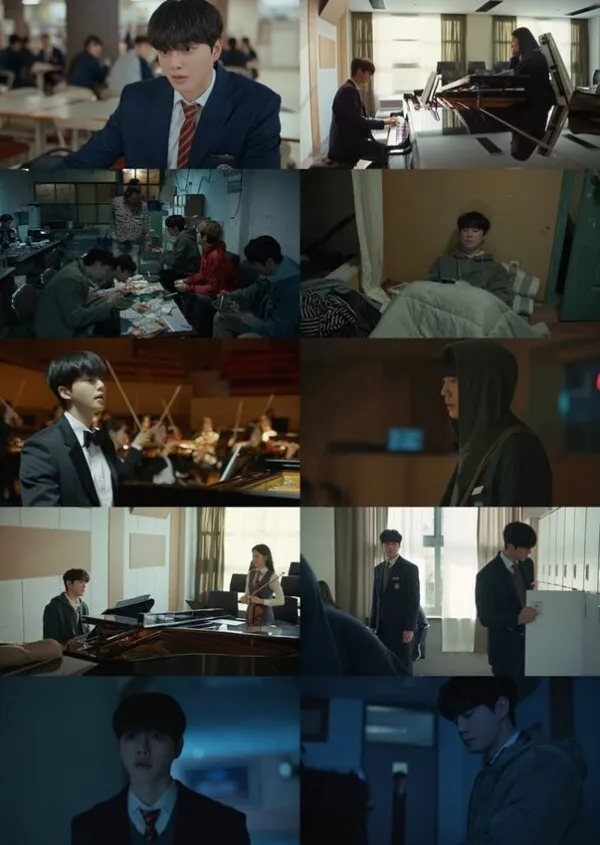
The first episode of 'Four Hands,' aired on the 29th, recorded an average viewership rating of 3.4% nationwide on paid platforms, peaking at 4.6%. In the Seoul metropolitan area, it recorded an average of 3.5% and a peak of 4.7%, ranking first in its time slot among cable and general programming channels. It also ranked first in its time slot among cable and general programming channels for the core 20–49 age demographic, which is tvN's key audience.
Rather than the absolute figures of the first episode, the point worth noting is the comparison with the predecessor. The previous work, 'Spellbound,' starring Park Eun-bin and Yang Se-jong, also started with a viewership rating in the 3% range but rose to 7.9% by its final episode. Therefore, rather than judging the success of 'Four Hands' based solely on early viewership, it is necessary to watch the trend after the second episode, when the core conflicts and character relationships begin to unfold in earnest.
The first episode devoted a significant portion to the process of two pianists, Kang Bi-o (Song Kang) and Choi Jeong-yo (Lee Jun-young), who lived in entirely different environments, reuniting after a gap of seven years.
Kang Bi-o is a promising student pianist at the Korea High School of Arts. With the goal of gaining recognition from his grandfather, the world-renowned conductor Kang Seung-un (Jung Jin-young), as a major life objective, he is not easily shaken by the gaze or evaluations of his peers. His action of casually throwing a commendation received at school into the trash bin clearly demonstrates his cynical and self-centered nature.
However, within Kang Bi-o, there lies a deficiency that is difficult to explain through mere arrogance. Despite having his outstanding skills already recognized, he is a character who constantly pushes himself to gain the recognition of the person most important to him. In a competitive society where musical talent is directly linked to self-esteem, Kang Bi-o's attitude reveals the psychology of a gifted individual where genius and anxiety coexist.
On the other hand, Choi Jeong-yo is someone who once competed with Kang Bi-o in junior competitions, but he is currently living a life that is practically distanced from music. As his family's fortune declined, he had to choose livelihood over the piano, and after school, he found himself in a position where he had to help loan sharks to pay off his father's debts.
The difference between the two is not limited to their economic environments. While the piano is a means for Kang Bi-o to prove his existential value, for Choi Jeong-yo, the piano is closer to a past he had to give up due to reality and a desire he still cannot let go of. Although they look at the same instrument, they approach music for entirely different reasons.
The reunion of the two takes place at a chance performance venue. As Choi Jeong-yo, who visited the venue for a music performance evaluation, recognizes that the performer on stage is Kang Bi-o, memories of the past are revived. Hearing Kang Bi-o's performance, Choi Jeong-yo feels deep emotions, and after the performance ends, he sits in front of a piano in a practice room and begins to play spontaneously.
This scene encapsulates the core narrative of 'Four Hands.' It is the process of two people who met as competitors being reconnected through music. In particular, Choi Jeong-yo's playing attracts the interest of not only Kang Bi-o but also the violist Hong Jae-in (Park Gyu-ri). Hong Jae-in, who was looking for an accompanist, recognizes his talent and recruits Choi Jeong-yo on the condition of providing accompaniment fees.
There was another person who recognized Choi Jeong-yo's musical potential. Yoon Seon-ju (Jae Hee), the chairperson of the Korea High School of Arts, and the famous pianist Do Hyeon-su (Kim Ju-heon) discover his innate talent after accidentally hearing him play and propose that he transfer to the school.
Although Choi Jeong-yo initially refused, saying he could not make a living with only the piano, he eventually changes his mind in the face of reality. When debt collectors come to his house, he decides to transfer to the Korea High School of Arts, which provides a dormitory, and thus re-enters the world of music.
And there, Choi Jeong-yo is assigned to the same class as Kang Bi-o. Choi Jeong-yo recognizes his former competitor instantly, but Kang Bi-o does not remember him. However, after hearing Choi's performance again, Kang Bi-o soon remembers that he is the person who once gave him his first 'second place' result.
With this, the relationship between the two, which serves as the central axis of 'Four Hands,' begins to take shape. Given that the title 'Four Hands' refers to the musical format of two people playing a single piano together, the relationship between the two characters goes beyond simple competition. The structure, where two people with different lives and values must coordinate to complete a single piece of music, is likely to function as the drama's core conflict.
In particular, in growth dramas featuring music, the narrative often expands through human relationships and desires surrounding the music rather than the performance skill itself. 'Four Hands' also touches upon issues of talent and environment, competition and friendship, and the desire for recognition versus self-actualization by contrasting a genius pianist with a talented individual who gave up music for survival.
The combination of Song Kang and Lee Jun-young is also a key point of interest. Song Kang breaks away from his existing romance-centered image to play Kang Bi-o, a cold and perfectionist character, while Lee Jun-young expresses the complex emotions of Choi Jeong-yo, who gave up his dream due to realistic constraints. The process of the two actors clashing and harmonizing through the common language of the piano is expected to determine the immersion of the work.
The 3.4% recorded by 'Four Hands' in its first episode is a modest starting point for a hit show. However, since there are cases where previous works also started with similar viewership ratings before gaining momentum, it is too early to judge the success or failure of the work based solely on the first broadcast. Whether the competitive relationship between Kang Bi-o and Choi Jeong-yo intensifies and how they influence each other musically will be the major variables for future viewership ratings.
Ultimately, the task for 'Four Hands' is not limited to realizing the beauty of the piano on screen. The long-term success of the drama will depend on how convincingly it portrays how two people from different worlds, sitting before a single set of keys, will create music together, and how they navigate the emotions of competition, inferiority, wounds, and growth in the process.



Comments 0