
Na Yeong-seok's 'Space Rice Cake Shop' expands, but viewership dips
Despite a record low 2.5% viewership rating, Na Yeong-seok's 'Space Rice Cake Shop' maintains its #1 spot in the 20-49 target demographic.
Na Yeong-seok's new variety show 'Space Rice Cake Shop' has entered a new phase by expanding its scale, but it received a disappointing report card in terms of viewership ratings. While recording its lowest nationwide viewership rating of 2.5%, it presented a completely different story by taking first place in the same time slot for six consecutive weeks in the 2049 target demographic. It is a classic 'paradox of numbers' where public buzz and the loyalty of the core viewership audience diverge.
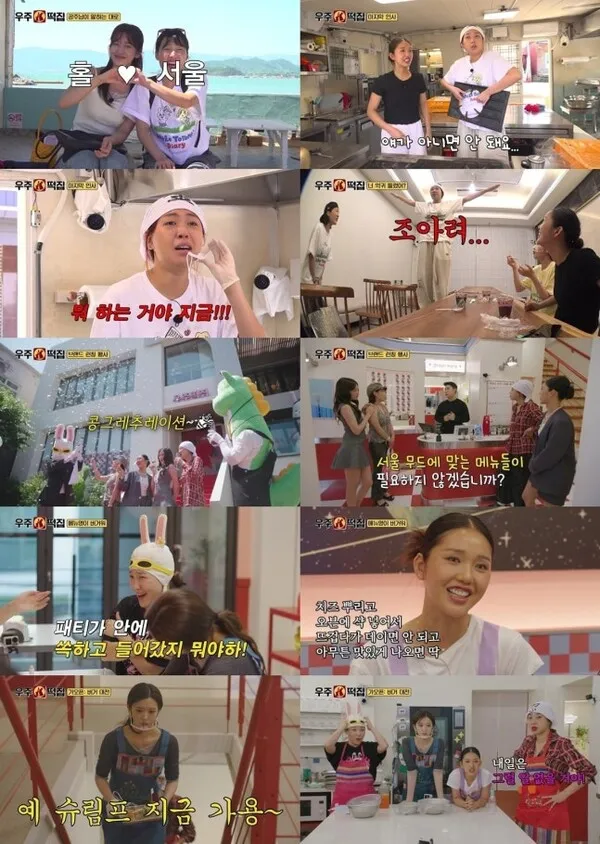
In the 6th episode of tvN's 'Space Rice Cake Shop' broadcast on the 4th, the process of Lee Eun-ji, Mimi, Lee Young Ji, and An Yu Jin—who finished their business in Goheung—preparing to open the second branch of 'Space Rice Cake Shop' in Yeonhui-dong, Seoul, was depicted.
On this day, the nationwide viewership rating recorded 2.5%, the lowest for the program itself. In the same time slot, KBS2's 'Happy Together: Glad We're Not Alone' recorded 1.9%, meaning 'Space Rice Cake Shop' edged ahead in numerical terms. Considering the host was Yoo Jae Suk, the matchup between the two major brands of the variety world, Na Yeong-seok and Yoo Jae Suk, also drew significant attention.
However, the situation was different in the 20–49 age group viewership rating, which tvN considers a key metric. 'Space Rice Cake Shop' recorded first place across all channels in the same time slot for six consecutive weeks in both nationwide and metropolitan areas. In other words, while it may look sluggish if looking only at the total scale of viewers, it is maintaining steady competitiveness among the core target audience important to the advertising market.
The most obvious change revealed in this broadcast was the size of the space.
Having left the Goheung store and moved up to Seoul, the Jirak-i-deul heard news from headquarters that they would be opening a second branch in Yeonhui-dong, Seoul. Lee Eun-ji and An Yu Jin, who are in charge of the hall, were delighted by the move to Seoul, but Mimi and Lee Young Ji, who were responsible for the kitchen, expressed regret about leaving the Goheung store they had grown accustomed to.
The final scene in Goheung showed the contrasting emotions of the four members. The kitchen team showed a special attachment as they said goodbye to the cooking utensils they had used for a long time, while the hall team left their final memories by taking photos at the seaside. Behind the variety show laughter, there was a sense of the team's relationship formed by living and working together in one space.
Upon arriving at the Seoul store, the atmosphere changed completely. Not only was the POS terminal that An Yu Jin wanted so much available, but even a reservation system was in place, and the kitchen was equipped with 9 burners, a griddle, and a separate dishwashing area. With a waiting zone, a photo zone, and a hall with 9 tables, the scale had grown so large that it was difficult to compare it to the small Goheung store.
This scene also signaled a change in the narrative structure of the program 'Space Rice Cake Shop.' If the business in Goheung was a kind of 'adaptation and survival,' the Seoul second branch is closer to the stage of full-scale brand operation and expansion. The four people, who were learning how to run a business through trial and error in a small shop, must now perform their roles within a larger system.
The development of new menus also gained momentum. Following the launch event, the four members learned how to make beef rice cake burgers, shrimp rice cake burgers, and mint carrot cake from Chef Kwon Sung Jun. The method involved using Gijeong rice cake like a hamburger bun and recycling the leftover rice cake from making burgers as a dessert.
In particular, during the process of naming the menus, the unique improvisation and linguistic sense of the 'Jirak-i-deul' came alive. When Lee Young Ji suggested the idea that the rice cake burger was 'too much of a burger' (a pun on the word 'burger' meaning burdensome), Lee Eun-ji added rhythm and choreography to it. The 'Original Tteokbokki' sold in Goheung also had its name changed to 'Lee Young Ji Original Tteokbokki' in Seoul, combining character and product.
However, just because the scale increased did not mean their operational abilities were automatically upgraded.
During a staff meal that doubled as practical practice, the burgers ordered from outside faced off against the rice cake burgers made directly by the Jirak-i-deul. The four members had to complete 15 sets of rice cake burgers and 10 sets of desserts for the production team within a 60-minute time limit. However, the outside burgers arrived first, and the Jirak-i-deul could not finish cleaning up even after exceeding the time limit by 5 minutes. Ultimately, the entire setting was delayed by about 13 minutes, and they even made the mistake of missing the shovel-shaped spoons for the dessert.
This scene is simultaneously entertaining and highlights the realistic challenges the Seoul second branch will face. While clumsiness and mistakes were sources of laughter in Goheung, in the larger Seoul store with a reservation system, even small errors can directly impact the customer experience. It is the moment where a 'business variety show' transitions from simple experiential content to the realm of operations and service.
The four members also identified areas for improvement through the production team's honest tasting evaluations. More important than presenting new menus was the process of repeated feedback and improvement. Ultimately, what 'Space Rice Cake Shop' shows is less about the traditional food itself and more about the process of reinterpreting the familiar in an unfamiliar way and building it into a brand.
Na Yeong-seok has transformed travel, daily life, food, and labor into variety narratives through shows like '2 Days & 1 Night,' the 'Flower Crew' series, 'Three Meals a Day,' 'New Journey to the West,' and 'Youn's Kitchen.' Recently, he has focused on stories built through participants forming relationships and accumulating daily life in specific spaces, rather than large-scale events or provocative games.
'Space Rice Cake Shop' follows that same trajectory. The core is the process of four members with distinct personalities—Lee Eun-ji, Mimi, Lee Young Ji, and An Yu Jin—becoming a team through food and labor. The move from Goheung to Seoul is not just a change of location, but a device to expand the program's universe.
However, the 2.5% rating also reflects the reality of the current broadcasting market, where it is no longer easy to draw viewers based solely on the reputation of a Na Yeong-seok variety show. As non-linear viewing platforms like OTT and YouTube become the norm, nationwide household viewership ratings alone cannot fully explain content consumption. Especially when the consumption of younger viewers is dispersed into clips, short-form content, and online playback rather than live broadcasts, traditional viewership metrics do not always align with actual fandom popularity.
Ultimately, the performance of 'Space Rice Cake Shop' cannot be judged by the 2.5% figure alone. While total viewership hit a record low, it maintained its #1 spot in the core target demographic for six consecutive weeks. This suggests that while mass expansion may have slowed, the bond with the younger viewers who consume Na Yeong-seok's variety shows remains strong.
From the small space of Goheung to the large-scale store in Seoul, 'Space Rice Cake Shop' has grown. As the program expands, the requirement is no longer just about scale, but about how well that space is filled with interesting stories. Ultimately, the true competitiveness of a Na Yeong-seok variety show lies not in the size of the shop or the fame of the cast, but in how long they can observe the labor and relationships of ordinary people and weave them into a narrative.



Comments 0
Comments are currently disabled.