
Jun Hyun-moo's spontaneous trip to Kazakhstan with just a backpack
Jun Hyun-moo embraces uncertainty on a spontaneous trip to Almaty, Kazakhstan, during a recent episode of MBC's 'I Live Alone.'
Jun Hyun-moo has boldly erased 'planning,' the most familiar formula of travel. Without deciding on a destination, accommodation, or route, he headed to the airport with nothing but a single backpack, deciding his destination only after looking at the flight information displayed on the electronic board. The destination for this sudden journey was Almaty, Kazakhstan. With only 29 hours available, it was a reckless trip in the truest sense of 'just leaving for now.'

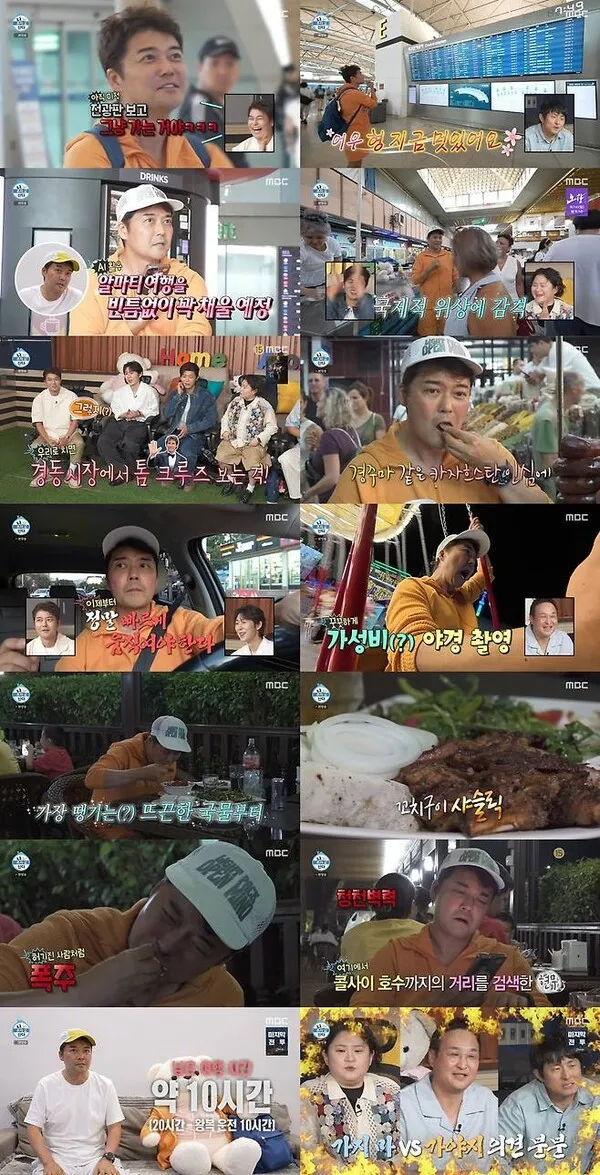
In the episode of MBC's 'I Live Alone' broadcast on the 14th, a day in the life of Jun Hyun-moo, who left for an impromptu overseas trip during his break, was revealed. Heading to the airport with only the decision to visit a place he had never been before during a short 2-day, 1-night break, he contemplated, "Where should I go?" while staring at the flight board.
In a typical trip, one would decide on a destination first and then proceed to book flights, accommodations, and transportation in order, but Jun's method was the exact opposite. He chose his destination by weighing flight times and schedules on the spot, finally selecting a flight to Almaty, Kazakhstan, which requires a 7-hour flight. After paying for the ticket, he settled his accommodation and rental car on-site.
Unplanned did not mean irresponsible. Rather, because Jun had decided nothing in advance, he had to constantly judge and make decisions on the spot. He obtained travel information for Kazakhstan from Gu Seong Hwan and Lee Joo Seung, received route recommendations from AI, and even drove himself to explore various parts of the city.
This style of travel seems to be a kind of 'experiment in spontaneity' for Jun. While planning is a device used to eliminate future uncertainty, it simultaneously removes the space for chance to intervene in a journey. When a traveler predetermines the destination and timetable, they gain convenience but lose the possibility of encountering unexpected events. Jun chose the opposite side. Instead of assuming uncertainty, he turned the uncertainty itself into the content of his travel.
Upon arriving in Almaty, the first thing Jun did was eat a hamburger. Starving from the 7-hour flight and the unplanned schedule that began at dawn, he devoured a hamburger at the airport. However, a moment of laughter occurred when the quiet airport suddenly became noisy the moment he started a phone call.
This scene was picked as the 'Best Minute' of the broadcast. Jun's reckless trip saw the viewership rating soar to a peak of 7.2%, recording first place among Friday variety programs with a 6.0% rating in the metropolitan area and a 3.7% rating among the 20–54 age group.
Afterward, Jun increased the density of his trip by visiting places such as the Green Bazaar, a traditional market in Almaty, the night view and amusement rides at Kok Tobe, and local lamb restaurants.
In particular, another unexpected incident occurred at the Green Bazaar. Local fans recognized Jun. He took photos with fans while shouting "I Live Alone," realizing that his program was well-known even in the middle of a market in a foreign country.
This was a scene that went beyond simple laughter. It demonstrated that the influence of Korean variety shows no longer stays within the programming schedules of domestic broadcasters, and it was a moment where Jun's individual broadcasting character was consumed like a cultural symbol across borders. While the traveler entered an unfamiliar space, he ended up reconnecting with a familiar world as people who recognized him appeared in that space.
Jun's foreign language skills also accelerated the pace of his trip. Even in an unfamiliar environment where the language was not understood, he actively communicated and created points of contact with locals. His proactive attitude stood out in that language is not merely a means of exchanging information during travel, but the most direct way to integrate oneself into an unfamiliar space.
However, the true challenge of the unplanned trip arrived from an unexpected place.
It was Kolsai Lake, which Gu Seong Hwan had strongly recommended. Through a map search, Jun discovered that the actual travel time from the restaurant to the lake was as much as 5 hours. The information he heard from Gu—that it was '1 hour by car'—was completely different from the actual distance on the map.
With about 20 hours of travel time remaining, he was in a situation where he would have to drive for 10 hours round trip. Jun froze, and the Rainbow members in the studio were split between 'you must go' and 'you shouldn't go.'
At this point, Jun's journey transcends a simple sightseeing variety show. A life without plans is not romantic because there are no plans, but because one must entrust their judgment to the variables that arise.
The phrase 'just leaving' is easy to say but difficult to execute. In life, as in travel, we constantly make plans and calculate risks to minimize failure. However, Jun temporarily set those safety measures aside. The result was a continuous series of unexpected laughter, confusion, discovery, and choice.
The short 29-hour window made this trip even more intriguing. In a long-term trip, mistakes or detours are easy to accommodate, but for Jun, time was an absolute constraint. Ultimately, the core of the trip shifted from how many places he visited to what choices he made within that limited time.
Thus, the decision regarding Kolsai Lake became the most important anticipation for the next episode: will he spend 10 hours driving just to see nature, or will he stay in Almaty to seek out other unexpected encounters?
For Jun, the process is more important than the destination. This is not a trip of following a set plan, but a journey where new stories continuously unfold precisely because there is no plan.
If the essence of travel is an escape from daily life, Jun escaped more than just the space of Seoul. He also escaped the familiar order of destinations and schedules.
A single backpack, a last-minute flight, a foreign language, AI-recommended routes, and even miscommunicated travel times—everything was imperfect, but that very imperfection turned the trip into a living event.
Will Jun choose the adventure of spending half of his remaining 20 hours on the road, or will he navigate Almaty through another spontaneous choice? Attention is focused on the next episode to see how his unplanned journey continues to head in unpredictable directions.



Comments 0
Comments are currently disabled.