
'Four Hands, Two Sonatas' Song Kang X Lee Jun-young, Tearful Reconciliation Ending—"Is This the Best?"
Song Kang and Lee Jun-young finally achieved a tearful reconciliation, letting go of the misunderstandings and guilt toward each other. However, the ending of the tvN weekend drama 'Four Hands, Two Sonatas' has faced criticism for being too rushed and overly romantic compared to the weight of the tragedy depicted throughout the series.
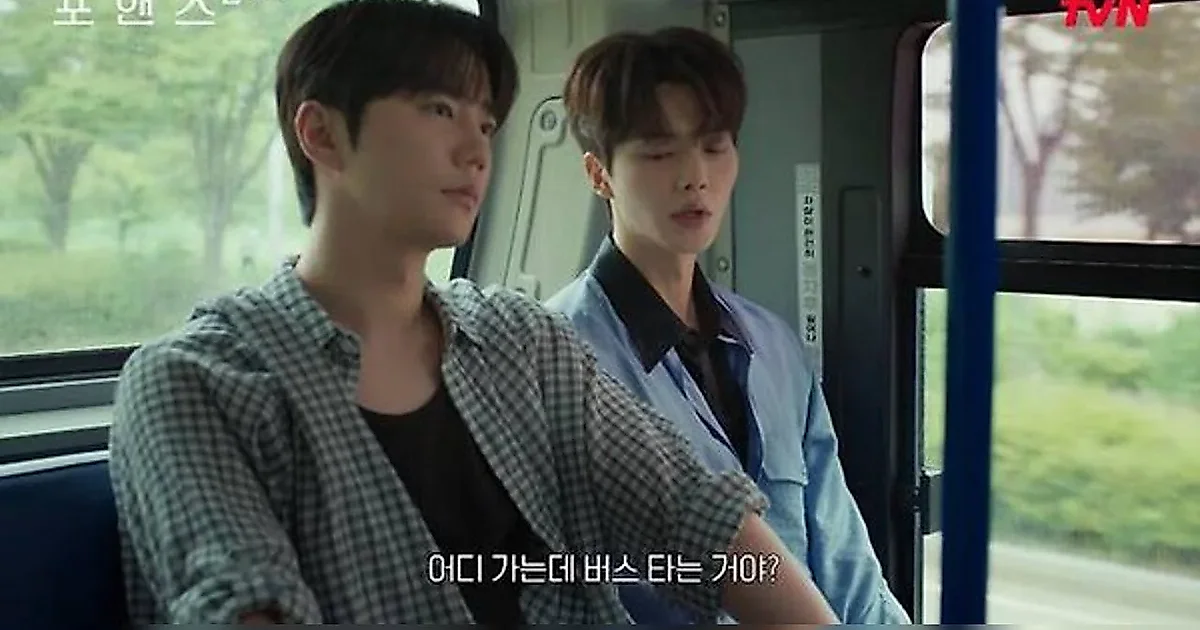
Song Kang and Lee Jun-young finally achieved a tearful reconciliation, letting go of the misunderstandings and guilt toward each other. Meeting again at an overseas monastery after three years have passed, the two people put an end to their long ill fate, smiling brightly under the sunlight. However, compared to the weight of the tragedy the work had drawn, the conclusion was patched up too quickly and romantically. Evaluations suggest that important events—from Jung Jin-young's death to Lee Jun-young's permanent hand paralysis, Song Kang's repentance, and the two's reunion—all rushed through in a single episode, which instead increased confusion and disappointment among viewers.
In the final episode of the tvN weekend drama 'Four Hands, Two Sonatas' broadcast on the 4th, the long-standing wounds surrounding Kang Bi-o (played by Song Kang) and Choi Jeong-yo (played by Lee Jun-young) were settled. Despite the dissuasion of Hong Jae-in (played by Jang Gyu-ri), Kang Bi-o held an emergency press conference to confess his past. He did not merely blame his mother, Kang Ji-hye, for the crime, but also admitted the fact that he himself had won a competition by seeing and copying Choi Jeong-yo's musical score. It was a moment where he publicly accepted that there were the sacrifices and wounds of others behind his success.
But just then, Kang Bi-o heard news of his grandfather Kang Seung-un's (played by Jung Jin-young) critical condition and headed to the hospital. Kang Seung-un, facing his end, offered a belated apology to the two. In particular, he confessed to Kang Bi-o that while he thought he would live as a number two person chasing Choi Jeong-yo his whole life, it was actually himself who had imprisoned his grandson. He also apologized to Choi Jeong-yo, stating that his own responsibility lay behind Kang Ji-hye's wrongdoing. And he passed away while listening to 'Moonlight Sonata' played by Kang Bi-o.
Kang Seung-un's death remained another wound for Kang Bi-o. Falling into guilt, he gave up the piano and even sold the piano he cherished. He attempted to let go of his very life, which he had sought to be recognized through music. However, Choi Jeong-yo went to find such Kang Bi-o and took him to Nakwon Arcade, where past memories remained. Even more surprising was the fact that Choi Jeong-yo had already personally bought and was keeping the piano that Kang Bi-o had sold.
Choi Jeong-yo sat in front of the piano while enduring severe shoulder pain. And he told Kang Bi-o to shake off at least the guilt toward him. It meant not to give up music because of the apology felt toward him. His words, "Whether intended or not, you were the light to me," showed that the relationship between the two had transcended a simple structure of victim and perpetrator. Ultimately, the two sat side by side at one piano and played 'Four Hands, Two Sonatas,' and the long-standing hatred and guilt were transformed into reconciliation through music.
However, the very next day, Choi Jeong-yo disappeared, leaving only a resignation letter. And the story suddenly jumps forward three years. Kang Bi-o belatedly learned that Choi Jeong-yo had left for overseas after being diagnosed with permanent hand paralysis. To respond to Choi Jeong-yo, who had endured everything for him, Kang Bi-o played 'Nemesis' and followed the traces he left to an overseas monastery. The two finally faced each other again in a sun-filled space and ended the story with bright smiles.
The problem lies in whether this conclusion provided sufficient emotional persuasion to the viewers. From the beginning of the work, the relationship between the two was placed upon complex layers of musical competition and jealousy, class differences, family desires, and the violence of the parental generation. In particular, the structure where one person's talent and success takes away another person's life was difficult to explain solely as an individual's fault. For a work that had built up such massive conflicts for a long time, there was a need to sufficiently show how those wounds are healed at the end and what price the two pay to choose a new relationship.
However, in the final episode, the most important events were instead compressed. Kang Seung-un's death was a key event in settling the wounds left by the family history, and Choi Jeong-yo's hand paralysis is a tragedy that effectively shakes the identity and foundation of life for a musician. Nevertheless, rather than these two events being sufficiently accumulated or explained, they passed by quickly and led to a warm reunion at the monastery. It is as if the size of the tragedy increased, but the time to accept it decreased.
In particular, the process of Choi Jeong-yo giving up his life and musical future for Kang Bi-o showed the meaning of forgiveness and salvation that the work intended to convey, while on the other hand, it also left questions about whether it was an excessively sacrificial relationship. This is because, in a situation where the boundaries between perpetrator and victim are complexly intertwined, true reconciliation should not be completed in a way where one person lets go of everything, but should be a process where both face the responsibilities of the past and choose a new way of life.
In that sense, the final scene of 'Four Hands, Two Sonatas' became a beautiful but paradoxically most controversial ending. The images of sunlight, the monastery, the reunion, and the smiles are certainly warm. However, it is highly likely that what viewers wanted was not simply a scene where the two meet again, but a more detailed emotional explanation of why they had no choice but to meet there again.
Ultimately, 'Four Hands, Two Sonatas' chose a story where two people wounded through music go beyond competition and hatred to acknowledge each other's lives. However, compared to the questions the work posed, the answer was presented too hastily. This is the reason why reactions such as "What on earth did the director and writer want to say?" and "The story of the beginning and the end became too different" are emerging. It was difficult to fill all the cracks in the narrative that had been built up over a long time with only beautiful music and the passionate performances of the actors.
'Four Hands, Two Sonatas'' final smiles shown by the two might have been closer to a starting point for living with wounds rather than the completion of forgiveness. However, in that it closed the curtain without sufficiently explaining that start, it is difficult to avoid the evaluation that the final episode left a greater sense of disappointment for viewers than the lingering imagery left by the work.
Lee Chang-seok is the CEO and editor of Mediafine and writes for Mediafine Global, mainly covering K-Variety and also writing on K-pop, Celebrity and K-drama.

Comments 0
Comments are currently disabled.