
Shaman and Singer Hwang Chan-hee Reflects on Family Estrangement and a Hidden Dream
On MBN’s *Scoop World*, Hwang Chan-hee shared how she returned to her family after a decade apart, became a shaman, and kept pursuing music while concealing her occupation for nine years. She said she took up singing in part because she wanted her children to remember her as a confident, admirable mother.
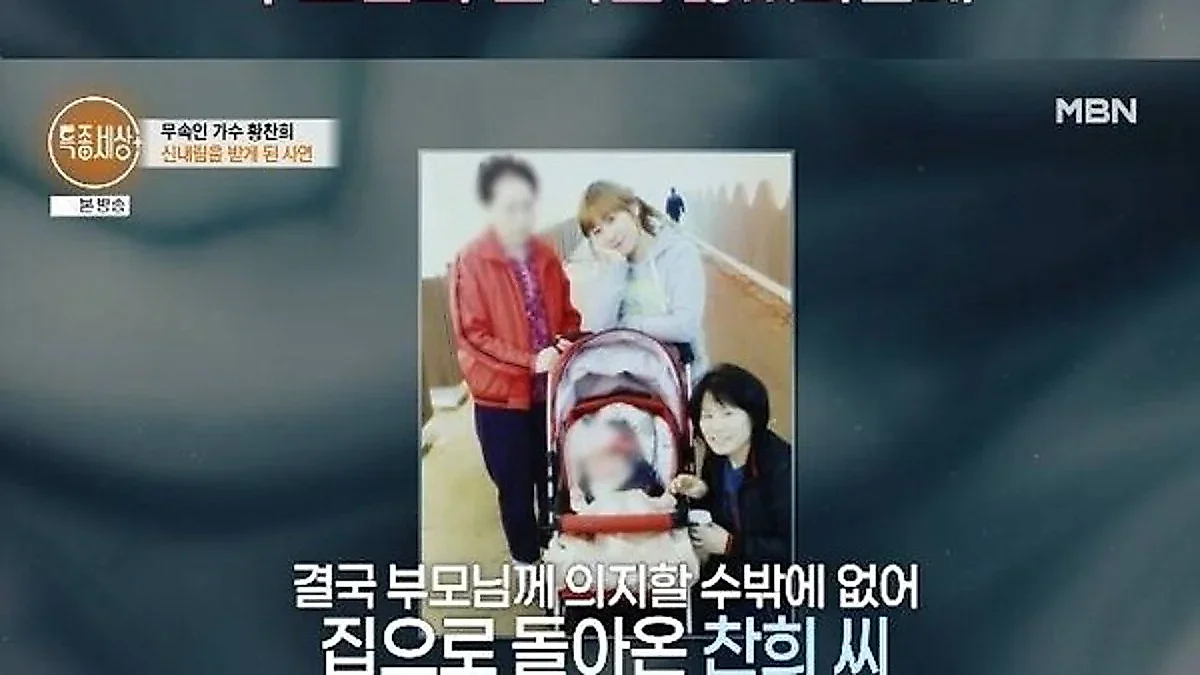
Shaman and singer Hwang Chan-hee shared her turbulent life story on the 761st episode of MBN’s documentary program Scoop World, broadcast on the 15th. She spoke about losing contact with her parents for 10 years, returning home, enduring illness she described as spiritual, and continuing to pursue music while keeping her shaman identity private for nine years.
At home, Hwang took on household duties while her husband recovered from shoulder rotator cuff surgery and wore a cast. She prepared meals and got the children ready for school, then prayed at a shrine set up in the house. She practiced singing in the car as she traveled, continuing to balance family life, shamanism and music.
Hwang, a shaman for 10 years, said her illness and initiation as a shaman once forced her to set aside her dream of becoming a singer. After resuming music, she said, “Once I became a singer, it felt as if everything that had been suppressed and built up inside me went down all at once. ‘So this is what it means to live. This is happiness.’”
One of the most painful parts of her life, she said, was her long estrangement from her parents. She now visits their home frequently with food, saying she feels deeply sorry for them and wants to make up, as much as she can, for what she could not do before. On this visit, she brought groceries from the market and said she wanted to do more for them now.
Hwang said she had been a well-behaved student and left home unexpectedly around the age of 20. She then went 10 years without contacting her parents. Looking back, she said the estrangement coincided with the onset of the illness she associated with becoming a shaman. “I kept thinking, ‘I’m completely on my own. I have to be alone,’” she said. She explained that she thought it would be better to bear her suffering alone because watching her go through it would also be painful for her parents.
Her parents spent years worrying about their daughter. Her father eventually had her resident registration canceled, believing it was the last way to bring her home. Hwang recalled thinking, “My parents had me deregistered? Fine, I won’t see them either.” She said she had laughed in disbelief, describing how far the relationship had deteriorated.
Her mother said her husband arranged the cancellation without telling her, hoping their daughter would return if he did so. “Her father had adored her since she was little,” her mother said. When Hwang called from time to time, her mother told her, “Come whenever you want. The door is always open.” Her parents had kept a place for her to return despite the long separation.
Hwang said her symptoms grew worse over time. After eating, she coughed so badly she could not speak, and her whole body swelled until she could not walk. She also experienced seeing shapes. “It was so hard that I thought, ‘Am I going to die like this?’” she said. Unable to endure the suffering, she returned to her parents 10 years after leaving home. Her return ended the estrangement, but her life remained difficult.
Hwang married and became a mother of two, but continued to suffer. After the birth of her second child, she divorced because of differences in personality and later remarried her current husband. Her mother, who watched her daughter enter shamanism, said she helped with the initiation because she could no longer bear to see her suffer. Tearfully, she recalled thinking, “You were going to live an ordinary life, but this is what happened. I wish I could have done it instead of you.”
Hwang did not give up on becoming a singer. Before her formal debut with an album two years ago, she performed in singing competitions and at events while concealing that she was a shaman. “When I first sang without revealing that I was a shaman, I felt very uncomfortable on stage,” she said. “I worried about what people would think if they found out later, so I couldn’t sing confidently.” She said she had feared people’s prejudice and reactions.
After keeping her shaman identity private for nine years, Hwang now continues both paths openly. “I think I revealed that I was a shaman after nine years. Now that I feel confident, I sing better,” she said. She said her confidence in singing grew when she stopped hiding her occupation.
Her children also influenced her decision to pursue singing. Hwang said she often feels sorry toward them, and recalled having many thoughts when her daughter brought home a questionnaire asking about her mother’s job. She worried the child might be hurt by prejudice or rejection toward shamanism. Through her identity as a singer, Hwang hoped her child would feel proud of her and that people might view shamanism with less prejudice.
“I hope to become a ‘wonderful mother,’ a ‘wonderful singer’ and a ‘confident shaman,’” Hwang said. Her account traced the family estrangement, marriage and divorce, illness and initiation, and the return to a long-held musical dream. She said performing was not only about achieving that dream, but also about accepting herself and living as a mother her children would not be ashamed of.
Lee Chang-seok is the CEO and editor of Mediafine and writes for Mediafine Global, mainly covering K-Variety and also writing on K-pop, Celebrity and K-drama.
Related Articles
Lee Kyung-kyu says he chose travel content because its YouTube views made him envious
I Am SOLO’s Yeong-cheol reveals public service career and willingness to take on childcare
Comments 0
Comments are currently disabled.