
Mother expresses suicidal ideation over daughter's seven-year unemployment
A mother expressed extreme despair, stating she "wants to die quickly," due to her daughter's seven-year period of unemployment following graduation from a prestigious university. During a broadcast of tvN STORY's 'Lee Ho-seon's Counseling Center,' expert Lee Ho-seon advised the daughter to move out to foster independence and break the cycle of reliance on her mother.
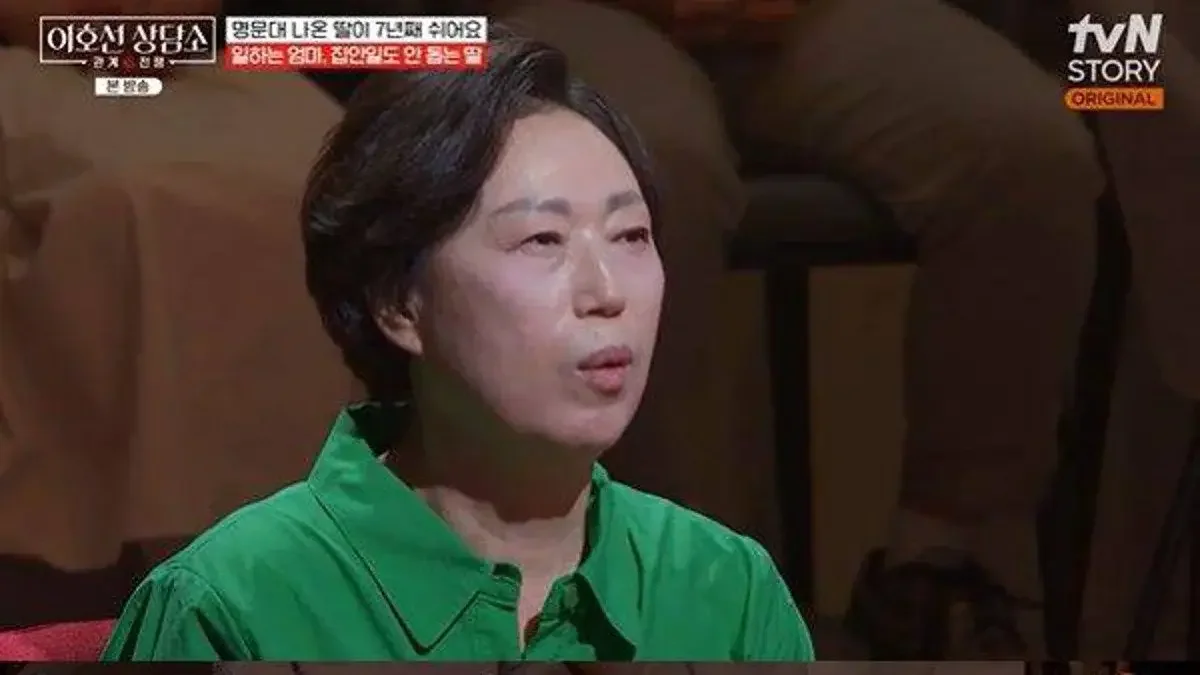
During a broadcast of tvN STORY's 'Lee Ho-seon's Counseling Center' on the 3rd, a mother expressed a desire to die due to the exhaustion of supporting her daughter, who has remained unemployed for seven years since graduating from a prestigious university.
The story of a mother exhausted by supporting her daughter, who has not held a proper job for seven years despite graduating from a prestigious university, has been revealed. Worried about her daughter's future, the mother eventually made the extreme statement, "I want to die quickly." Upon hearing this, counseling expert Lee Ho-seon called for a fundamental change in the mother-daughter relationship. The realistic conflict involving a child's independence and parental sacrifice captured the attention of viewers.
In the episode of tvN STORY's 'Lee Ho-seon's Counseling Center' broadcast on the 3rd, a mother with a daughter who has been out of work for seven years since graduating university, and a wife wishing to escape the control of a patriarchal husband, appeared respectively. In both cases, recurring conflicts and emotional exhaustion within the family unit emerged as the core issues.
The first participant shared her long marriage to a patriarchal husband. The couple, who met as elementary school classmates and married, have three daughters, but the husband strictly applied rules within the household. The wife explained, "With four women in the house, we aren't good at noticing messiness, but my husband says he sees it. There is even a curfew for our daughter." The husband also revealed fixed gender roles, stating, "There is a thought that men should do the heavy lifting and women should do the delicate work."
Lee Ho-seon pointed out the inconsistency in the husband's claims. Since the wife also works and earns money, it is contradictory for the husband to define housework and childcare solely as the woman's role. The problem went beyond simple household rules and led to anger and violence. The wife revealed that when the husband feels unacknowledged, he becomes severely angry, using profanity or committing acts of violence.
The confession that their relationship had solidified into a hierarchy since their honeymoon was particularly shocking. The wife recalled that when she contacted her husband after a minor car accident while on her way to a company dinner, she received anger instead of concern. When the husband scolded her, it would basically last for about an hour and a half, and he once even threw a wooden neck pillow at her. She revealed that she had to go to the emergency room at the time, but she cannot remember due to the shock.
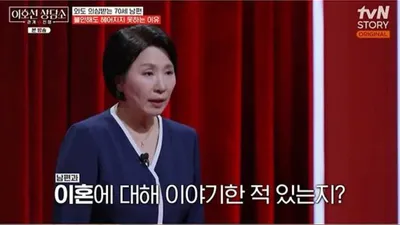
The husband maintained a position that he could absolutely not accept divorce. To the wife's confession that he said, "If we divorce, I won't be in this world," Lee Ho-seon defined this as "emotional hostage-taking." The implication was that using the excuse of protecting the family to psychologically trap the other person can further worsen the relationship. While the husband claimed he was dissatisfied even with her going out three times a month, claiming she did not understand him, Lee Ho-seon analyzed that his loneliness and fear are being expressed through the wrong method of control.
Lee Ho-seon sharply noted, "He is a patriarch, but this is a fake patriarch." She argued that if the original purpose of a patriarchal role is to care for and protect the family, then verbal abuse and violence are the exact opposite of that responsibility. She made it clear that while the husband's loneliness might be understandable, using it as a reason to control his wife or commit violence cannot be justified.
The second story involved a conflict between a mother and her daughter, who has been unemployed for seven years after graduating from a prestigious university. The mother recalled that the daughter was a good student who was admitted to an autonomous private high school immediately, and that she never pressured her to study. However, after graduating from university, the daughter worked at a food company for about two months before quitting, and subsequently began working at a cafe provided by her eldest sister, but she never once properly kept her commuting time. She also did not do housework, so when the mother returned from her job as a housekeeper, the dishes and cleaning were piled up.
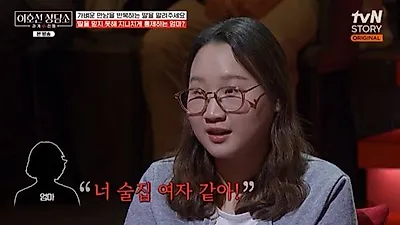
The daughter countered with a specific reason for quitting her jobs. She claimed that a colleague, who usually spoke to her with a smile, criticized her publicly during a weekly meeting. Regarding the cafe, she explained that she left on good terms because her sister suggested she use it like her own laboratory. Regarding the issue of tardiness, she claimed she stayed late at work as much as she arrived late, and cited low self-confidence, doubts about her aptitude for the work, and an unpleasant smell in the classroom as reasons for quitting her job as an English academy instructor.
The mother's despair stemmed from anxiety about her daughter's future. While the daughter claims to have depression and ADHD, the mother stated she believes everyone experiences a little bit of depression. Expressing her fear, she said, "I am worried she will just collapse like this. I don't think our home will change. There is no vision," before finally breaking into tears. While she desperately wanted her daughter to work diligently and take care of herself, reality felt like being stuck in place for a long time.
The most shocking part was the mother's confession regarding death. Mentioning how her own mother passed away in 22 days after living without pain at age 67, she said, "I think that went well. I want to go faster than that." The pressure of feeling like she must work for her entire life and the despair over the family's future converged into this extreme expression. Lee Ho-seon emphasized the mother's survival and the recovery of her life, saying, "Do not talk about dying. Parents have no choice but to live."
Lee Ho-seon also ordered specific changes for the daughter to achieve independence. Advising, "The daughter must leave the house. She is someone who would live much better if she lived separately," she suggested that since the daughter had achieved academic success in the past, she might find new possibilities in an independent environment. She also suggested that the daughter take time to personally prepare a meal for her mother once a week. The intent was for the daughter to move away from a life of depending on parental sacrifice and to learn responsibility and relationships anew.
Oh Seo-yoon reports for Mediafine Global, mainly covering K-Variety and also writing on K-drama, K-pop and K-movie.

Comments 0
Comments are currently disabled.