
BTS ‘ARIRANG’ Chorus to be Revealed for the First Time on Japanese TV—The Power of K-Folk Song
The moment BTS colored the Tokyo Dome with the Korean folk song ‘ARIRANG’ will be broadcast on Japanese television for the first time. This symbolic moment, where Japanese fans joined in a chorus of a traditional Korean melody, highlights how Korea's cultural identity resonates on the global pop stage.
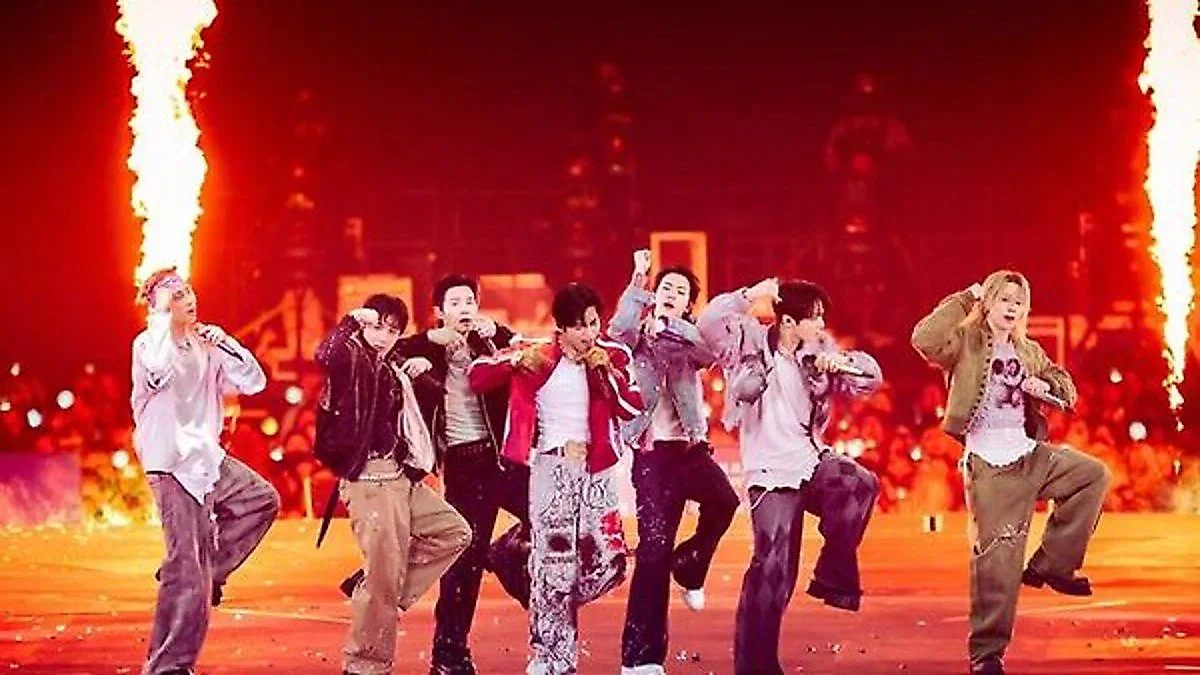
The moment BTS colored the Tokyo Dome in Japan with the Korean folk song ‘ARIRANG’ will be revealed again through local television. The scene where Japanese fans, who are not familiar with the Korean language, sang the traditional folk song in unison was noted as more than just a highlight of the performance; it was a symbolic moment showing how Korea's cultural identity forms a consensus on the world pop music stage. Since the unique Korean melody was completed by the audience's chorus during a global pop star's performance, significant interest is expected to be drawn by this TV broadcast.
Japanese broadcaster TBS will exclusively broadcast ‘BTS WORLD TOUR ‘ARIRANG’ IN JAPAN’ for the first time on TV through ‘TBS Channel 1 Latest Drama·Music·Movies’ on the afternoon of November 28. The broadcast contains the scenes from the first day of BTS's Japanese performance held at the Tokyo Dome on April 17. TBS has designated November as a BTS special period and plans to illuminate the group's diverse activities by programming a total of 28 programs, including concert live footage, variety shows, and movies, under the name ‘BTS Special ~Precious New Chapter~’.
The scene attracting the most attention in this broadcast is the moment when the song ‘Body to Body’ from the 5th studio album ‘ARIRANG’ fills the venue. As the ‘ARIRANG’ melody inserted into the song resonated, a chorus followed from the audience singing the Korean folk song together. As the songs sung by the seven members on stage blended with the voices of numerous spectators, the entire Tokyo Dome turned into a massive chorus hall. TBS also specially introduced this scene, focusing on the power of music to connect the hearts of people from different backgrounds.
The Tokyo Dome performance held last April drew great interest locally, mobilizing a total of 110,000 spectators over two days. In particular, the Japanese media noted that BTS melted Korea's traditional sentiments into modern pop music. The Japanese magazine SPUR evaluated the resonance of ‘ARIRANG’ that filled the venue as an overwhelming moment. Beyond the level of singing along to familiar pop hits, the fact that the traditional Korean melody was completed by the chorus of the entire audience in a large-scale venue left a special impression.
The music specialist media Real Sound also pointed out the meaning of ‘ARIRANG’ sung by the audience. The interpretation is that the sentiment of the folk song, which contains the pain of parting and longing while also containing the will to move forward, meets the message conveyed by BTS's new album. As the folk song, which has contained the lives and emotions of Koreans for hundreds of years, combines with modern music, it has expanded into a universal emotion not limited to a specific era or region.
The resonance of ‘ARIRANG’ did not stop at the Japan performance. During the Mexico performance last May, the sight of the audience singing along to the folk song melody inserted into ‘Body to Body’ also became a hot topic. The local media Infobae selected the ‘ARIRANG’ chorus as one of the 10 most impressive scenes in the performance. Evaluations came that it showed the power of music to transcend language barriers as even audiences unfamiliar with Korean lyrics participated in the song.
A similar scene unfolded in Europe as well. In the Munich, Germany performance, approximately 70,000 spectators sang ‘ARIRANG’ together, making the entire venue a massive chorus stage. Rolling Stone Germany reported the scene where a large-scale audience passionately sang along to the traditional Korean folk song while highlighting the performance held last July. The influential French daily Le Monde also noted that the difference in language did not prevent the audience's participation, focusing on the fact that ‘ARIRANG’ in ‘Body to Body’ was completed by the audience's chorus.
This phenomenon shows BTS's global influence while simultaneously making one rethink the relationship between Korean popular music and traditional culture. The sight of overseas fans encountering the Korean language and Korean culture through BTS's music, and furthermore singing traditional folk songs together, shows that modern popular music can be a channel for cultural exchange. While ‘ARIRANG’ is a song familiar to Koreans for a long time, it gains new meaning at the moment when audiences living in different languages and cultural spheres share the same melody.
In particular, the 5th studio album ‘ARIRANG’ and ‘Body to Body’ are read as attempts by BTS to reveal their cultural roots while maintaining a global musical sense. This is because they do not stop at preserving tradition only as a legacy of the past, but reinterpret it into the musical language of the present and share it with a global audience. Contrary to the old conventional wisdom that Korean elements must be diluted to succeed in the global market, it shows the possibility that a unique identity can instead be a powerful medium for empathy.
When the Tokyo Dome performance is revealed again on Japanese TV this coming November, the emotion of the ‘ARIRANG’ chorus that unfolded on site is expected to be re-examined. Viewers who could not see the performance in person will also be able to experience the heat of the stage created by BTS and the 110,000 spectators. The scene where Korea's traditional folk song resonates across borders through a global star's performance is expected to serve as an opportunity to once again confirm the cultural scalability of BTS's music.
Currently, BTS is meeting global fans through a world tour. Following the Santiago, Chile performances on the 14th and 16–17th (local time), they are scheduled to continue their South America tour in Buenos Aires, Argentina and São Paulo, Brazil.
Separately, the movements related to the Grammy Awards of K-pop singers, including BTS, are also drawing interest. It has been reported that BTS recently decided not to submit for the ‘Best Asian Pop Music Performance’ category of the ‘2027 Grammy Awards’, and following HYBE, artists belonging to SM, JYP, and YG have also not submitted songs for that category. As the status of Korean music on the global stage changes, the resonance of ‘ARIRANG’ delivered by BTS through performances remains as a scene that shows the possibility of Korean music's identity and global empathy beyond simple stage production.
Lee Chang-seok is the CEO and editor of Mediafine and writes for Mediafine Global, mainly covering K-Variety and also writing on K-pop, Celebrity and K-drama.


Comments 0
Comments are currently disabled.