
Home › K-Variety › The Truth of the Gyeongseo Middle School Field Trip Tragedy Revealed After 56 Years: 'It Wasn't the Teachers' Fault'
K-Variety
The Truth of the Gyeongseo Middle School Field Trip Tragedy Revealed After 56 Years: 'It Wasn't the Teachers' Fault'
A 1970 field trip tragedy involving Gyeongseo Middle School students resulted in 46 deaths after a bus collided with a train. After 56 years, survivors have come forward to clear the names of teachers who were falsely accused of abandoning students during the accident.
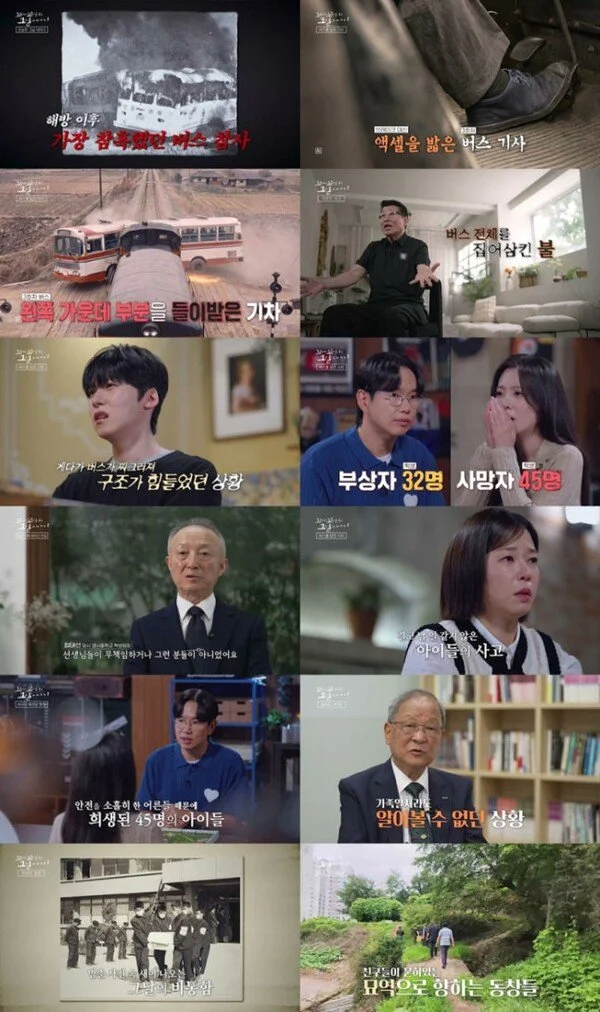 The truth of the Gyeongseo Middle School field trip tragedy revealed after 56 years: 'It wasn't the teachers' fault'
The field trip that children had been eagerly waiting for turned into an irreversible tragedy in an instant. In 1970, students from Gyeongseo Middle School in Seoul left for Asan, Chungnam, and on their way back, a train and a bus collided, claiming the lives of as many as 46 students. However, after more than half a century, testimony has emerged that some of the memories surrounding the accident at the time were different from the facts. Voices have belatedly been raised to restore the honor of the teachers who were branded with the stigma of abandoning students and fleeing immediately after the accident.
The SBS program 'The story of the day when the tail was bitten', broadcast on the 1st, shed light on the 1970 Gyeongseo Middle School field trip bus tragedy through the episode 'Nightmare Field Trip'. In this broadcast, the full story of the tragedy was retraced based on the testimonies and records of survivors who directly experienced the accident at the time. The cast members watching the broadcast were also speechless at the horrific situation the young students had to endure.
The accident occurred in October 1970. At the time, approximately 470 third-year students from Gyeongseo Middle School in Mapo-gu, Seoul, and 11 teachers set out on a day trip to Hyeonchungsa Shrine in Asan, Chungnam. The students were divided among 7 buses, but each vehicle was overcrowded far beyond its capacity. In some cases, more than 70 people boarded a bus with a capacity of 39, and specifically, Bus No. 3, which carried students from classes 3 and 4, had as many as 77 people on board.
The tragedy occurred on the way back. Around 4 PM, Bus No. 3, traveling toward Cheonan, entered a railroad crossing, and despite the alarm sounding, the bus did not stop. Ultimately, a running train and the bus collided head-on, and the train only stopped after pushing the bus about 80m. Immediately after the collision, a fire broke out in the engine and fuel tank at the front of the bus, and massive flames instantly engulfed the entire vehicle.
Rescue efforts were also not easy. Due to the impact of the accident, the bus body was severely crushed, and the protective bars installed on the windows even prevented students from escaping. Local residents who saw the accident scene and students following behind rushed to help by breaking the windows with stones, but what they could do was limited in the face of fierce flames and black smoke. Ultimately, this accident resulted in the tragedy where 46 students died. At the time, it was recorded as one of the most horrific bus accidents since liberation.
However, the tragedy of the accident did not end that day. Following the disaster, media reports conveyed the sentiment that the supervising teachers had not properly cared for the students and had left the scene when the accident occurred. As many years passed, this story became solidified as fact during the process of remembering the accident. However, the memories of the surviving students who were on the bus at the time were different.
According to the stories brought forth again by the survivors after 56 years, there was a reason why the teachers could not board Bus No. 3. It is said that while the teachers were away looking for a student who was late, Bus No. 3 departed first. In other words, the explanation is that the teachers did not abandon the students and leave, but rather, because the bus departed first while they were in the process of looking for the students they were supposed to supervise, the teachers could not board. The survivors spoke in unison, saying that they must correct the long-misunderstood facts and that "the honor of the teachers must be restored."
The accident itself had structural problems that were difficult to explain solely by the driver's judgment. The railroad crossing where the accident occurred at the time had a daily traffic volume of about 5,000 vehicles, but it was a place where no barriers or managers were installed. It was introduced through the broadcast that even though a rice mill blocked the view, proper consultation between railway-related institutions and relevant government departments did not take place, and the safety grade of the crossing was not appropriately adjusted due to issues such as budget problems.
The overcrowding of the vehicles carrying the students also demonstrates the safety reality at the time of the accident. More than 70 students boarded a single bus with a capacity of 39, and Bus No. 3 was packed with 77 people. Not only the structural problems of the vehicle itself, but also the excessive number of passengers influenced the difficulty for students to escape quickly when the accident occurred. It was as if the risk factors that would inevitably expand a single accident into a major catastrophe were already accumulating everywhere.
In the early morning the day after the tragedy, a temporary morgue was prepared at Gyeongseo Middle School. However, due to the fire, the damage to the bodies was so severe that it was difficult for the bereaved families to even identify their children with their own eyes. Ultimately, employees from the National Forensic Service were dispatched to the scene to conduct dental identification and began the work of identifying the deceased. Later, as a student receiving treatment also passed away, the final number of victims increased to 46.
In the graduation album published the following year, the phrase 'Lost Stars' was left along with the images of friends who could not return to school. For the surviving students, the accident was a memory that could never be erased for a lifetime. One survivor, who suffered severe burns, had cut off contact with former classmates for a long time amidst the aftereffects and trauma of the accident, but met friends again through the broadcast after 56 years. The survivors still visit the gravesite every October to commemorate their friends who passed away first.
Jung Yi-rang, watching the broadcast that day, showed tears as she viewed the incident from the perspective of a parent raising a child, and Oneus KEONHEE and BOL4 Ahn Ji-young also expressed sorrow at the horrific situation at the time. Jang Hyun-sung, Jang Sung-kyu, and Jang Do-yeon emphasized that "the tragedy where children are sacrificed due to the mistakes of adults must never be repeated again," suggesting that the accident must be remembered for a long time.
The Gyeongseo Middle School field trip tragedy is an accident from the past that occurred 56 years ago, but the records of that day still leave many questions. The causes of the tragedy cannot be explained by a single reason, including the environment that ignored safety, the overcrowded operation of vehicles, the structural limitations after the accident, and above all, the memories that became solidified differently from the facts. Above all, the testimony of the survivors, revealed belatedly, shows how long a misunderstanding placed on one person can persist over many years.
56 years since the day the children who went on a field trip could not return to school. The people left behind still remembered the names of their friends. And only now, through the voices of those who were at the scene at the time, another truth that was buried along with the tragedy is coming out into the world.
The truth of the Gyeongseo Middle School field trip tragedy revealed after 56 years: 'It wasn't the teachers' fault'
The field trip that children had been eagerly waiting for turned into an irreversible tragedy in an instant. In 1970, students from Gyeongseo Middle School in Seoul left for Asan, Chungnam, and on their way back, a train and a bus collided, claiming the lives of as many as 46 students. However, after more than half a century, testimony has emerged that some of the memories surrounding the accident at the time were different from the facts. Voices have belatedly been raised to restore the honor of the teachers who were branded with the stigma of abandoning students and fleeing immediately after the accident.
The SBS program 'The story of the day when the tail was bitten', broadcast on the 1st, shed light on the 1970 Gyeongseo Middle School field trip bus tragedy through the episode 'Nightmare Field Trip'. In this broadcast, the full story of the tragedy was retraced based on the testimonies and records of survivors who directly experienced the accident at the time. The cast members watching the broadcast were also speechless at the horrific situation the young students had to endure.
The accident occurred in October 1970. At the time, approximately 470 third-year students from Gyeongseo Middle School in Mapo-gu, Seoul, and 11 teachers set out on a day trip to Hyeonchungsa Shrine in Asan, Chungnam. The students were divided among 7 buses, but each vehicle was overcrowded far beyond its capacity. In some cases, more than 70 people boarded a bus with a capacity of 39, and specifically, Bus No. 3, which carried students from classes 3 and 4, had as many as 77 people on board.
The tragedy occurred on the way back. Around 4 PM, Bus No. 3, traveling toward Cheonan, entered a railroad crossing, and despite the alarm sounding, the bus did not stop. Ultimately, a running train and the bus collided head-on, and the train only stopped after pushing the bus about 80m. Immediately after the collision, a fire broke out in the engine and fuel tank at the front of the bus, and massive flames instantly engulfed the entire vehicle.
Rescue efforts were also not easy. Due to the impact of the accident, the bus body was severely crushed, and the protective bars installed on the windows even prevented students from escaping. Local residents who saw the accident scene and students following behind rushed to help by breaking the windows with stones, but what they could do was limited in the face of fierce flames and black smoke. Ultimately, this accident resulted in the tragedy where 46 students died. At the time, it was recorded as one of the most horrific bus accidents since liberation.
However, the tragedy of the accident did not end that day. Following the disaster, media reports conveyed the sentiment that the supervising teachers had not properly cared for the students and had left the scene when the accident occurred. As many years passed, this story became solidified as fact during the process of remembering the accident. However, the memories of the surviving students who were on the bus at the time were different.
According to the stories brought forth again by the survivors after 56 years, there was a reason why the teachers could not board Bus No. 3. It is said that while the teachers were away looking for a student who was late, Bus No. 3 departed first. In other words, the explanation is that the teachers did not abandon the students and leave, but rather, because the bus departed first while they were in the process of looking for the students they were supposed to supervise, the teachers could not board. The survivors spoke in unison, saying that they must correct the long-misunderstood facts and that "the honor of the teachers must be restored."
The accident itself had structural problems that were difficult to explain solely by the driver's judgment. The railroad crossing where the accident occurred at the time had a daily traffic volume of about 5,000 vehicles, but it was a place where no barriers or managers were installed. It was introduced through the broadcast that even though a rice mill blocked the view, proper consultation between railway-related institutions and relevant government departments did not take place, and the safety grade of the crossing was not appropriately adjusted due to issues such as budget problems.
The overcrowding of the vehicles carrying the students also demonstrates the safety reality at the time of the accident. More than 70 students boarded a single bus with a capacity of 39, and Bus No. 3 was packed with 77 people. Not only the structural problems of the vehicle itself, but also the excessive number of passengers influenced the difficulty for students to escape quickly when the accident occurred. It was as if the risk factors that would inevitably expand a single accident into a major catastrophe were already accumulating everywhere.
In the early morning the day after the tragedy, a temporary morgue was prepared at Gyeongseo Middle School. However, due to the fire, the damage to the bodies was so severe that it was difficult for the bereaved families to even identify their children with their own eyes. Ultimately, employees from the National Forensic Service were dispatched to the scene to conduct dental identification and began the work of identifying the deceased. Later, as a student receiving treatment also passed away, the final number of victims increased to 46.
In the graduation album published the following year, the phrase 'Lost Stars' was left along with the images of friends who could not return to school. For the surviving students, the accident was a memory that could never be erased for a lifetime. One survivor, who suffered severe burns, had cut off contact with former classmates for a long time amidst the aftereffects and trauma of the accident, but met friends again through the broadcast after 56 years. The survivors still visit the gravesite every October to commemorate their friends who passed away first.
Jung Yi-rang, watching the broadcast that day, showed tears as she viewed the incident from the perspective of a parent raising a child, and Oneus KEONHEE and BOL4 Ahn Ji-young also expressed sorrow at the horrific situation at the time. Jang Hyun-sung, Jang Sung-kyu, and Jang Do-yeon emphasized that "the tragedy where children are sacrificed due to the mistakes of adults must never be repeated again," suggesting that the accident must be remembered for a long time.
The Gyeongseo Middle School field trip tragedy is an accident from the past that occurred 56 years ago, but the records of that day still leave many questions. The causes of the tragedy cannot be explained by a single reason, including the environment that ignored safety, the overcrowded operation of vehicles, the structural limitations after the accident, and above all, the memories that became solidified differently from the facts. Above all, the testimony of the survivors, revealed belatedly, shows how long a misunderstanding placed on one person can persist over many years.
56 years since the day the children who went on a field trip could not return to school. The people left behind still remembered the names of their friends. And only now, through the voices of those who were at the scene at the time, another truth that was buried along with the tragedy is coming out into the world.
#Gyeongseo Middle School
#SBS
#The story of the day when the tail was bitten
#field trip tragedy
#bus accident
#survivors
Copyright © Mediafine Global All rights reserved. Unauthorized reproduction, redistribution, and AI training prohibited.
Related Articles

GREE Reveals "Apartment and Car" to Future Mother-in-Law—Marriage Permission Put on Hold
2026.10.03
Kim Min's Life as a True Artist on a Different Dimension—'I Live Alone' Explodes with 8.4% Rating
2026.10.03

'I Am SOLO' 33rd Season Yeong-suk, Reason for Appearing: "There is someone else I have my eye on"
2026.10.03
Comments 0
Comments are currently disabled.