
Jung Mi-jo: "A Scandal with André Kim?" — How She Confronted the Press Over False Rumors
Singer and painter Jung Mi-jo recalls her special bond with the late André Kim and the absurd scandal that led her to confront a newspaper office.
Singer and painter Jung Mi-jo shared an anecdote about visiting a newspaper office to protest an absurd scandal reported in a women's magazine years ago, reflecting on her long-standing relationship with the late André Kim. While baseless rumors were manufactured between the top fashion designer of the era and a rookie female singer, their relationship eventually remained a special bond that preserved a scene from Korean popular culture.
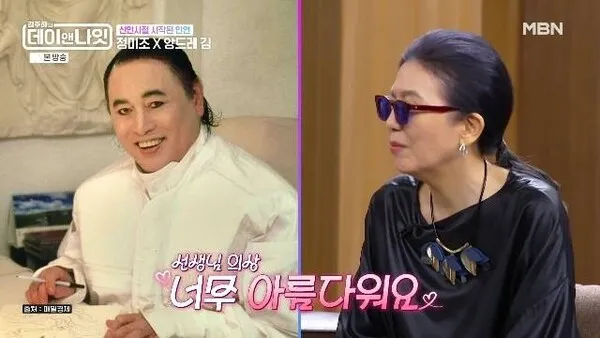
On the 41st episode of the MBN entertainment show "Kim Ju-ha's Day and Night," which aired on the 5th, Jung Mi-jo appeared alongside Song Chang-sik to discuss her activities in the entertainment industry during the 1970s.
During the broadcast, Jung Mi-jo's height of 170 cm became a topic of conversation, noting that she was quite tall for a female singer at the time. "I was the tallest among female singers back then," she recalled. Combined with her Westernized features and unique aura, she built a visual image distinct from typical singers from the very beginning of her debut.
At the center of that image were the designs of André Kim. Jung Mi-jo stated that she wore André Kim's clothing every time she appeared on television since her rookie days, saying, "Not just stage outfits, but whenever I appeared on shows, I always wore Teacher André Kim's designs."
Their connection began with a chance encounter. While passing through a broadcasting station hallway, Jung Mi-jo spotted André Kim and remarked, "Teacher, your designs are so beautiful." This led to André Kim inviting her to his atelier, which sparked their relationship.
At the time, it was uncommon for a rookie singer to consistently wear the clothes of a top-tier domestic designer. Jung Mi-jo's unique appearance, tall stature, and stage presence perfectly matched André Kim's signature grand silhouettes. André Kim also viewed Jung Mi-jo as a model who could express his fashion world, and she even stood as a model on his fashion shows three times.
The runway photos shown during the broadcast captured Jung Mi-jo's overwhelming presence, which remains striking even by today's standards. This was why Kim Ju-ha, Moon Se-yoon, and Jo Jazz expressed admiration, saying, "She is so tall," "Her beauty is piercing," and "She is so cool."
Their bond went beyond simple clothing sponsorship. In 2023, Jung Mi-jo donated about 20 pieces of clothing received from André Kim to the Ewha Womans University Museum, and these garments were revealed to the public again through an exhibition.
Jung Mi-jo recalled that when she wore the clothes back then, she didn't fully realize how beautiful and magnificent they were. It was only after seeing them displayed on mannequins under spotlights that she felt, "This is why Teacher André Kim's clothes are so beautiful, elegant, and flamboyant."
This is also significant because André Kim's designs are more than just stage costumes; they are important records in Korean fashion history. André Kim was a figure who expanded the popular image of Korean fashion through his unique style, which combined vibrant colors, dramatic silhouettes, Oriental aesthetics, and the grammar of Western haute couture. His method of showcasing his clothes through celebrities and models was also an important channel for the integration of popular culture and the fashion industry at the time.
Even after Jung Mi-jo paused her singing career to study abroad, her relationship with André Kim remained unbroken. When she returned to Seoul to hold a solo exhibition after studying in Paris in 1986, she visited his atelier to pay his respects, and André Kim personally prepared and gifted her the outfit she would wear for the exhibition opening.
Jung Mi-jo expressed her gratitude for this, saying, "I am thankful for it even after all these years," remembering André Kim's meticulous consideration long after the time has passed.
However, an event that cannot be omitted when explaining their relationship is the scandal reported in a women's magazine in the past.
Jung Mi-jo revealed that she was greatly angered when an unfounded scandal between herself and André Kim was reported. "I was so angry that I went to that newspaper office," she recalled. "In front of many people, I lost my temper and asked, 'How could such a scandal happen between the Teacher and me?'"
She explained that the newspaper staff were flustered and took her to a separate room to apologize. For Jung Mi-jo, it wasn't just simple gossip; it was a report that distorted the very relationship she had with André Kim, who had looked after her for a long time.
Kim Ju-ha drew laughter by commenting, "They say smoke doesn't rise from a chimney that has no fire, but in the entertainment industry, it does rise." Since it was not an era where individuals could directly clarify facts through real-time SNS as they can now, the private lives and human relationships of celebrities were often shaped by the reporting of certain media outlets.
In particular, the practice of women's magazines and entertainment media in the 1970s and 1980s to sensationally consume the private lives and romantic relationships of stars was one of the primary sales strategies used to stimulate public curiosity. There were many cases where the narrative of "what happened between person A and person B" took precedence over fact-checking. Jung Mi-jo's case serves as an anecdote illustrating the media environment of that era.
Jung Mi-jo, a graduate of the Department of Western Painting at Ewha Womans University, debuted as a singer in 1972 and established herself as a leading female singer of the 1970s with a string of hits including "Gaeyeoul," "Griun Saenggak," "Whistle," and "Bulkkot."
However, at the height of her career, she suddenly announced her retirement in 1979 and left for France. Since then, she has shifted the focus of her life from singer to painter and educator, studying art and serving as a university professor.
In Jung's life, music and art were not two disconnected careers. The sensory imagery she honed on the pop music stage and the formative artistic sense she accumulated as a painter became the important foundation for her later work. André Kim's designs, in this context, were not merely "clothes by a famous designer," but a cultural record that connected her youthful physique, image, stage, and art.
After a 37-year hiatus from the music industry, Jung Mi-jo returned as a singer in 2016 with the album "37 Years." Despite the long gap, her signature deep and restrained vocals remained intact, and her past hits were rediscovered by a new generation.
In particular, her representative song "Gaeyeoul," released in 1972, gained renewed attention across generations when IU remade it in 2017. The fact that the music of a star from one era was called upon again through the voice of a young singer shows that Jung's work is not a legacy confined to a specific time.
Ultimately, the anecdote Jung Mi-jo shared regarding the scandal with André Kim is more than just a piece of entertainment industry trivia. It is a record of how baseless gossip can distort a person's relationships, while simultaneously showing how the fashion and music of an era leave a shared history.
While the scandal from decades ago has vanished, the 20 pieces of clothing André Kim left for Jung Mi-jo remain in a museum. The rumors have evaporated, but the works and memories have become an archive. Perhaps the truest testimony to their relationship is not the sensational headlines of the time, but the preserved clothing and Jung Mi-jo's memories that have endured through the years.

Comments 0
Comments are currently disabled.