Miyeon's endoscopy vlog sparks medical advertising controversy
(G)I-DLE's Miyeon faces scrutiny after her health checkup vlog, featuring a sedated endoscopy, triggered complaints over potential medical law violations.
Miyeon of (G)I-DLE is facing a civil complaint requesting a review of whether she violated the Medical Service Act after revealing her first-ever health checkup and sedated endoscopy process. Controversy is spreading over whether a video produced as simple health content falls into the category of medical advertising, as it exposed medical institutions, medical staff, and actual medical procedures.
However, it has not been confirmed that Miyeon or the production team violated the Medical Service Act. On the 7th, a formal complaint was filed with the Yongsan-gu Public Health Center in Seoul via e-People, and whether the video constitutes medical advertising and if there are specific legal issues requires review by the competent authorities.
The controversial video is titled '(G)I-DLE Miyeon's First Health Checkup at Age 30, Did I... Talk Nonsense? | Evangelist EP.00,' which was released on Miyeon's YouTube channel 'Evangelist' on the 1st. The content captures the process of Miyeon, who has turned thirty, undergoing her first health checkup, introducing everything from basic tests like blood pressure, vision, and blood/urine tests to a relatively detailed look at a sedated gastroscopy.
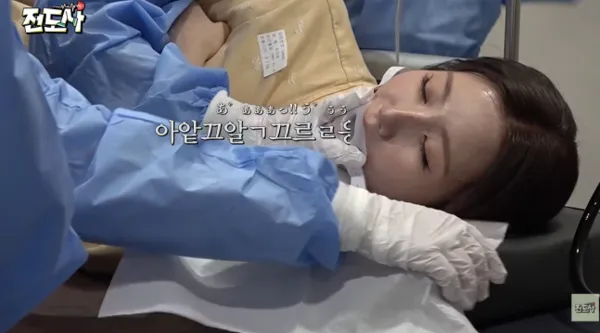
The problematic part is the sedated endoscopy process. It is reported that the original version included scenes of sedatives being administered, medical staff preparing for the examination, and the process of the endoscope being inserted through the oral cavity. This means that beyond simply 'undergoing an exam,' the actual process of a medical procedure appeared on screen.
Furthermore, information that could identify the medical institution was partially exposed. The interior facilities of the hospital and the medical staff appeared on screen, and the phrase 'Health Checkup Center Specialized in Upper/Large Intestine Endoscopy' displayed on the wall was also included in the video. The complainant, referred to as 'A,' requested a verification of the name of the medical institution, the medical staff, the facilities, and the appropriateness of the 'specialized hospital' designation.
In particular, it is reported that there were differences between the video at the time of release and the current version. Some scenes in the original version that allowed for the identification of the medical institution were subsequently given mosaic processing, and the production team stated they identified and supplemented parts where information identifying the medical institution was not sufficiently processed.
The core issue raised by the complainant is not the fact that 'filming took place at a hospital' itself. The point of contention is whether the information regarding a medical institution or medical professional delivered to consumers through YouTube content, along with the exposure of actual medical procedures, can be viewed as medical advertising.
The Ministry of Health and Welfare's guidelines regarding medical advertising state that the act of informing consumers about medical procedures, medical institutions, or medical professionals may constitute medical advertising, regardless of whether monetary compensation was provided. If judged to be medical advertising, it must comply with the advertising regulations of the Medical Service Act.
Article 56 of the current Medical Service Act also imposes restrictions on medical advertising. In particular, even when medical professionals advertise, content that exposes direct procedural acts such as surgery can be subject to restrictions. Therefore, how much of the actual endoscopy process was revealed in this video has emerged as a crucial factor for judgment.
However, it cannot be simplified to say that 'it became medical advertising because there was sponsorship.' Miyeon's side has instead stepped forward to deny any advertising or sponsorship itself.
The production team of 'Evangelist' stated in an official statement on the 8th that the content was not planned to promote a specific medical institution and that they had not received any requests for advertising, promotion, or production from the medical institution where they filmed. They explained that they received no monetary compensation or economic support, such as production costs, advertising fees, or sponsorship fees, and that Miyeon's health checkup and medical treatment costs were paid directly by the production team.
The production team admitted that information capable of identifying the medical institution was not sufficiently processed in some parts. Consequently, they stated that they added additional blurring to those parts during the review process after the teaser release and subsequently re-inspected the entire video.
This controversy demonstrates new regulatory issues that can arise as celebrity YouTube content rapidly expands beyond simple daily life reveals into the realms of health, medicine, and beauty. In the past, when hospitals or pharmaceutical products were exposed in broadcast programs, legal reviews were often conducted during the production stage. However, as personal channels and web variety shows have grown rapidly, the boundaries have become much more complex.
In particular, a celebrity's health checkup differs in nature from a typical vlog. When a famous person's actual examination at a specific hospital is made public, it can create an impression of that medical institution's expertise or service, even if unintentional. Therefore, determining the criteria for judging the production team's intent versus the actual exposure effect remains a significant issue.
The controversy is particularly difficult for Miyeon because the content's purpose was not to promote a medical institution, but to share her own health status and experience of her first checkup. The production team also emphasized this intent, drawing a line against any advertising purposes. However, legally, the judgment may depend on what information the content actually delivered, regardless of the production intent.
At this stage, it cannot be concluded that Miyeon is responsible for violating the Medical Service Act. The complaint filed with the Yongsan-gu Public Health Center is currently under review. The core of the upcoming judgment will be whether the content constitutes medical advertising, who the advertising entity is, the extent of the medical institution's involvement in the filming, and whether the exposure of medical procedures and institution information complies with the law.
Ultimately, the heart of this matter is not simply that 'Miyeon revealed a sedated endoscopy.' It is a more fundamental question of where the line should be drawn between showing personal health experiences as content and informing consumers about medical institutions through advertising. With Miyeon's side denying any advertising or sponsorship, attention is focused on the final decision.
Related articles