Song Eun-i's 30-Year Wealth Strategy vs. Kim Sook's -37% Loss
Comedians Song Eun-i and Kim Sook reveal contrasting investment results on VIVO TV, highlighting the gap between long-term savings and market volatility.
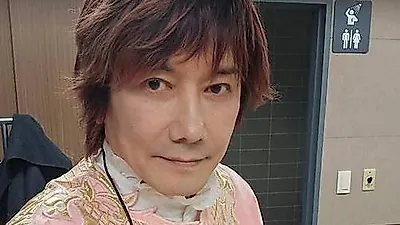
Broadcaster Song Eun-i's long-standing savings habits are drawing attention once again. Following an anecdote about her maintaining a financial product joined back in 1993 when her monthly salary was 200,000 won, she has now become the center of discussion by revealing the cumulative return on her pension savings, highlighting an investment style that prioritizes long-term asset management over short-term market trends.
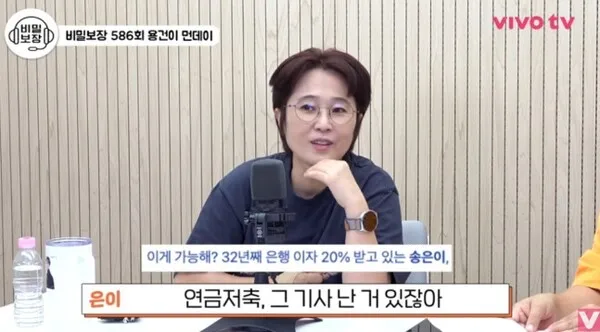
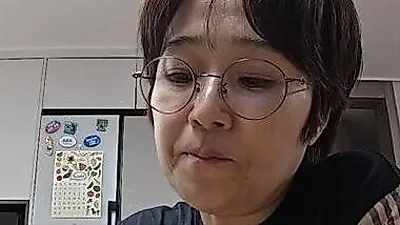
On the 9th, a video titled "Song & Sook Investment Returns Revealed: Where do securities company employees invest? The reason Kim Sook opened a securities app during the broadcast" was released on the YouTube channel VIVO TV. Ahead of a phone connection with a securities company employee, Song Eun-i and Kim Sook disclosed their respective investment statuses, revealing unexpected return reports.
Kim Sook opened the floor. She lamented, "In the stock market, I have more than one or two things to complain about right now," expressing that the return on the ETF she holds is currently minus 37%. She did not hide her frustration over the investment loss, reacting to the market in a way that was practically a protest.
Song Eun-i laughed at this, asking, "Why are you complaining to this person?" while adding, "There are more than one or two people stuck in the market right now." It was a scene where the two resolved the market volatility that anyone with investment experience can encounter through entertaining conversation.
Then, the atmosphere shifted. It happened when Song Eun-i revealed her cumulative return on pension savings. She stated, "There is a cumulative return on pension savings. Cumulative is different from short-term returns," revealing that her cumulative return is in the 30% range. Kim Sook immediately shot back, "Are you bragging?", continuing the two's characteristic bickering chemistry.
The point to note here is the concept of 'cumulative' emphasized by Song. It is difficult to interpret the results of managing assets over a long period in the same way as whether the return at a specific point in time is good or bad. Since the performance of actual financial products can vary depending on the evaluation period, criteria, and whether costs and dividends are reflected, it is difficult to judge total investment capability based on a single figure alone.
The reason Song's wealth management philosophy catches the eye cannot be explained solely by her recent disclosure of investment returns. She previously revealed on VIVO TV that she has maintained a financial product joined back in 1993 when her monthly salary was 200,000 won.
She explained that at the time of joining, a high interest rate in the 20% range was applied, and even now, the product maintains an interest rate in the 10% range.
Even at that time, online speculation arose that she must have accumulated significant assets, as the fact that she was a 'celebrity holding a high-interest product for nearly 30 years' was highlighted. However, Song drew a line herself, stating that the fact that interest rates are high and the scale of the principal are separate issues, saying, "The amount is not large."
Rather, what she emphasized was habit rather than the amount. Song's consistent explanation was that the habit of steadily saving even small amounts can become the foundation for meaningful asset management when accumulated over a long period. Her expression, "Small is by no means small," encapsulates a wealth management philosophy that is different in nature from flashy investment success stories.
What makes Song's case interesting is that her attitude toward saving has remained relatively consistent even as the financial environment in Korea has changed significantly. In the 1990s, high interest rates on bank deposits and savings played an important role in forming household wealth, but as the era of low interest rates passed, the proportion of market-based financial products such as stocks, ETFs, and pension accounts increased.
Song is also utilizing pension savings in accordance with the changing times. While she maintained stable financial products like 'high-interest savings' in the past, she is now managing investment performance through pension savings, which have a strong character of long-term retirement assets. This can be read as a way of differentiating financial tools according to the life cycle rather than seeing savings and investment as disconnected concepts.
On the other hand, Kim's investment experience shows the reality of individual investors appearing in the more recent market entry process. She confessed that she used to "treat people who didn't invest in stocks like fools," and then admitted that she also rushed into the market and recorded -37% in an ETF. It is a facet of the volatility that a person who was observing the investment craze can experience when entering the market late.
Of course, one cannot simply compare Song's 30% cumulative return with Kim's -37% to determine who succeeded or failed. Investment periods, contribution scales, product compositions, and purchase timings all differ. Rather, their cases show how crucial 'when, what, and how long one holds' is when interpreting returns.
Ultimately, the reason their conversation draws interest beyond mere laughter is that it is highly relatable. One person has managed assets by not canceling small financial products for decades, while the other is experiencing unexpected losses after jumping into the market. While it may seem like a celebrity's wealth management anecdote, it contains the actual choices and trial-and-error faced by ordinary Korean investors.
In particular, the method shown by Song is far from a "one-shot" investment success story. Rather than chasing high returns, she adheres to principles of maintaining financial products over long periods, verifying long-term performance through pension savings, and most importantly, consistently managing even small amounts.
Kim also showed a moment of reflecting on her attitude toward investing through this experience. The two contrasting reports reveal the dimension of time hidden behind the numbers of 'return rates.'
Song's 30-year financial product and Kim's current ETF performance ultimately lead to one question. The key to wealth management is not how much one earns right now, but how consistently one can maintain a method that fits their investment purpose and duration. This is why their pleasant conversation offers more than just laughter, presenting a realistic topic for viewers.
Related articles