Kim Sung-kyung weeps over Taegukgi drawn over Japanese flag
Broadcaster Kim Sung-kyung reveals her family's history of independence activism after seeing a rare Taegukgi relic at Jingwansa Temple.
Broadcaster Kim Sung-kyung burst into tears after facing an authentic Taegukgi drawn with ink over a Japanese flag. After personally confirming the relic, which preserves traces of the independence movement during the Japanese colonial period, Kim revealed a special family history, stating that her great-uncle was also a participant in the independence movement.
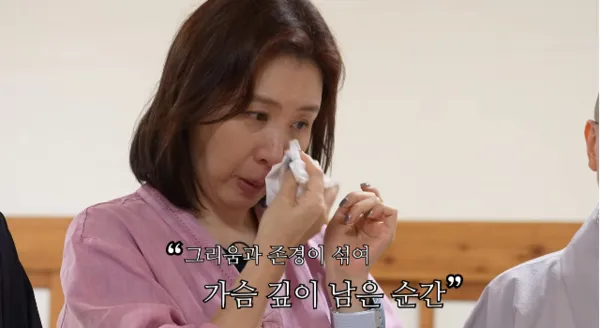
On the 27th, Kim visited Jingwansa, a thousand-year-old temple located on Bukhansan Mountain, alongside physiognomist Park Seong-jun. While touring the temple, the two listened to explanations regarding the discovery process and historical significance of the independence movement relics preserved at Jingwansa.
In particular, the duo headed toward the Chilseonggak pavilion of Jingwansa. This location gained attention from the historical and cultural communities when traces of the independence movement from the Japanese colonial period were discovered during building renovation work in 2009.
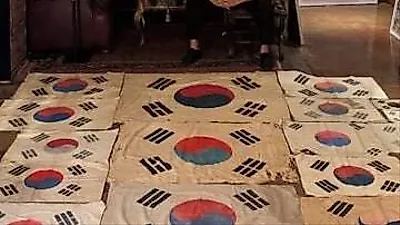
During the disassembly and restoration process as the century-old building was tilting, a bundle wrapped in Hanji (traditional Korean paper) was discovered between the Buddhist hall and a pillar. Upon opening the Hanji bundle, which had been deeply hidden in a space not easily visible, the Taegukgi revealed itself.
It was not just the Taegukgi that was discovered. 19 items of newspapers published between June and December 1919 were also identified in the same location. These relics show the circumstances under which items related to the independence movement were concealed inside the temple during a period of intense Japanese surveillance.
Explanations at the site suggested a high possibility that these relics were related to Monk Baek Cho-wol.
Monk Baek Cho-wol is considered one of the representative figures who led the Buddhist independence movement during the Japanese colonial period. He participated in the independence movement around the time of the March 1st Movement and is known to have been involved in the production and distribution of independence-related printed materials and Taegukgis.
Monk Bon-eom explained that it is presumed Monk Baek Cho-wol hid the Taegukgi he used during the independence movement at Jingwansa before being captured by the police.
Listening to this story, Kim could not control her emotions as she imagined the moment the independence activist must have hidden the relic.
"The monk said he covered the Taegukgi with soil while hiding it; I wonder what his heart was like at that moment? I suddenly found myself imagining that," Kim said, her eyes reddening.
Her emotions intensified even further the moment she faced the actual authentic Taegukgi after hearing about its historical significance.
When Monk Bon-eom remarked, "It seems you two have accumulated much merit in your past lives. Opportunities to see a Taegukgi like this are not many," Kim looked at the flag and said, "I'm getting goosebumps. Am I overreacting? I feel like I'm going to cry."
The reason Kim's eyes were moistened was not merely the emotion of seeing an old Taegukgi in person.
The Taegukgi in question was described as having the Taegeuk symbol drawn in ink over a Japanese flag, unlike standard Taegukgis. Considering that the Japanese flag was a symbol of Japanese colonial power, the act of drawing the Taegeuk over it can be interpreted as a visual manifestation of the Korean people's will for independence and national identity at that time.
In particular, the period around the 1919 March 1st Movement was a time of extreme Japanese control and censorship. The Taegukgi held a meaning beyond being a simple national flag. To the people demanding independence, the Taegukgi was a political symbol representing sovereignty and the national community, and the act of waving the Taegukgi on the street was itself an expression of resistance against colonial rule.
Facing the Taegukgi imbued with such meaning, Kim eventually wept uncontrollably.
And in that moment, she shared her own family history.
Kim revealed, "My maternal grandfather was a military doctor during the Korean War, and my great-uncle was an independence activist." She conveyed the fact that her family also did not bypass the turbulent periods of modern Korean history.
Kim further explained that she was recently designated as a descendant of a person of merit for independence. She was designated through the 60th Committee of Descendants of Independence Patriots and Martyrs under the Ministry of Patriots and Veterans Affairs.
As the Jingwansa Taegukgi and her family history connected in one place, the Taegukgi seemed to hold a meaning for Kim that went beyond a simple cultural heritage. It was a moment where the independence movement, which she had encountered in history books or records, connected to her own bloodline and current life.
The Taegukgi and newspapers found at Jingwansa are evaluated as important materials showing that the independence movement during the Japanese colonial period was not limited to specific spaces or individuals but spread to various sectors, including religious circles and local communities. Most importantly, the way the relics were discovered shows how meticulously independence activists tried to preserve records and symbols to evade Japanese surveillance.
The Taegukgi, which has endured 100 years, has emerged back into the world from a gap in a temple building. Standing before it, Kim wept as she confessed that the history of the independence movement also existed within her own family.
Kim was born in 1972 and is 54 years old this year. She made her debut as a second-generation SBS announcer in 1993 and has since expanded her career as a broadcaster. Also widely known as the younger sister of actress Kim Sung-ryung, she has shared her daily life and family stories through various broadcasts.
This visit to Jingwansa transcends a mere experience of historical relics by a famous broadcaster; it serves as a moment where personal family history meets modern Korean history. The tears shed by a descendant before a Taegukgi that someone had to risk their life to hide a century ago serve as a reminder that the history of the independence movement is not a fossilized past, but a memory that continues to this day.
Related articles