Song Il-kook: Descendants of independence activists struggle to make a living
Actor Song Il-kook discusses the historical irony and economic hardships faced by the descendants of independence activist General Kim Jwa-jin.
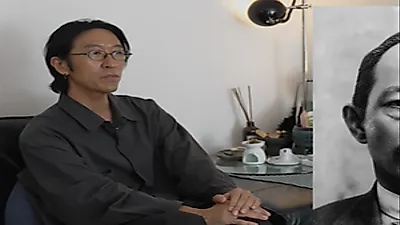
With controversies surrounding pro-Japanese activities resurfacing ahead of Liberation Day, actor Song Il-kook—the great-grandson of independence activist General Kim Jwa-jin—is drawing renewed attention for his remarks regarding the historical irony he has experienced as a descendant of an independence activist.
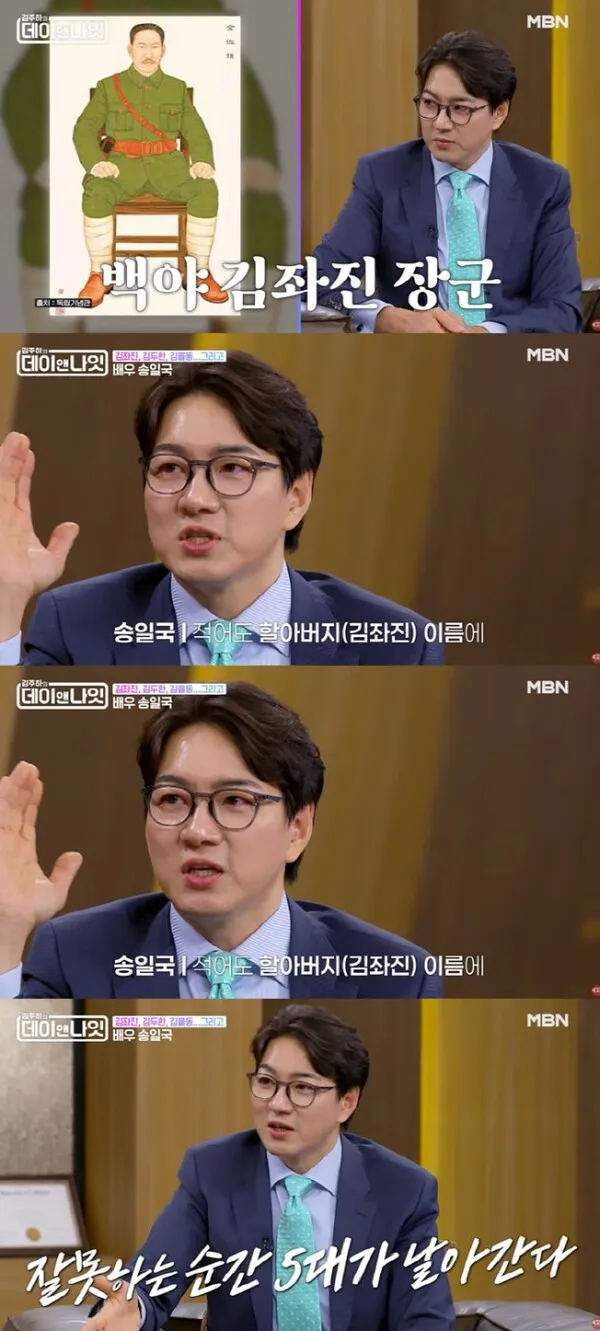
Appearing on MBN's "Kim Ju-ha's Day and Night" in May, Song spoke candidly about his family history as a descendant of an independence activist, the resulting sense of responsibility, and how the legacy left by his ancestors has manifested in the lives of his descendants.
On that day, Song mentioned that his three sons, the 'Samdungis,' do not yet fully understand their ancestry. He revealed, "They don't know well yet. In fact, I only came to understand the meaning of such things after I passed the age of 30."
He then shared the words he had heard repeatedly in his household since childhood. It was a request: "At least do not do anything that would disgrace the name of your grandfather, Kim Jwa-jin." Song noted that he has no choice but to say the same thing to his three sons, using a joking expression: "The moment you do something wrong, five generations will be wiped out."
These words go beyond simple family education, demonstrating how the identity of being a descendant of a historical figure impacts an individual's life. The awareness that a single action can be linked to an ancestor's name is a source of pride on one hand, but inevitably acts as a significant psychological burden on the other.
Song explained that there was a significant gap between the historical perspective of General Kim Jwa-jin and how he was viewed within the family.
While he noted, "General Kim Jwa-jin is a hero to the outside world," he added, "But if you look at him as the true head of a household, there is no greater enemy than him." This is because, in the process of disposing of vast wealth to fund the independence movement, his family ended up facing extreme economic hardship.
It is known that General Kim Jwa-jin's family possessed considerable economic power at the time, owning a massive 99-room mansion in Hongseong. Song compared this to modern times, explaining it was on the level of "the CEO of a decent mid-sized company."
However, General Kim Jwa-jin invested his economic foundation into the independence movement, such as disposing of his assets and using his house as a school. Song explained that it was "the exact same situation as a family living luxuriously and suddenly being thrown out onto the street," while General Kim Jwa-jin himself departed for Manchuria.
He emphasized the tragedy of his family history through the lives of the women.
Introducing a family photo taken just before the Korean War, Song mentioned the four generations of women: General Kim Jwa-jin's mother, his wife Oh Sook-geun, Kim Du-han's wife Jae Hee, and a young Kim Eul-dong. Looking at them, he described their lives as "truly tumultuous."
This means that behind the grand historical cause of the independence movement, there existed daily sacrifices—such as the livelihood of the family, the lives of women, and the education of children—that are relatively easy to overlook in official historical records.
In particular, the most painful point raised by Song was the socio-economic gap that existed between the descendants of independence activists and the descendants of pro-Japanese collaborators.
He stated, "The irony is that, because of this, the pro-Japanese descendants were actually well-off. They received good educations and could even send their children to study abroad. Meanwhile, the descendants of independence activists struggled to make a living, let alone study."
The core of this remark is not simply to compare specific groups. It points to the historical reality that those who invested their wealth and lives into the independence movement did not necessarily receive economic compensation after liberation; rather, the descendants had to bear the cost of that sacrifice.
Song emphasized, "I believe that is why we must treat the descendants of independence activists well."
How the state and society fulfill their responsibility to those who sacrificed their personal lives for the nation is not merely a matter of welfare, but a matter of historical justice. This is why the way we remember the independence movement should not end with memorial halls, ceremonies, and remembering the names of heroes.
Song also shared an anecdote of visiting the National Cemetery with his mother-in-law after his marriage.
His mother-in-law took him to a small tombstone and introduced it as "your father." It was the grave of an unnamed soldier who died during the Korean War.
Through this experience, Song said he reflected on the fact that he had only been remembering famous heroes like General Kim Jwa-jin. He added, "There are heroes like General Kim Jwa-jin, but there were also many unnamed soldiers whose sacrifices allowed us to win the war. She told me never to forget that," noting he felt a strong sense of awe at the time.
The memory of history is ultimately a matter of choice. If we only remember those whose names remain, history becomes a chronicle of heroes; but if we remember even those who vanished without a name, it finally becomes a complete record of an era.
Song's remarks are drawing attention again ahead of Liberation Day for this very reason. Rather than reducing the independence movement to the narratives of a few great individuals, we must also look at the economic and social sacrifices their families endured and the deaths of the nameless many.
Ultimately, remembering liberation is not merely about memorizing the names of independence activists. It is about remembering that while some gave everything for the nation, others bore the cost through their family's poverty, and others disappeared into history without even leaving a name.
Song's sentiment that "our country was created through the sacrifices of many people" asks us what we should truly remember on Liberation Day. When we look beyond the names of heroes to the lives of the families hidden behind them and the countless sacrifices unrecorded in history books, the meaning of liberation becomes a more tangible reality.
Related articles