Na Yeong-seok ditches luxury and stars for -27°C hiking
PD Na Yeong-seok breaks his successful variety show formula, swapping overseas travel and famous stars for harsh Korean mountains in 'Take a Hike!'
PD Na Yeong-seok has boldly stripped away the successful variety show formula he has built over a long period. Instead of famous overseas tourist destinations, comfortable accommodations, and a cast with proven chemistry, he has put harsh domestic mountain environments and four strangers at the forefront. Moving away from the grammar of travel variety shows that provided vicarious satisfaction through splendor and consumption, he has made the 'process of suffering together' itself the object of observation.
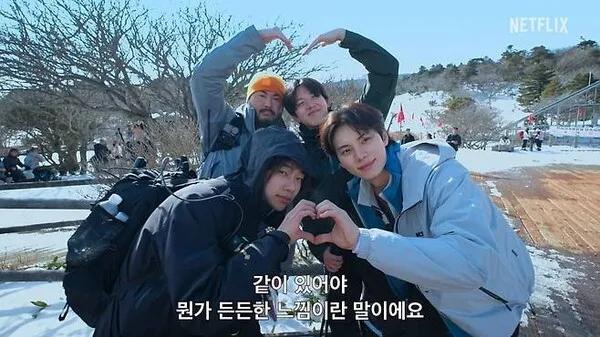
The Netflix variety show 'Take a Hike!', released on the 18th, captures the process of Car, the garden, DAY6's Yoon Do-woon, actor Lee Chae-min, and All Day Project's Tarzan climbing Mt. Seorak, Mt. Taebaek, Mt. Halla, and more.
The most striking aspect of this program is 'what was given up.' It minimizes the overseas locations, luxury accommodations, and visits to famous tourist attractions commonly seen in recent travel and observation variety shows, instead entering the primal space of the mountains. During the filming at Mt. Seorak, temperatures dropped to as low as -27.5°C, and not only the cast but also dozens of production staff members underwent the grueling hike together.
This does not merely remain a 'variety show themed around hiking.' In travel variety shows, locations are usually objects of consumption. They visualize the pleasure of travel by allowing viewers to admire beautiful scenery, eat delicious food, and rest in good accommodations. In contrast, in 'Take a Hike!', the mountain is closer to a space that must be overcome rather than consumed. The cold, fatigue, and physical limits naturally draw out the true personalities of the cast.
The cast composition, the core of any variety show, also differs significantly from Na's existing methods.
Instead of individuals like Lee Seo Jin, Lee Soo Geun, and Eun Ji-won, who have worked with Na for a long time and have already established relationships, he chose a relatively unfamiliar combination: Car, the garden, Yoon Do-woon, Lee Chae-min, and Tarzan. The narrative of the program lies in the process of these four people, who do not have sufficient information about each other, gradually forming relationships as they climb the same mountains and experience the same hardships.
This is read as an important shift in Na's variety shows. In his past programs, the intimacy between cast members was a key device for producing laughter. Because viewers already knew the personalities and relationships of the long-time cast members, the situations themselves became the narrative without the need for separate explanations.
However, 'Take a Hike!' removes that familiarity. Instead, it shows the process of strangers acquiring intimacy through shared experiences. Relationships are not something that already exists, but something created within the program.
Na's representative travel variety shows have grown along with the expansion of space. In shows like 'Youn's Kitchen,' he utilized exotic spaces like overseas locations and built a unique world by combining travel, labor, food, and relationships. In essence, the overseas locations themselves provided a kind of fantasy to the viewers.
'Take a Hike!' flips this formula. Even without taking a plane to cross borders, it creates sufficient spectacle through the scenery of Mt. Seorak, Mt. Taebaek, and Mt. Halla. Furthermore, by capturing the process of preparing hiking gear, climbing the mountains, and even the appearance of other hikers encountered on-site, it naturally draws Korea's unique hiking culture into the program.
Ultimately, what Na has chosen this time is not 'greater stimulation,' but a change in the way stimulation is created.
As competition in travel variety shows shifts toward the scarcity of locations, the fame of cast members, or price competition for accommodations, the differentiation between contents inevitably weakens. No matter how many famous overseas tourist attractions are shown, the moment they become familiar to viewers, those places are no longer special. Similarly, if the sight of famous celebrities traveling together is repeated, the freshness of their relationships declines.
Na chose reverse thinking at this point. Rather than making the location glamorous, he makes the situation difficult; rather than composing the cast with famous people, he makes the relationships unfamiliar.
In particular, the -27.5°C cold does not demand scripted lines from anyone. When physical strength drops and they are exhausted by the cold, the actual reactions of the cast members are naturally revealed. Variety show laughter also arises from human bewilderment, consideration, conflict, and solidarity shown in extreme situations, rather than from contrived games or missions.
This approach also aligns with the characteristics of documentary-style observational variety. Rather than the production team directly creating laughter, they design the environment the cast members are in and capture the accidental changes in relationships that occur within it. Consequently, the true spectacle of 'Take a Hike!' lies not in the mountains themselves, but in the human transformations triggered by the mountain environment.
This is a major gamble for Na. While repeating a successful formula is stable from a production standpoint, it also carries the risk of his content becoming trapped in familiar tropes. By simultaneously abandoning the safety nets of overseas locations and a verified cast, 'Take a Hike!' is a bold new experiment.
Ultimately, the question this program poses is exactly what the title asks: “Take a Hike!” And the answer is not simply to reach the summit. Humans sometimes discover each other more clearly through discomfort than through comfort, and find the meaning of relationships in the journey rather than the destination.
Whether Na's decision to abandon glamorous overseas locations and familiar star combinations for sub-zero mountains will be a mere variation or a complete reinvention of his variety show grammar remains to be seen.
Related articles