Park Soo Hong airplane controversy sparks terminology debate
Comedian Park Soo Hong faces scrutiny after a decision to deplane caused a 70-minute flight delay, sparking a debate over the correct English terms.
[Oh Seo Yoon Column] Park Soo Hong, Airplane Controversy—Deplaning, Disembarking, or Leaving a Show?

Due to comedian Park Soo Hong's controversy regarding his decision to deplane and then reverse that decision, public curiosity is growing regarding the specific terms for 'deplaning,' 'disembarking,' and 'leaving a show.' The incident began on the 23rd on Korean Air flight KE415 bound for Guam.
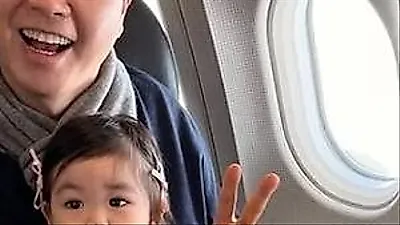
Park Soo Hong boarded the business class cabin of this flight along with his wife, Kim Da Ye, and their 22-month-old daughter, J. However, as J continued to cry, he expressed his intention to deplane to the flight attendants. But during the waiting process, as the child regained composure, he expressed his intention to board again. Since the family did not actually exit the aircraft at that time, it is understood that there was no issue with withdrawing the intention to deplane under Korean Air regulations.
However, the fact that the aircraft's operation was delayed remains. Flight KE415 was originally scheduled to depart at 10:05 AM, but it took off at 11:15 AM, approximately 70 minutes late, meaning the remaining passengers had to bear the resulting damages.
Korean Air explained that a delay code corresponding to passenger support services was assigned, and noted that if a passenger expresses an intention to deplane, additional procedures such as cabin security searches may occur. In particular, if a passenger has checked baggage, the process of removing the luggage from the aircraft can begin immediately upon the expression of the intent to deplane.
Even if the passenger later withdraws the intention to deplane, time must inevitably be spent because the already started processes of unloading and reloading baggage, as well as in-flight security procedures, must be carried out again. Therefore, the prevailing view is that this delay should be interpreted not as an exceptional privilege provided to Park Soo Hong's family, but as a result of complex normal airline safety and security procedures triggered by the intent to deplane.
However, the controversy is not subsiding. There are many opinions that traveling abroad with a 22-month-old child should have been considered more carefully in advance. Furthermore, all the damages were effectively shifted to all passengers except Park Soo Hong, as well as the flight crew. In that process, interest in the specific terminology is rising.
To the public, 'hacha' (leaving a vehicle/show) is a very familiar word. It means getting out of a car. In the broadcasting industry, 'hacha' is also used euphemistically to describe leaving a program one was appearing in regularly. While 'hacha' can be used when getting off a plane, the term 'haseon' (disembarking a ship/vessel) is somewhat closer.
This is because the expression 'seungseon' (boarding a vessel) has often been used when boarding airplanes for a long time. While 'hacha' or 'haseon' are not incorrect, the consensus is that 'hagi' (deplaning/getting off) fits best in the context of an airplane. Of course, it is not a term that has been frequently used, but it seems it will become familiar now. Ironically, it is because of this controversy.
Related articles