Yoo Jae Suk apologizes after slip of the tongue regarding Farinelli
Entertainer Yoo Jae Suk issues repeated apologies after a remark about singer Jo Kwan-woo's unique falsetto inadvertently referenced a historical castrato.
Entertainer Yoo Jae Suk found himself issuing repeated apologies after an unexpected slip of the tongue regarding a musical comparison. While discussing singer Jo Kwan-woo's unique falsetto, Yoo mentioned "Farinelli," only to realize the inappropriate nature of the remark after learning the historical context of the figure.
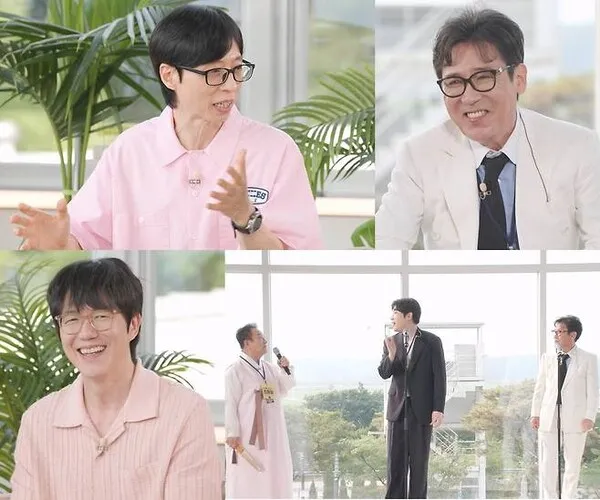
In the 7th episode of "Happy Together: Glad We're Not Alone," airing on the 28th, Yoo Jae Suk will appear alongside Jang Hang Jun, Yoon Jong-shin, and special MC Sung Si-kyung to watch the participants' performances.
The episode features singer Jo Kwan-woo appearing with his father, traditional Korean musician Jo Tongdal. Jo Tongdal stirred the studio by explaining his son's unique singing style, remarking, "I thought Kwan-woo was a eunuch because of his falsetto."
In response, Yoo Jae Suk remarked to Jo Kwan-woo, "Aren't you the Korean Farinelli?" He was attempting to draw a parallel between Jo's high vocal range and the famous figure.
However, the atmosphere shifted immediately when Yoon Jong-shin clarified, "That person was a real eunuch." Realizing the historical implications of his comment, Yoo Jae Suk repeatedly apologized, saying, "I am sorry," and even bowed his head, adding, "I lack musical knowledge."
The Farinelli mentioned by Yoo was a famous castrato singer who represented the 18th-century European opera scene. Born Carlo Broschi, he gained fame as one of the greatest opera singers of his era due to a high vocal range and volume maintained after being castrated in his youth.
Castrati were unique figures that emerged from the intersection of the opera industry's demands and a socio-cultural environment where women's stage activities were limited. Farinelli, in particular, is evaluated as having possessed overwhelming musical talent and star power. While connecting Jo Kwan-woo's falsetto to Farinelli's musical image is understandable, Yoo's expression could be perceived very differently when considering the figure's physical history.
The broadcast will also reveal the background of how Jo Kwan-woo operated as a "faceless singer" for a long time.
Jo recalled that upon his debut, he expressed his intention not to appear on TV, a request the production team readily accepted. He noted, "When I said I wouldn't appear on TV when I started my activities, the production team just agreed, saying, 'That's a good idea.'"
This was a highly unusual strategy in the pop music market at the time. During an era when television appearances and a star's face were primary promotional tools, he chose to hide his face and lead solely with his voice.
Ultimately, Jo's strategy resulted in explosive success. His first album sold approximately 1.3 million copies, and his second album sold about 3.2 million copies, remaining iconic records of the 1990s music market. His singing style, utilizing overwhelming high notes and falsetto, became a distinct musical identity that set him apart from other male ballad singers of the time.
However, revealing his face led to unexpected changes.
Jo revealed, "As soon as I first appeared on broadcast, my daily album sales dropped from 20,000–30,000 copies to just 2,000–3,000 copies." This implies that the previous strategy of maximizing the fantasy surrounding the music by hiding his face weakened once his appearance was known.
This serves as an interesting case study of how image can reinterpret music in popular culture. When the imagination formed by a voice alone meets the actual physical appearance of a person, the "star image" consumed by the public can shift.
Jo's case is particularly noteworthy as it shows that the 1990s music industry did not always move in lockstep with television and album sales. Unlike the current era where an artist's image is consumed in real-time via SNS and video platforms, radio, albums, and TV appearances exerted independent influences back then.
Yoon Jong-shin, who also worked as an underground singer in the past, empathized with Jo's experience. He felt a connection to the idea that the method of public exposure can influence how music is evaluated and consumed.
This episode of "Happy Together: Glad We're Not Alone" carries significance beyond a simple verbal slip on a variety show. On one hand is Farinelli, a unique musical existence in history, and on the other is Jo Kwan-woo, who built his identity through his voice. Yoo Jae Suk's brief mistake serves as a catalyst to reflect on the musical backgrounds of both figures.
Above all, Jo Kwan-woo's story demonstrates that a star's face is not necessarily a prerequisite for musical success. The strategy of the "faceless singer," who replaced a face with a voice to move the public's imagination, reads as an even more unique cultural experiment in today's era of overflowing imagery.
Related articles