
Lee Hye-sung raises philosophical questions on ancestral guilt and historical responsibility
Broadcaster Lee Hye-sung has raised profound philosophical questions regarding whether descendants should bear responsibility for the wrongdoings of their ancestors and the extent to which nations must apologize for historical errors.
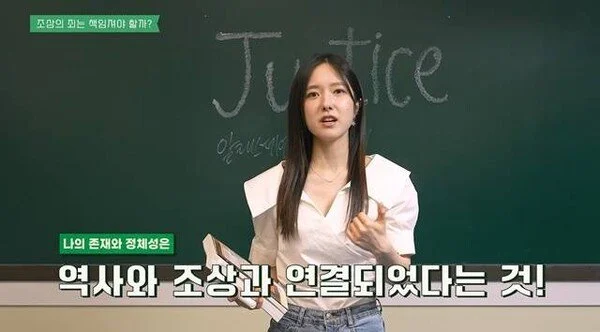
Broadcaster Lee Hye-sung has raised weighty questions regarding the pro-Japanese actions of ancestors and the moral responsibility of their descendants. By referencing a case reminiscent of the controversy surrounding the pro-Japanese activities of actress Oh Ha-young's great-grandfather, she questioned whether individuals must be held accountable for the mistakes of their ancestors and to what extent a nation should apologize for past historical errors. Moving beyond simple criticism or defense, she drew attention by philosophically revisiting historical responsibility, individual identity, and community ethics.
On the 20th, a video titled "The justice we believed was right might be wrong | Justice: What's the Right Thing to Do?" was released on the YouTube channel Lee Hye-sung's 1% Book Club. In the video, Lee opened by stating, "Recently, there was a controversy when the pro-Japanese actions of a public figure's great-grandfather during the Japanese colonial period were revealed." While she did not mention a specific name, her remarks evoked the controversy involving the pro-Japanese history of actress Oh Ha-young's great-grandfather.
Lee first noted that the clear wrongdoings of historical perpetrators cannot be denied. However, she asked, "Should we atone for the sins of our ancestors instead?" The question expanded from individual responsibility to the issue of national historical apologies. "Furthermore, should the state apologize for past historical wrongs? If so, from where does that moral and philosophical basis arise?" she asked, contemplating the criteria for evaluating the past and the scope of responsibility for the current generation.
To grapple with these questions, Lee revisited the book "Justice: What's the Right Thing to Do?" by American political philosopher Michael Sandel. She confessed that although she had read it in high school, she still found it difficult to understand easily. "Even reading it now, I wondered what this meant. I struggled to digest it, having to go back, ruminate, and chew through the sentences," she said, expressing how she realized that the concept of justice cannot be explained by a simple distinction between good and evil.
In explaining the book's content, she presented a hypothetical thought experiment involving five independence activists and Yi Wan-yong. She posed the question of whether it is right to sacrifice one person to save five, assuming five independence activists—Yu Gwan-sun, Yun Bong-gil, Ahn Chang-ho, Ahn Jung-geun, and Hong Beom-do—are on one side of a railroad track, while Yi Wan-yong, known for his pro-Japanese activities, is on the other. While one side might prioritize the result of saving more lives, the other might question what right an individual has to decide who to sacrifice. This example demonstrates how conclusions can change depending on the criteria used to judge justice.
"If even a small variable changes, our answer does not come easily," Lee explained. "The world we live in is this complex. Numerous variables are intertwined." She suggested that when evaluating historical events, judgments may vary depending on whether one considers only the results, looks at the motives and responsibilities of the actions, or considers the relationship between the individual and the community. This is why debates surrounding past wrongs are difficult to resolve through mere emotional condemnation or simple exoneration.
Lee also mentioned Germany's acknowledgment of and compensation for the Holocaust, Japan's past history issues, and the debate over apologies for slavery in the United States. She noted that the question of why the current generation should be responsible for the wrongs committed by previous generations applies to nations and society beyond individual families. The core issue is whether descendants, who did not directly commit past crimes, must inherit that responsibility, and if so, whether that responsibility is a punishment for the crime or an obligation for victim recovery and historical memory.
Introducing the perspective of philosopher Alasdair MacIntyre, she explained that humans are beings who cannot be completely separated from the history of the community to which they belong. "As for my existence, I did not suddenly drop into the universe," Lee said, emphasizing that individual identity is formed within the relationships and history that continued before one's birth. This implies that an individual is not an independent being who explains themselves solely through their own choices, but is also part of the stories accumulated by family, society, and the nation.
She continued, "We cannot selectively inherit historical consciousness by taking only the proud and good parts of our history and cutting out the unpleasant parts." She questioned the attitude of accepting only past glories as one's legacy while pushing away shameful history as something unrelated to oneself. From this perspective, historical responsibility is different from imposing the sins of ancestors directly onto descendants. It can be interpreted as the matter of remembering past wrongs, acknowledging damages, and fulfilling responsibilities at the community level to ensure the same things do not happen again.
Oh Ha-young previously became embroiled in controversy after her great-grandfather's history was reintroduced following the introduction of his background on a broadcast. It was reported that she subsequently apologized through a handwritten letter and suspended her activities. While Lee used the case reminiscent of that controversy as a starting point, the questions posed in the video led to broader issues of past history and the responsibility of descendants beyond the evaluation of a specific individual.
"Whether we like it or not, we are born embracing everything our ancestors did. Ultimately, I cannot help but be part of some grand story," Lee said. Her remarks leave room for various interpretations, as she distinguished between regarding an ancestor's wrongdoing as the personal sin of a descendant and not turning away from the history of the community one belongs to. Remembering the past is not about demanding unconditional guilt from descendants, but a process of asking how to understand the inherited history and what attitude to take in creating the future.
Ultimately, the questions Lee raised do not stop at determining "who the sinner is." They ask to what extent responsibility can be held for those who did not directly commit past wrongs, how a community should remember and recover from historical damage, and what criteria are needed to avoid imposing unlimited guilt on individuals while not ignoring an uncomfortable past. The question of whether one must atone for the sins of ancestors leads to a contemplation of what kind of history we inherit and what kind of responsibility we choose to take in the face of that history.
Lee Chang-seok is the CEO and editor of Mediafine and writes for Mediafine Global, mainly covering K-Variety and also writing on K-pop, Celebrity and K-drama.



Comments 0
Comments are currently disabled.