
‘The Assassin(s)’: Only 170,000 More to Break Even—Is Controversy a Marketing Fairy?
The film 'The Assassin(s)' is nearing its break-even point with over 3.13 million cumulative viewers, despite ongoing controversies regarding historical distortion and intense political disputes.
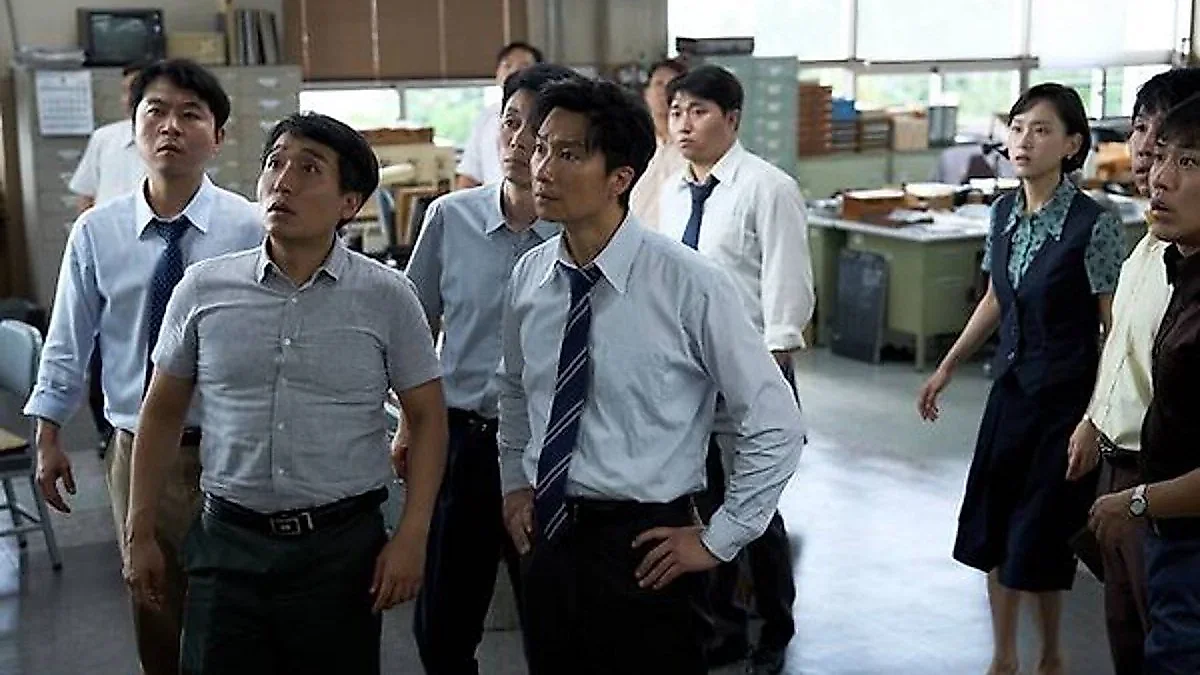
The film 'The Assassin(s)' is nearing its break-even point, steadily attracting audiences despite controversies over historical distortion and intense disputes within political circles. The cumulative number of viewers has exceeded 3.13 million, leaving approximately 170,000 viewers to reach the break-even point, which is known to be 3.3 million. As it enters its fourth week of release, attention is focused on whether it can surpass the break-even point this weekend. While the controversy surrounding the work does not easily subside, the box office performance is expected to serve as another turning point proving the film's economic success.
According to the Korean Box Office Information System of the Korean Film Council on the 17th, 'The Assassin(s)' recorded a cumulative audience of 3,139,218 as of the 16th. The break-even point estimated by the film industry is approximately 3.3 million. This figure was calculated based on a total production cost of 19 billion won—comprising 16 billion won in net production costs plus 3 billion won in marketing and promotion costs—while taking into account overseas sales and domestic secondary rights revenue. Since the number of viewers required to reach the break-even point is relatively small and the reservation ranking is being maintained, expectations are rising that the goal could be reached as early as this weekend.
Reservation indicators also show that the ability to mobilize audiences is still alive. As of 5 PM on the 16th, 'The Assassin(s)' ranked 3rd in real-time reservation rates. It recorded 3rd place in the overall ranking, following foreign films such as 'Chiikawa the Movie: The Secret of Mermaid Island' and 'The Odyssey', but it was the highest-ranking among Korean films. Although it is not the explosive box office trend seen during the early stages of release, it is encouraging that it is steadily securing audiences in a theater market where new releases are appearing one after another.
The reason why the crossing of this break-even point is receiving particular attention is due to the environment surrounding its box office success. 'The Assassin(s)' is a work dealing with the assassination of former President Park Chung-hee, and since its release, it has stood at the center of debate regarding the interpretation and representation of historical facts. As evaluations surrounding the film's content coincided with confrontations in political circles, it has been mentioned as a case that shows the historical perception and ideological conflict of Korean society beyond the work itself. This is the background of why the box office performance has come to hold more meaning than simple audience numbers.
Political disputes are also continuing. On the 13th, the Seoul Jongno Police Station summoned Lee Jong-bae, a former People Power Party Seoul City Council member who filed a complaint against the director, writer, and producer of 'The Assassin(s)' on charges of defamation by stating false facts, to investigate him in his capacity as the accuser. Subsequently, at the plenary meeting of the National Assembly Culture, Sports and Tourism Committee held on the 14th, the ruling and opposition parties clashed over whether to select film industry officials as witnesses for the parliamentary audit. As the debate over the film's historical interpretation has spread to matters involving the National Assembly and investigative agencies, interest has grown further. However, the fact that the accusation and investigation procedures are underway does not itself establish the validity of the charges or confirm the illegality of the film.
The situation surrounding lead actor Yoo Hae-jin also added weight to the controversy. Previously, some far-right groups held rallies and protests in front of Yoo Hae-jin's residence in Seongbuk-dong, Seoul. Ko Beom-seok, head of the Seoul Metropolitan Police Agency, stated during a parliamentary audit on the 15th that protective measures for Yoo Hae-jin's side had been lifted following their request. As the debate surrounding the work led to actions directed at the actor personally, questions were also raised about how to distinguish between criticism of historical interpretation and the safety of individuals and freedom of expression.
Foreign media also paid attention to the controversy surrounding 'The Assassin(s)'. The NYT reported that the film has reignited the 'culture war' between the progressive and conservative camps in Korea by bringing conflicting evaluations of former President Park Chung-hee back to the surface. It suggests that a single film does not merely reproduce past events but stimulates current political memories and values. The pattern in which audience reactions to the work and confrontations in political circles influence each other shows that the film remains a subject of social debate even after its release.
Nevertheless, the number of viewers has increased bit by bit. 'The Assassin(s)', which was released on September 23, exceeded 1 million viewers in 4 days, 2 million in 11 days, and 3 million in 20 days. It is also significant in that it was the fifth Korean film released this year to surpass 3 million viewers. The fact that it secured a consistent audience base while the intensity of the controversy increased suggests that interest in the work cannot be explained solely by political pros and cons.
The audience evaluations are also a point to note. While the Naver real-viewer rating once dropped to the 2-point range due to allegations of macro manipulation, as of the 16th, the rating recorded 8.9 out of 10. The Egg Index, a viewer satisfaction indicator from CGV, also reached 92%. However, it is difficult to conclude as an objective judgment of the entire film because online ratings can be influenced by the composition of participants, evaluation methods, and public opinion at a specific point in time. To grasp the flow of the box office more three-dimensionally, one must look at the number of viewers, reservation rates, and actual viewer evaluations together.
If 'The Assassin(s)', which has entered its fourth week of release, surpasses the break-even point, it can be recorded as a result of continuing theatrical success amidst controversy. However, reaching the break-even point does not mean a conclusion to the historical debate surrounding the work. The audience's choice, the film's economic performance, and the criticism and interpretation of historical representation need to be examined by different standards. Attention is focused on whether 'The Assassin(s)', which has exceeded 3.13 million cumulative viewers, can step onto the 3.3 million mark this weekend and move to the next stage of box office success.
Lee Chang-seok is the CEO and editor of Mediafine and writes for Mediafine Global, mainly covering K-Variety and also writing on K-pop, Celebrity and K-drama.



Comments 0
Comments are currently disabled.