Lee Hwi-hyang: Wearing diapers and white hair for dementia role
Actress Lee Hwi-hyang undergoes a radical transformation, using white hair and diapers to authentically portray a dementia patient in her new film.
Actress Lee Hwi-hyang has undertaken the most daring transformation of her 44-year acting career. She revealed her naturally snow-white hair and even wore diapers on set to experience the physical reality of a dementia patient. It was a choice she did not even disclose to the production crew. An actress who has long been known for her glamorous and intense villainous roles, she has let go of her appearance, her pride, and her familiar acting patterns to fully inhabit the life of a single character.
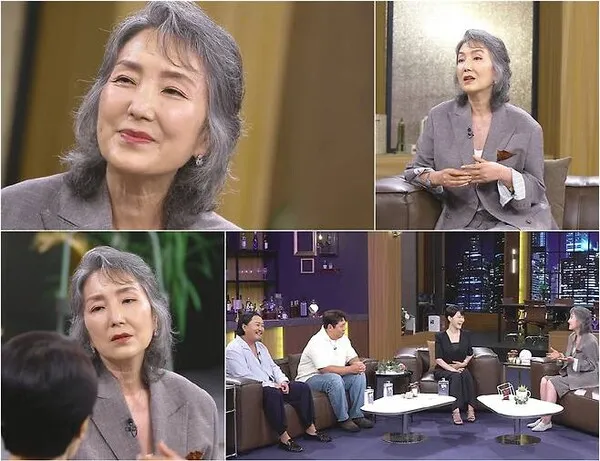
Appearing on episode 39 of MBN's 'Kim Ju-ha's Day and Night' airing on the 22nd, Lee will share behind-the-scenes stories from the film 'Family Trip'—her first leading role in a movie since her debut—and reflect on her journey as an actress.
'Family Trip' tells the story of a family that takes an impromptu trip to Busan to celebrate the birthday of Sun-im, a woman suffering from dementia. Lee plays the role of Sun-im, who gradually loses her memory.
The first thing that catches the eye in this work is Lee's appearance. Instead of the glamorous makeup and intense image she has established with the public, she reveals her pure white hair.
Lee revealed, "It is my natural hair color. I appear in the movie with this hair exactly as it is."
This is not merely makeup to express the appearance of old age. It is closer to a choice to strip away the very image that has been layered upon her throughout her long years as an actress.
Explaining her motivation for appearing on the show, Lee said, "I thought, if I can strip away everything that has been glamorously layered on me and act as the natural and primal Lee Hwi-hyang in a way that contributes to a work, then I'm okay even if this is my last one."
The 'glamorously layered things' she refers to do not just mean physical appearance. It is also related to the intense villainous image that has long followed her name.
Starting her acting career in the early 1980s, Lee has portrayed numerous characters while moving between television and the big screen for over 40 years. In particular, she built a unique presence by intensely portraying characters who express desire, jealousy, and anger without hesitation in Korean dramas with clear good and evil dynamics.
However, for an actor, a specific image can be a symbol of success and a shackle at the same time. This is because a character that is strongly imprinted once can repeatedly influence the casting choices of production teams as it is familiar to the public. Lee also confessed that while she built her reputation as an actress by playing villains for a long time, she experienced significant mental and physical exhaustion in the process.
In this work, Lee was not satisfied with simply expressing the character as the external image of an 'elderly person with dementia.'
To understand the life of an actual dementia patient, she stayed in Busan for a month. She visited dementia nursing homes and even attended singing classes attended by dementia patients. Moving beyond mere observation, she experienced their daily lives and rhythms firsthand to find the character's body language and emotional nuances.
And in that process, she made a choice she did not tell anyone.
Lee confessed, "I wore diapers while filming. Even the filming crew didn't know."
She brought the urinary issues and physical discomfort that can occur in dementia patients into her acting. In that she tried to implement even the parts that might not be directly shown on camera to be close to reality, this goes beyond the level of simple makeup or method acting.
For an actor, the body is the most direct tool for acting. Not only expressions and voice, but also gait, posture, breathing, gaze, and hand movements become elements that constitute a character. Lee's choice is closer to an approach of understanding the life of a dementia patient through her own body rather than imitating it from the outside.
In particular, the disease of dementia touches upon the fundamental realms of human existence: memory and identity. Even when a human being can no longer remember who they are, that person's life and dignity do not disappear. If 'Family Trip' does not remain a simple family movie, it is highly likely that this question lies at its center.
This is also why Lee let go of her image. Only by shedding the glamorous outer shell of an actress could the vulnerability and ordinariness of the character Sun-im be revealed.
However, Lee's current challenge does not end simply with taking on a new role. She confessed that she once considered quitting acting altogether.
According to Lee, her skepticism toward acting deepened about 5 to 6 years ago. In particular, she said she felt a significant mental and physical burden from playing continuous villainous roles.
"Since I kept playing villains one after another, it was very hard both mentally and physically," she said, expressing the struggles of a veteran actress who had to consume her inner self to perform.
Villain roles require significant energy because of their high emotional intensity. Even if it is not the actor's actual feeling, they must continuously generate anger, hatred, and hostility. Lee said, "It was so hard because I had to constantly create anger from within me.""
The public enjoys the intensity of villains on screen, but they rarely see the psychological cost the actor must bear in the process. For Lee, who has long been praised as an actress who excels at playing villains, that image eventually became a weight that limited her acting world.
Nevertheless, the reason she ultimately chose to continue acting was unexpectedly simple.
While discussing with fellow actors about when they were happiest in life, Lee looked back on her own moments of joy. The answer was clear: it was when she was acting.
She said, "I realized that I am happiest when I am acting. The euphoria that comes from channeling emotions I hadn't thought of is incomparable.""
For an actor, acting is both a livelihood and a way to confirm one's self. By acting out the lives of others, they discover their own emotions and expand their existence by passing through human interiors they might not experience in reality.
For Lee, acting was ultimately something she could not give up. Though exhausted by repeating villainous roles, that fatigue was not a rejection of acting itself. Rather, the euphoria of discovering new emotions through certain roles brought her back to the stage.
So, she finally reached the conclusion: "I must be an actress."
'Family Trip' could serve as a new starting point for Lee. A long 44-year career brings fame and experience, but it also creates a familiar image. In this work, Lee has dismantled that familiarity herself.
She did not hide her white hair, she experienced the life of a dementia patient firsthand, and she endured physical discomforts that might not even appear on screen. Most importantly, she set aside her past image as a 'specialist villain' to fully observe the life of an elderly woman losing her memory.
While the idea that an actor's range should widen as they age is common, it is never easy to actually abandon one's representative image. Lee's transformation is meaningful precisely because of that.
The first thing a 44-year veteran actor did was not to create a more intense persona, but rather to strip away everything that had been layered upon her.
And in doing so, Lee became an actress once again—not as a glamorous villain or an intense star, but as a human being wavering between memory and life.
Attention is now focused on whether 'Family Trip,' which she began with the mindset that 'it's okay even if this is my last one,' will be recorded as another turning point in Lee's acting career.
Related articles