Demands to 'Fire' PD Kim Hyeon-ji Surge After She Criticized RESCENE's WONI's Use of Gyeongsang-do Dialect
A controversy is erupting over RESCENE's WONI's use of regional dialect, leading to intense debate between PD Kim Hyeon-ji and netizens.
The controversy surrounding the Gyeongsang-do dialect expression used by WONI, a member of the group RESCENE, is spreading through the broadcasting industry and online spaces. The dispute began when a PD from MBC Gyeongnam pointed out that the expression is associated with specific online communities, but counterarguments have since emerged stating that the expression is also used as a regional dialect, leading to an ongoing battle over the context and interpretation of the phrasing.
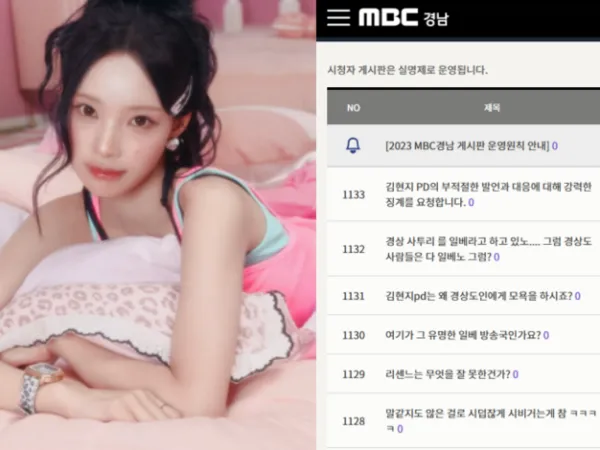
As of the 6th, protest posts regarding PD Kim Hyeon-ji's remarks have been flooding the viewer bulletin board of the official MBC Gyeongnam website. Some viewers are demanding official explanations and measures, expressing opinions such as, "It is inappropriate to conclude that a regional dialect is the expression of a specific group," and "Isn't this placing an unnecessary stigma on local residents who use the Gyeongsang-do dialect?"
The controversy began with a YouTube video of RESCENE member WONI released on the 28th of last month. WONI, who is from Geoje, Gyeongnam, used the phrase, "It's scary. Even the lighting is scary (Museopno)" during filming. Subsequently, claims were made in some online communities that the expression is similar to how the late former President Roh Moo-hyun is disparaged in the far-right online community Ilgan Best Storage.
However, counterarguments were equally strong. Some netizens argued that the suffix "-no" is a dialect actually used in the Gyeongsang-do region, and that attributing political meaning to the expression itself without specific circumstances or intent is an excessive interpretation.
PD Kim Hyeon-ji later expressed her awareness of the issue regarding the use of the expression through her SNS. She stated that she felt concern after witnessing a female idol and the production team naturally exchanging "-no" expressions, mentioning that there are cases where certain expressions are consumed with hateful meanings online. She further argued that it is not merely a matter of speech style, but a matter of the attitude used when expressing oneself.
However, the controversy entered a new phase as instances where Gyeongsang-do dialect expressions were used as subtitles in MBC Gyeongnam programs that PD Kim had participated in previously came back into focus. When it was revealed that regional dialect expressions such as "Mworahano" (What are you saying?) and "Eodigano" (Where are you going?) were used in past broadcasts, some netizens pointed out, "Isn't it contradictory to define expressions that were used as regional language in the past as hate speech now?"
As the controversy spread, PD Kim switched her SNS account to private.
Opinions also diverged within political circles regarding the matter. Former leader of the Rebuilding Korea Party Cho Kuk expressed the view that the "-no" expression used in certain contexts has been used as hate speech, suggesting that the youth need to recognize the social meaning of such expressions.
On the other hand, leader Lee Jun-seok criticized the act of attributing political meaning to a young person from Gyeongsang-do using their hometown dialect as excessive stigmatization. He emphasized that in the Southeast dialect, "-no" is used not only for interrogative forms but also in various situations such as exclamations or monologues.
This controversy is expanding beyond a simple debate over speech style into an issue surrounding the boundary between regional dialects and modified expressions in online communities, and how specific expressions are interpreted within a social context.
Experts point out that even with the same expression, the meaning can change depending on the user's place of origin, intention of speech, and conversational situation, noting that the context of use and social perception must be examined alongside the language itself.
Related articles