Sim Soo Bong apologizes for remarks targeting Kim Da-hyun
Veteran singer Sim Soo Bong issues an apology after controversial remarks made toward 17-year-old singer Kim Da-hyun at a trot festival.
Singer Sim Soo Bong has found herself embroiled in controversy following public remarks regarding junior singer Kim Da-hyun, prompting her side to explain the situation. It is reported that Sim was surprised upon learning her comments had become a controversy, stating, "I didn't realize I spoke like that." However, as it was revealed that Kim was deeply hurt enough to burst into tears while traveling, the impact of the expressions used on the public stage was significant, regardless of the veteran singer's intentions.
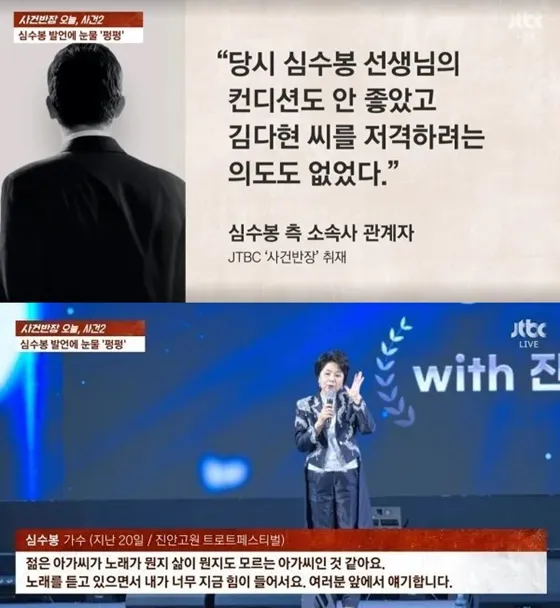
On the 21st, the JTBC program 'Scandal Supervisor' presented the positions of both sides regarding Sim's remarks during the 'Jinan Highland Trot Festival' held in Jinan, North Jeolla Province. The core of the controversy lies in Sim expressing strong displeasure toward Kim, who performed before her, by mentioning music and life experiences.
At the time, Sim specifically targeted Kim using expressions such as "that woman" and "young lady," making remarks to the effect of "she made my head dizzy" and "singing is not something you do so carelessly." She even added, "It is not easy to experience life, go through hardships, and perform music that consoles those who come to see you." Although these were impromptu remarks made at the venue, the controversy grew rapidly as videos and the atmosphere of the scene spread online.
The explanation from Sim's side focused on the fact that the remarks were not an intentional criticism aimed at a specific junior singer. It was stated that Sim was not precisely aware that Kim was the one performing immediately before her, and that she held no personal ill will. The explanation provided was that while she was not feeling well, dance music that did not align with her musical style continued to play, and in the process of discussing her usual thoughts on 'Young Trot,' her expressions became excessively harsh.
However, the intention of the remarks and the resulting impact were separate issues. The impact grew even larger as it became known that the subject was a young singer who is only 17 years old. This is because a veteran singer who has been active in the South Korean popular music scene for a long time explaining her musical standards can be perceived very differently by the public than publicly evaluating a specific junior's stage.
The situation reported by Kim's side shows that the controversy did not end as a simple online argument. Kim's father, Kim Bong-gon, told STARNEWS that while Kim was monitoring her performance while traveling after the event, she discovered Sim's remarks. Kim stated that although his daughter initially tried to endure it, she eventually burst into tears, appearing to be significantly wounded.
Sim was also reported to have been bewildered after confirming how her remarks were delivered. The reaction, "I didn't realize I spoke like that," shows a significant gap between her emotions at the time of the remark and the actual language conveyed to the public. Although they were words spoken momentarily on stage, as they were recorded in video, every context, expression, and single word was delivered directly to the public, resulting in an impact that expanded beyond what was expected at the scene.
Ultimately, Sim admitted her mistake through an official apology. She explained the situation, noting she was under considerable stress due to the noise at the venue, saying, "On the 20th, I literally made a slip of the tongue on a trot festival stage in the provinces while many people were watching." She added, "I have nothing to say, even if I had ten mouths, regarding the fact that I uttered words that went beyond common sense at an inappropriate moment during a trot festival where everyone should be laughing and enjoying themselves."
In particular, while Sim explained that she did not know exactly who the preceding singer was and did not intend to embarrass a specific person, she admitted it was her fault that she ultimately hurt the junior singer's feelings. In essence, she accepted responsibility by distinguishing between intention and result.
This incident also touches upon the reality of the trot industry undergoing a rapid generational shift. Veteran singers like Sim, who have served as a pillar of South Korean popular music for a long time, and young trot singers who emerged through audition programs, show significant differences in both their methods of activity and stage grammar. In particular, the younger generation's trot does not stay within traditional singing styles and emotions but actively expands the genre's boundaries by combining dance, performance, and variety shows.
In this process, conflicts in musical tastes or evaluation standards between generations can naturally occur. The problem lies in how these differences are expressed. When criticism or advice regarding music is perceived as a public evaluation of an individual—especially when the subject is a young junior with little experience—the social weight of the remarks becomes much heavier.
Sim's apology ultimately addressed this point. While explaining that she did not intentionally attack a specific person, she did not deny the responsibility for making remarks that could hurt a junior in a public setting. Kim also revealed that after speaking directly with Sim, she received an apology, encouragement, and comfort, bringing the conflict between the two parties toward a resolution.
However, the tears Kim shed behind the scenes show why this incident cannot be dismissed as a mere "slip of the tongue." A single comment on stage can leave a lasting wound for the person involved, and for entertainers whose names and music are mentioned in front of the public, a public evaluation carries a much larger impact than private emotions.
Ultimately, the core of this controversy lies not only in Sim's intentions. It also raises questions about how different musical perspectives can be reconciled in a trot industry where veterans and rookies, tradition and change, coexist, and how criticism and advice between seniors and juniors should be communicated.
 Up next
Sim Soo Bong apologizes to Kim Da-hyun, offers to gift her a song
More on Kim Da-hyun