Sim Soo Bong vs. Kim Da-hyun: The Debate Over Trot's Essence
A performance by Kim Da-hyun sparks a heated debate on the dignity of Trot following veteran singer Sim Soo Bong's public criticism.
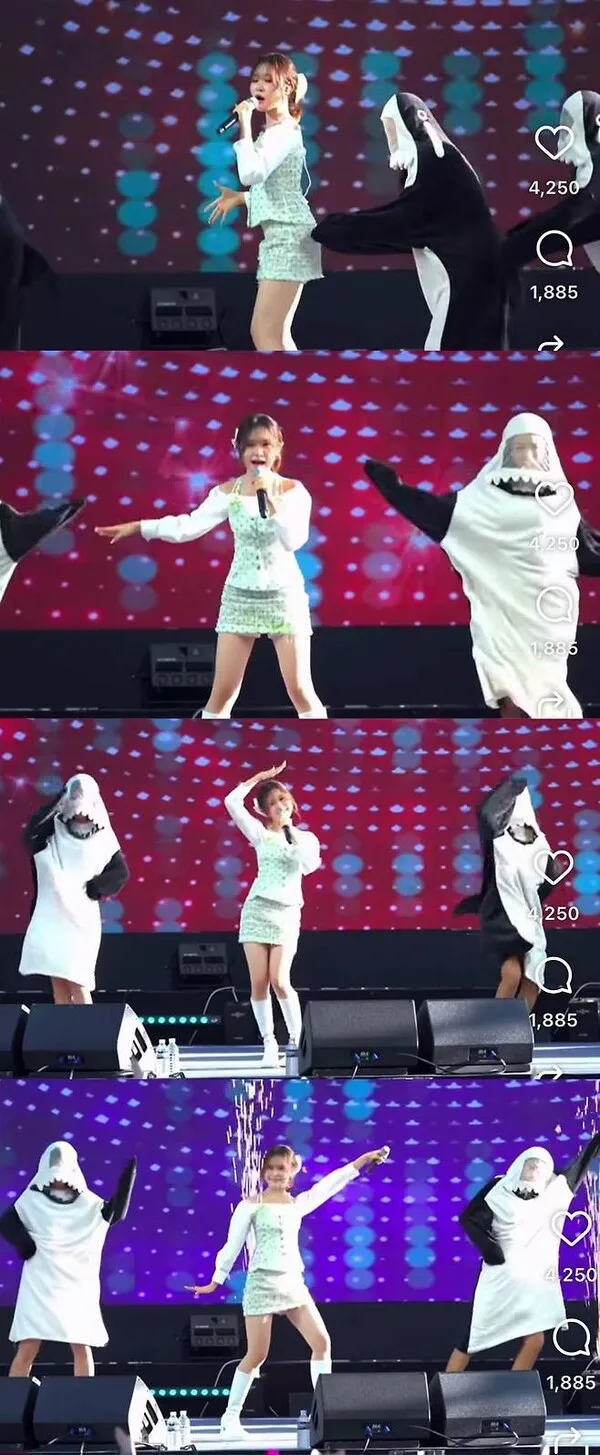
The landscape of the controversy shifted as new footage emerged. The debate triggered by veteran singer Sim Soo Bong's public criticism of her 17-year-old junior, Kim Da-hyun, seemed to be settling through apologies and reconciliation. However, as video of Kim's actual performance spread online, public opinion has split once again. While the initial narrative framed it as a veteran singer shaming a junior 55 years her junior, the release of the stage video has gained momentum among those arguing, "It is understandable why Sim Soo Bong reacted that way.'
Ultimately, this incident has transcended a simple emotional clash between two singers. It raises deeper questions regarding the essence of Trot, the permissible range of stage expression, and the responsibility of the broadcasting and management systems that transform young singers into cultural commodities.
The controversy began at the 10th Jinan Plateau Trot Festival held in Jinan County, Jeonbuk State, on the 20th. Before Sim Soo Bong took the stage, Kim Da-hyun performed songs including "I'm the Lottery Jackpot," "Flower Maiden," and "Praise Whale." During the "Praise Whale" stage, she performed with dancers dressed as sharks, using choreography reminiscent of the children's song "Baby Shark's Big Show!"
Watching Kim's stage, Sim Soo Bong unleashed intense remarks during her own turn to perform. Asking if her manager was present, she remarked, "It made my head spin," adding, "It seems this young lady does not know what singing is or what life is." She directly targeted the performance, stating, "Please do not send that performer in front of me again," and "Singing is not something you do so carelessly. Music that consoles the audience is not that easy.'
Based solely on her immediate remarks, Sim Soo Bong's attitude was undeniably harsh. Directly calling out a specific junior in front of an audience and devaluing her performance was bound to cause waves, given the hierarchical nature of the senior-junior relationship in the industry.
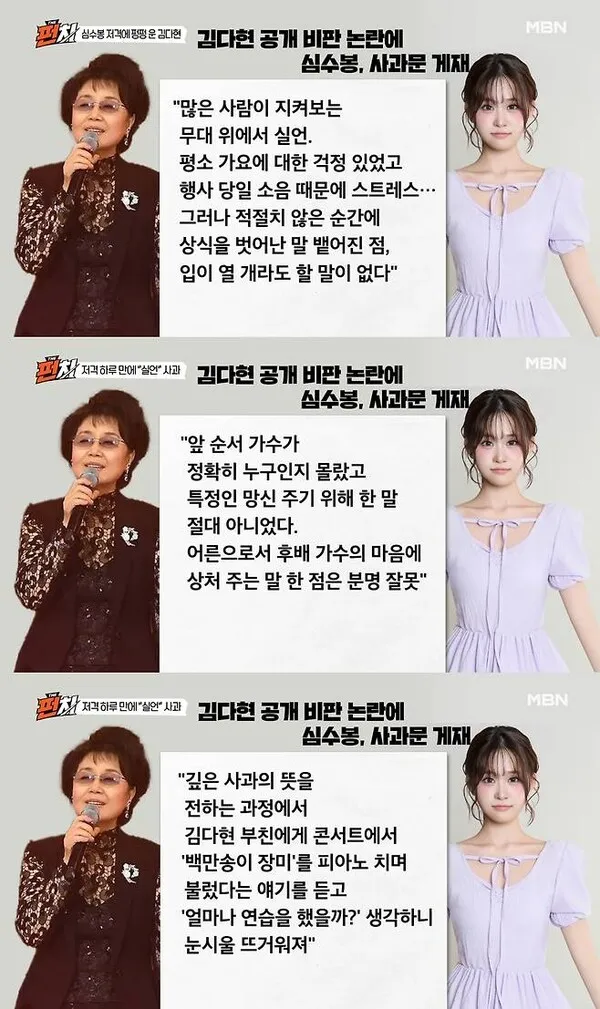
Sim Soo Bong later issued an official apology, explaining she did not know exactly who the preceding singer was and had no intention of shaming a specific person. She admitted it was wrong as an adult to say words that would hurt a junior's feelings. Kim Da-hyun also confirmed she spoke directly with Sim and received both an apology and comfort.
On the surface, the conflict has been resolved.
However, cultural debates do not end with simple reconciliation. When new context emerges, public interpretation shifts. This time, it was the video of Kim's stage.
Upon seeing the video, some netizens expressed strong rejection toward Kim's performance. Reactions included, "Seeing the video, I understand why Sim Soo Bong acted that way," "From Sim's perspective, it might have looked like a mockery of Trot," and "The performance and technique precede the singing." Some expressed sympathy with Sim's remarks, citing the noise and excessive choreography as problematic.
It is difficult to definitively call this a "reversal of public opinion." Online sentiment moves quickly based on how clips are edited, and a single short video can leave a stronger impression than the full context of a performance. Whether one favors Kim's stage often comes down to individual taste and generational sensibilities.
Nevertheless, this video is significant because it adds visual context to Sim Soo Bong's remarks, which sat at the center of the debate.
This is a crucial distinction in cultural criticism. When judging the intent behind a statement, people look at the scene that prompted it. It is a different matter whether Sim simply disparaged a young singer's ability, or whether she was agitated by a performance that deviated significantly from the aesthetic standards of Trot she upholds.
However, a further distinction must be made.
Whether Kim's stage failed to meet Sim's aesthetic standards and whether Sim's method of public criticism was appropriate are two separate issues.
When these are tied together, the debate turns into a factional fight. Criticizing Kim's stage is often misinterpreted as justifying Sim's behavior, while questioning Sim's reprimand is seen as defending the performance itself.
Yet, artistic evaluation is more complex.
Kim's performance may be a vibrant spectacle to some, but to others, it may be an excessive production that dilutes the genre's essence. A young singer blending Trot with children's song elements can be viewed as an experiment, or as a violation of the genre's identity for those who value its traditional narrative power.
The most interesting artistic conflicts occur at this intersection: between a genre that "sings of life" and one that "sells entertainment.'
For Sim's generation, Trot carries historical weight. The emotional landscape of Korean modern history—including the Korean War, industrialization, and displacement—has long served as the soil for the genre. The "Han" (sorrow) and "Heung" (excitement) of Trot are not mere decorations but are intertwined with the collective Korean psyche.
For Sim, singing is not just a combination of sounds; it is a medium to interpret life. In a previous broadcast with Son Tae-jin, she noted that to write good lyrics, one must experience hardship, citing her own family history and losses as the source of her songwriting.
Thus, Sim's discomfort cannot be dismissed as simple generational conflict. It stems from a deep-seated aesthetic belief regarding the purpose of the stage.
Conversely, modern Trot is produced in a different cultural environment. Many stars are born through audition programs at a young age, where musicality is often weighed alongside variety-show character, trendiness, and viral potential.
In this era, Trot has become both a "song of life" and "mass entertainment.'
As the genre connects through TV, YouTube, and short-form content, the requirements for singers have changed. It is no longer enough to sing well; one must engage the audience, capture attention, and create moments that are easily reproducible in short clips.
Kim's performance can be seen as a product of this shift. Labeling it merely as a "clueless young singer" is too simplistic; it is an example of how young Trot artists are reconfiguring their stages for modern entertainment.
However, this raises another question: what are we demanding of young artists?
- The desires of adults hidden behind the label "Trot Prodigy'
Kim Da-hyun rose to fame as a "Trot prodigy." While this acknowledges her talent, it also turns her age into a commodity. The industry consumes the growth narrative of young stars, often treating them as "finished products" before they have even had the chance to develop as individuals.
Some netizens interpreted Sim's remarks as a critique of the adults surrounding Kim, rather than the girl herself. This highlights the need to examine an industry structure that demands adult-level perfection while simultaneously consuming the "cuteness" of youth.
While this perspective is valid, we must also be careful. We should not automatically dismiss Kim's stage as immature simply because she is young, nor should we shield her from all criticism solely because of her age.
Young artists do not need unconditional praise or public shaming; they need an environment that allows for growth.
- Artistic progress begins with "why," not with "that's wrong"
Some of the concerns raised by Sim Soo Bong are worth considering. The industry must continue to discuss how much performance should support or overshadow music, and where the line lies between genre identity and modern variation.
However, the moment such questions are demanded through public reprimand, artistic criticism risks becoming an exercise in authority.
Furthermore, the premise that one must "experience life to sing well" is not an absolute truth. Art's greatest power lies in the imagination—the ability to transcend one's own experience to reach the lives of others. A lack of life experience is not a disqualification for an artist; what matters is how sincerely they interpret the lyrics and how persuasively they present them on stage.
 Up next
Sim Soo Bong: Harsh on Kim Da-hyun, but gifts original song to Song Ga-in
More on Kim Da-hyun