
Broadcaster Lee Hye-sung denies advocating for pro-Japanese activities
Broadcaster Lee Hye-sung has issued a clarification regarding controversial remarks about historical responsibility made during a book review video on her YouTube channel, stating she never advocated for pro-Japanese actions or suggested descendants must atone for their ancestors' sins.

Broadcaster Lee Hye-sung issued a statement on the 21st to clarify that her recent book review video on the 'Lee Hye-sung's 1% Book Club' YouTube channel was misinterpreted. She denied advocating for pro-Japanese activities or claiming descendants must atone for ancestral sins, explaining that the controversial remarks were philosophical questions from Michael Sandel's book.
Broadcaster Lee Hye-sung has issued a follow-up statement regarding controversy surrounding remarks on historical responsibility made in a book review video on her YouTube channel. She explained that certain sentences quoted while introducing the book's content were misinterpreted as her own personal opinions. Lee drew a line, stating she has never advocated for pro-Japanese activities or expressed the opinion that descendants must atone for the sins of their ancestors, and requested that viewers check the full context of the video.
On the 21st, Lee posted a lengthy message on her social media, stating, "I want to correct the fact that the contents of my recent video are being conveyed differently from my intentions." She addressed the part of the video where she said, "None of us can be free from historical responsibility, and we must live with that responsibility," explaining that she meant one cannot ignore the wrongdoings of ancestors even if they were not committed by oneself.
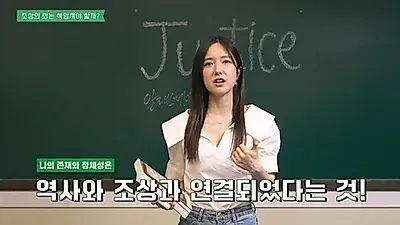
The controversy stemmed from a book review video released on the YouTube channel 'Lee Hye-sung's 1% Book Club' on the 20th. Titled "The justice we believed was right might be wrong | Justice: What's the Right Thing to Do?", the video used Michael Sandel's book 'Justice: What's the Right Thing to Do?' to cover issues such as the responsibility of descendants for the wrongdoings of ancestors and whether a nation should apologize for past wrongs. The remarks gained heightened attention as they evoked recent controversies regarding the pro-Japanese activities of the great-grandfather of actress Oh Ha-young.
In the video, Lee introduced topics including the reparations for the Holocaust in Germany, apologies for past history in Japan, and the debate over reparations for slavery in the United States. Specifically, after outlining the logic opposing reparations for slavery in the United States, she used the communitarian perspective of philosopher Alasdair MacIntyre to question whether an individual can be completely separated from the history and traditions of the community to which they belong. She was introducing a philosophical discussion on how individual identity is influenced by history and traditions that existed before one's birth.
She explained, "Whether we like it or not, we are born carrying everything our ancestors did," adding, "We cannot selectively inherit historical consciousness by taking only the proud parts of our history and cutting out the unpleasant parts." She also noted that MacIntyre used the expression "moral shallowness" to describe the attitude of treating past wrongs as matters unrelated to the present. The segment dealt with the philosophical problem of how to remember and accept a community's history, separate from the legal responsibility for ancestral actions.
However, controversy arose when parts of the video were stripped of context and accepted as Lee's own assertions. In particular, as questions about why descendants should atone for ancestral sins appeared alongside explanations emphasizing historical responsibility, interpretations of her stance varied. Lee previously stated, "I did not make a personal opinionated remark," and shared the relevant pages of the book, requesting through YouTube comments that viewers watch the entire video.
In this additional clarification, Lee provided a more specific reason for introducing MacIntyre's views. "The attitude of saying, 'It happened before I was born, so it has nothing to do with me,' is described as 'moral shallowness,'" she said, adding, "I introduced it in the video because I deeply empathized with this perspective." Her intention was not to argue that past wrongs must unconditionally be transferred to descendants, but rather to address how individuals should accept the historical responsibilities of a community.
She further emphasized, "I have never advocated for pro-Japanese activities, nor have I ever expressed the opinion that 'we must atone for the sins of our ancestors.'" She added, "The sentences read in the video were questions posed by the book, and I also introduced counterarguments to them. I am correcting the part where those specific sentences were taken out and conveyed as my personal opinion." She explained that introducing a book's controversial arguments is distinct from supporting those arguments as one's own position.
This controversy demonstrates the importance of context and the boundaries of quotation when dealing with sensitive subjects like historical responsibility. How past wrongs are linked to individuals today is a complex issue that must be discussed by distinguishing historical memory, moral responsibility, and legal responsibility. Given that concluding a speaker's position based on specific sentences can alter the original intent of the discussion, it is necessary to examine the full context.
Oh Ha-young released an apology and suspended her activities after the pro-Japanese activities of her great-grandfather, Ahn Sang-ho, became known. Lee Hye-sung's book review video was perceived more sensitively because it dealt with historical responsibility and the role of descendants amidst this ongoing controversy. As Lee issues further clarifications, attention is focused on whether the focus of the debate will shift from the interpretation of certain remarks to the perspective on historical responsibility itself.
Lee Chang-seok is the CEO and editor of Mediafine and writes for Mediafine Global, mainly covering K-Variety and also writing on K-pop, Celebrity and K-drama.
Comments 0
Comments are currently disabled.