Hwang Seok-jeong reveals why she reconciled with her 'witch' mother after 40 years
Actress Hwang Seok-jeong shares how her professional perspective as an actress helped her understand her mother after decades of estrangement.
Actress Hwang Seok-jeong, a graduate of Seoul National University, opened up about the lifelong conflict with her mother, a nearly 40-year estrangement, and the process of reconciliation that began when she started viewing her mother as a distinct 'individual' through her lens as an actress. Their story, which transcends simple family conflict, serves as a poignant example of how war, poverty, and thwarted ambitions are projected onto the next generation.
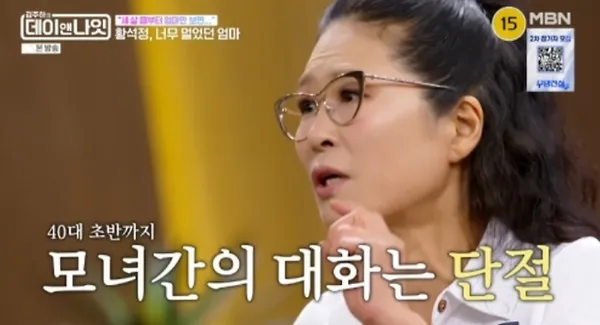
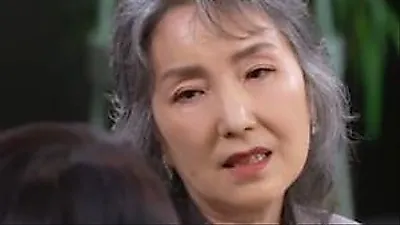
Appearing on MBN's 'Kim Ju-ha's Day and Night' on the 29th, Hwang confessed her extreme aversion to her mother during her childhood, stating, "I didn't speak a single word to my mother until my early 40s." She added, "I hated her so much. Just being near her made my blood boil. I wanted my mother to be like a mother, but she was like a witch."
To her, her mother was less of a 'mom' in the traditional sense of nurturing her children and more of a figure who constantly demanded things. Despite the family not being financially well-off, her mother insisted on intensive music education for her children.
Hwang recalled, "We couldn't even pay the monthly rent or afford food, yet there was a piano in the house. Her obsession with making her children study music was immense." Ultimately, all three siblings majored in music: her younger brother in piano, her older brother in music theory, and Hwang herself in traditional Korean music.
This educational fervor was rooted in her mother's own frustrated life. According to Hwang, her mother had excellent academic standing and a deep passion for music, but due to poverty and family opposition, she was unable to pursue the education she desired.
It is said that fearing her family would block her from attending university, her mother left home during her high school years to find a former teacher and enroll in college on her own. While attending a girls' high school, she even earned a full scholarship to study in the United States—an opportunity awarded only once every four years—but was forced to give it up due to her family's opposition.
The experience of having her own talents and desires thwarted manifested in the opposite way in her children. She hoped her children would achieve the musical dreams she could not realize, and in that process, education functioned as both an expression of love and a tool of control.
Her father, the other pillar of the family, also led a turbulent life. Hwang explained that her father had served as a child soldier in the North Korean People's Army before descending to the Republic of Korea, and possessed innate musical talent. Although he never formally trained as a singer, he was a high tenor who performed in a military band.
However, her father squandered his wages on alcohol and gambling, leaving the resulting economic and emotional instability to be borne by the mother and her children. Hwang revealed that she gradually distanced herself from her mother within this environment.
In family psychology, the phenomenon where parents project their own unmet needs or frustrations onto their children is often explained as 'intergenerational transmission.' While a parent's deficiencies are not necessarily inherited, their anxieties, expectations, and control methods can influence a child's emotional development through repeated patterns.
The most striking part of Hwang's confession is that the catalyst for resolving the long-standing conflict was not 'reconciliation as a family,' but rather her professional perspective as an actress.
After her mother underwent spinal surgery and requested help with medical expenses, Hwang began living with her again and started looking at her mother through a different lens. She said, "When actors deal with a person, they approach them as a character living in a specific historical context, rather than simply looking at them as 'Mom.'"
She began to analyze her mother's life as a narrative. In doing so, behind the 'mother' who had caused her pain, she began to see a woman of a certain era who had endured war and poverty, had been unloved, and had been unable to fully realize her talents and dreams.
Hwang said, "I saw a girl from that era who was truly smart and had dreams, but went through war and could not achieve what she wanted because she was not loved."
This shift in perspective demonstrates the true meaning of 'understanding' in human relationships. Understanding does not mean justifying every action; rather, it is the process of looking past a person's role as a fixed victim or perpetrator to see the era and environment that shaped them.
For an actress, character analysis is not about judging actions as good or evil, but about tracing why a person acts, what they desire, what they fear, and what historical conditions created them. Hwang applied this professional methodology to her mother, allowing her to view decades of emotional fractures through a new lens.
"My mother said, 'A miracle happened to us,'" Hwang shared. "It was a miracle that should never have been possible." She added, "All the resentment toward her has dissolved, and now we are like friends."
Hwang began her career on the theater stage in the late 1990s before expanding into film and television. She has become well-known for her ability to portray strong, unique characters, and her background in traditional Korean music at Seoul National University has also drawn public interest.
In her life, music was a symbol of her mother's control during her childhood, but it eventually became the foundation for her professional craft. Ironically, the very family environment and musical upbringing that drove her away from her mother ultimately provided the tools to observe and interpret human nature, creating the path to finally understanding her.
The 40-year estrangement between mother and daughter did not end with a judgment of who was right. By re-reading her mother's life as a narrative, Hwang reconstructed her past wounds into something new. Her story serves as a reminder that while family can cause the deepest wounds, it is also the relationship that allows us to see a person in their most complex and three-dimensional light.
Related articles