See You at Work Tomorrow! Hits No. 1 with Narrative of Modern Worker Alienation and Salvation
tvN's new drama 'See You at Work Tomorrow!' claims the top spot with a 6.0% viewership rating, exploring the hyper-realistic struggles of modern office life.
'See You at Work Tomorrow!', the new tvN Monday-Tuesday drama, took the top spot in its time slot during its premiere, recording a peak viewership rating of 6.0% in the metropolitan area (according to Nielsen Korea). This numerical achievement suggests that the success is not merely a result of stimulating public interest, but rather that it accurately pierced the desire for 'reality representation' that modern viewers seek to consume through media.

The narrative of the protagonist Cha Ji-yoon (played by Park Ji-hyun) presents a typical example of an emotional laborer and a subject subordinated to bureaucracy living in a late-capitalist society.
Equivalence of Heartbreak and Commuting: Despite experiencing extreme loss in the private sphere (a ghosting breakup) and emotional exhaustion in the public sphere (dealing with difficult customers), the subject ultimately chooses the 'commute.' This moment exposes how the capitalist system forces the continuity of labor over an individual's existential sorrow.
Mise-en-scène and Visual Symbols: The 'Chimaek' (chicken and beer) consumed after work functions not just as food and drink, but as a minimal reward symbol to replenish the emotional energy depleted during the day and as a device to visualize the loneliness of the modern worker.
Gang Si-u (played by Seo In-guk) appears as a typical 'technocrat' figure representing efficiency and meritocracy. He demonstrates a thorough principle-based worldview. However, the warmth hidden beneath his cynical exterior (such as finding an idea notebook or lines acknowledging the subject's labor value) implies that this character is not merely a henchman of the system, but a multi-layered individual who mediates the 'restoration of humanity' within the system.
The narrative turning point of this work occurs where relationships in the public sphere (Office) combine with private narratives (the sharing of past divorce facts and loss).
Violation of Taboos and Subversion of Relationships: The power dynamic between a supervisor and a subordinate is dismantled as it moves to the informal space of a 'drinking session.' Cha Ji-yoon's remark that "dating and going to work are the same" is a point that keenly captures the fatigue of human relationships experienced by modern people.
Linguistic Tension and Subversive Ending: The moment in the latter half of the drama where Cha Ji-yoon responds to Gang Si-u's proposal, "Let's meet again," with "Do you want to have another drink at my place?" shows a reversal of agency. The moment the female character, who remained a passive object, takes control of the relationship, the narrative acquires rapid romantic tension.
'See You at Work Tomorrow!' is a text that cleverly layers the most classic 'office romanticism' onto the 'hyper-realism' of bleak workplace life.
Actor Seo In-guk's restrained internal acting and Park Ji-hyun's realistic emotional lines organically bridge the gap between these two opposing worldviews. Ultimately, this drama emphasizes that the force that allows modern people to continue 'commuting tomorrow' lies not in obedience to the system, but in the human connection and solidarity (romance) that blooms in the cracks of that system. Attention is focused on whether this salvation narrative will continue to derive sociological implications beyond genre clichés.
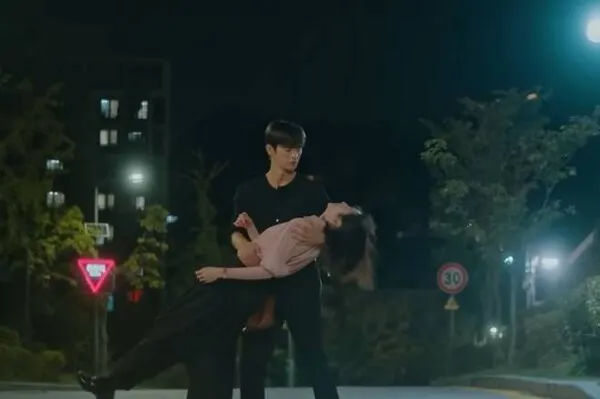
 Up next
Park Ji-hyun finds closure in Shanghai after family business failure
More on Park Ji-hyun