Chungha, Nam Yu-jeong caught in musical etiquette controversy
Speculation surrounds Chungha and Nam Yu-jeong regarding alleged disruptive behavior during a musical performance, though no evidence has been provided.
Singer Chungha and actress Nam Yu-jeong have had their names mentioned in a controversy regarding so-called 'audience disturbance' (gwan-keu), which refers to behavior that disrupts the immersion of other audience members during a performance. However, the posts currently spreading online are merely reports containing the claims of a specific spectator, and it has not been confirmed what actions the two individuals actually took at the venue. The parties involved have not released any statements to date.
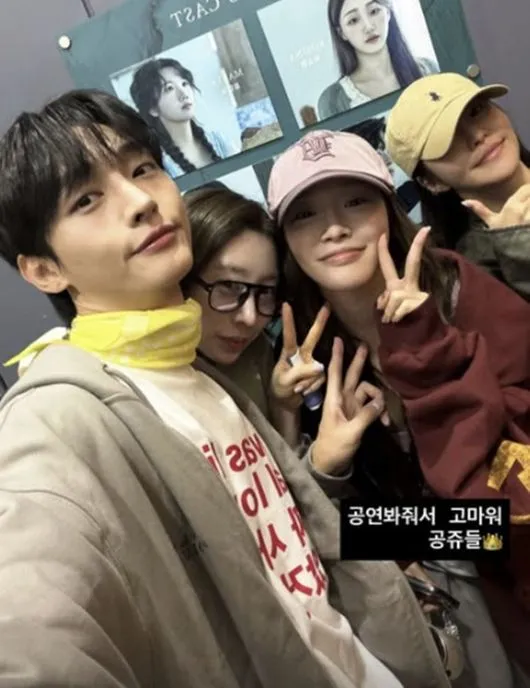
Recently, posts criticizing the viewing etiquette of spectators at the musical "Portrait of a Boy" have been spreading across social media and online communities. The performance features singer Yoon Ji-sung, and the author of the post claimed to have witnessed Chungha, Nam Yu-jeong, and others at the venue.
The author claimed that during the performance, one member of the group turned on their mobile phone and repeatedly checked the time, while another member repeatedly lifted and lowered their legs onto the chair. Expressing displeasure, the author wrote, "Even if they are celebrities, shouldn't they maintain basic etiquette? Please do not engage in audience disturbance.""
As the post was rapidly shared online, some users began speculating that the spectators identified by the author might be Chungha and Nam Yu-jeong. However, the post itself does not present specific videos or photos to prove that the two individuals committed the actions in question.
It is confirmed that Yoon Ji-sung recently shared photos taken with Chungha, Nam Yu-jeong, and others who attended his performance. Along with the photos, Yoon left a message saying, "Thanks for watching the show, princesses.'
Because of this, speculation that the spectators mentioned in the post are the same individuals has spread online. However, this in itself cannot serve as direct evidence that the two actually engaged in the problematic behavior. The fact that they watched the performance and the claim that they performed specific actions are separate issues. Based on the information released so far, it is not even clearly confirmed who used the mobile phone or who placed their legs on the chair.
'Gwan-keu' is a slang term short for 'audience critical,' referring to behaviors that disturb the viewing experience of other audience members in movie theaters or performance venues. Representative disruptive behaviors include mobile phone ringtones or calls, talking during a performance, excessive movement, kicking the seat in front, and taking photos or videos. Due to the nature of performing arts, where the audience and actors share the same space, even small actions by a spectator can significantly impact those around them.
In particular, unlike movies, musicals are a genre where the actor's performance, music, lighting, and stage sets are combined in real-time. The audience also experiences the work in the same space at the same time. Therefore, light, movement, or noise occurring in the seating area can go beyond simple individual behavior and damage the concentration of surrounding audience members. This is why even the light from a mobile phone screen can be quite noticeable in a dark theater.
However, one cannot accept all controversies regarding viewing etiquette raised online as fact. Especially when celebrities are involved, there is a tendency for speculation about 'who did it' to spread faster than factual verification. In a situation where there is no objective data regarding actual behavior, if specific individuals are pointed out based only on a witness's memory or circumstances, the issue of performance etiquette may instead transform into groundless criticism.
This case also requires a distinction between these boundaries. While it is confirmed through Yoon's posts that Chungha and Nam Yu-jeong watched his performance, no evidence has been released to conclude that the respective actions mentioned in the online post belong to the two of them. Therefore, at this stage, it is more accurate to say that their names were 'mentioned amidst speculation regarding audience disturbance' rather than saying they 'committed audience disturbance.'
Chungha, after gaining fame through her activities with I.O.I, established her own musical identity as a solo singer with hits such as "Roller Coaster," "Gotta Go," and "Snapping." Recently, interest has also been focused on her future activities as she announced the conclusion of her exclusive contract with her agency, MORE VISION.
Nam Yu-jeong is also continuing her career in various fields including music and broadcasting following her time in a girl group. Recently, she has been focusing on musical activities, such as releasing remake singles. Given the professional nature of both individuals, which draws public attention, it is interpreted that this controversy spread more rapidly due to the high level of public interest in their daily lives.
While it cannot be assumed that celebrities must follow stricter norms than general audiences, their actions in public spaces carry a higher risk of sparking unexpected controversy. Conversely, one must be cautious about consuming unverified behaviors as fact simply because the individuals involved are famous.
Ultimately, the core of this 'gwan-keu' controversy lies in balancing the principles of theater etiquette with the journalistic principle of factual verification. While basic consideration is required in the audience to avoid disrupting others, there is also a need to avoid expanding individual reports and speculations into established facts online.
Currently, the only confirmed facts are that Chungha and Nam Yu-jeong attended Yoon Ji-sung's "Portrait of a Boy" and that an online post has raised claims regarding their behavior. It has not yet been determined who actually performed the actions in question. As a small action in a theater can escalate into a massive online controversy, it is necessary to look at the full context rather than making hasty conclusions until further facts are confirmed.
Related articles