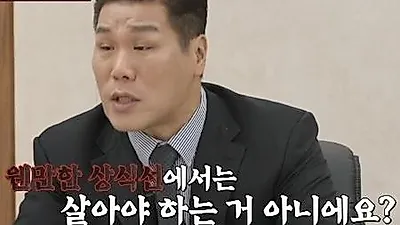
Lee Dong-gun criticizes husband for fueling mother-in-law conflict
On JTBC's 'Divorce Camp,' investigator Lee Dong-gun slams a husband for passing his mother's angry texts to his wife instead of mediating.
What should be the role of a husband in a couple experiencing conflict between a mother-in-law and a daughter-in-law? The case of 'The Husband-on-Others' Side Couple' featured on JTBC's 'Divorce Camp' has reopened this question. It was revealed that the husband fueled the fire of conflict by passing along an agitated text message sent by his mother to his wife exactly as it was. While the husband explained, "I wanted my wife to know how angry my mother was," the family investigator defined this as re-transmitting conflict rather than mediation.
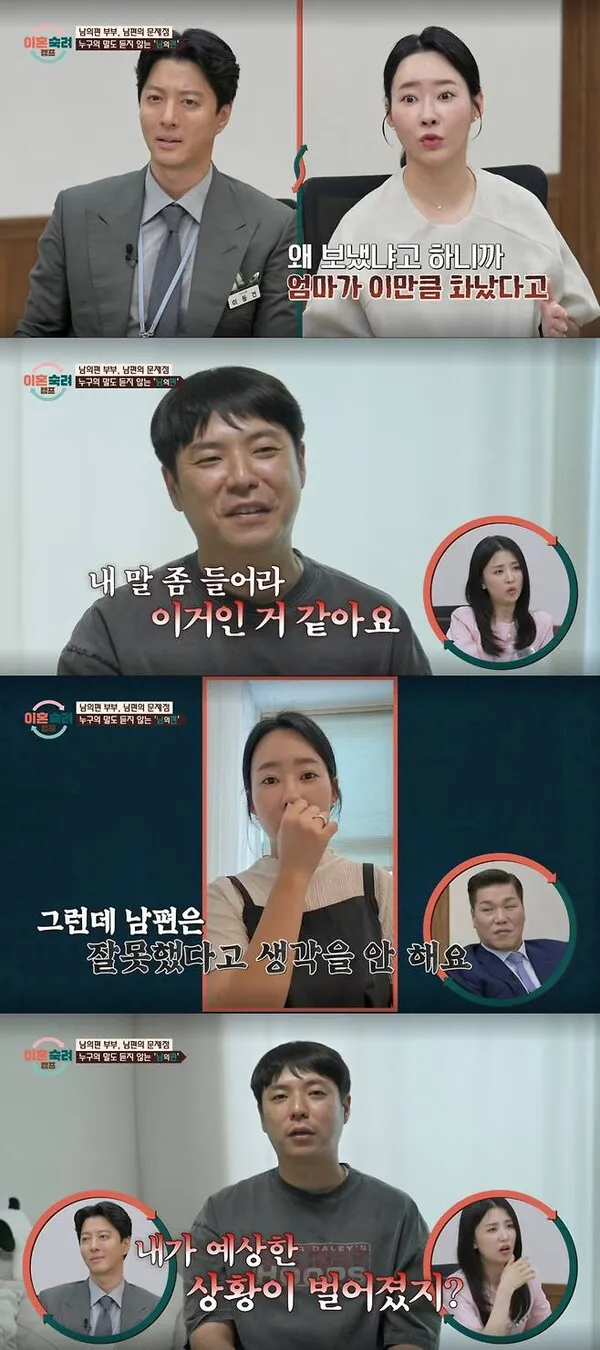
In the 100th episode of JTBC's 'Divorce Camp' aired on the 17th, the story of 'The Husband-on-Others' Side Couple,' who hold differing views regarding mother-in-law/daughter-in-law conflict, was revealed. On this day, the wife appealed that her husband fails to act as a neutral mediator in the relationship between his mother and herself, and instead worsens the situation by conveying his mother's emotions to her.
The wife stated, "My husband cannot remain neutral in the conflict between mother-in-law and daughter-in-law. He passes on the conversations he had with his mother directly to me."
The actual text message from the mother-in-law contained significant emotion. The mother-in-law sent messages to her son to the effect of, "I shouldn't have intervened in your lives," and "I feel relieved to have finally seen your true colors through this opportunity." The content was filled with disappointment and anger regarding the relationship between her son and daughter-in-law, going beyond simple dissatisfaction.
The problem lay in the fact that the husband passed these messages directly to his wife.
In family conflicts, if a third-party spouse passes the agitated remarks of one side directly to the other, the intensity of the conflict can increase even if there is no direct clash between the primary parties. Especially if the original conversation was emotionally heightened, there is a possibility that the context or buffer is lost during the transmission process, leaving only an aggressive message for the recipient.
Family investigator Lee Dong-gun pointed to this exact point as the problem.
Lee said that the mother-in-law expressing her emotions strongly to her son is "understandable, as it is the mother's position speaking to her son." However, he pointed out, "The real problem is the husband who delivered that."
The wife asked the husband why he sent that specific text to her, and he explained that he was trying to let her know the fact that "Mom is this angry."
However, Lee's judgment was different. He analyzed that the husband is excessively swayed by his mother's emotions.
Lee said, "The husband is too mother-centered. Because the husband moves according to his mother's emotions and mood, the wife has no choice but to be upset."
He then specifically explained the role of a mediator. He suggested that when conflict arises between family members, what a spouse should do is not to move one side's words directly to the other, but to mitigate the intensified emotions and adjust them into a form that the other party can accept.
Lee pointed out, "To be a mediator of the relationship, you must neutralize that story and deliver it by absorbing the shock. Right now, this is just inciting a fight."
The husband, however, did not readily understand why his behavior was problematic. He said, "Others say it's wrong, but I don't really know."
At this point, the couple's conflict showed signs of transcending simple mother-in-law/daughter-in-law tension. This was because what the wife took issue with was not just a specific remark from the mother-in-law, but the husband's attitude of not reflecting on his own actions during a conflict and instead shifting the responsibility to her.
The wife appealed, "He passes on things to me that don't need to be said to me. When he does that, I grow to dislike my mother-in-law more and more." She explained that the more the husband conveys the mother-in-law's emotions, the more the mother-in-law is imprinted on her as a hostile entity.
A bigger problem was that the husband did not admit his behavior was wrong. The wife said, "My husband doesn't think he did anything wrong. He always tells me, 'Your thinking is bad.'"
The husband defined his behavior as 'sharing the situation.' He explained, "Passing on my mother's text was sharing the situation. Since you did things your way, didn't the situation I anticipated happen? It meant I wanted you to listen to me."
This statement made the cast even more bewildered. While to the husband it was an act to show the wife the consequences of not following his judgment, from the wife's perspective, it could be perceived as an act of dumping the mother-in-law's anger directly onto her.
Furthermore, the husband said he did not expect the wife to get angry upon receiving the text. He explained, "I didn't think my wife would be angry. I thought she would repent her mistake."
His comments were interpreted as an expectation that his wife would admit her actions were wrong, rather than an attempt at resolving the conflict through dialogue.
The wife's family investigator, Park Ha-sun, reacted strongly to the husband's attitude. She delivered a sharp rebuke to the husband, saying, "It seems like you should just live with your mother instead." She pointed out the husband's tendency to prioritize his mother's emotions and judgment over his wife, who is the core partner in the marriage.
Seo Jang-hoon also analyzed the husband's attitude as a unique type. He remarked, "The husband is a very unique person. I thought he was just gentle and ordinary, but he has strong self-conviction and thinks he is always right."
In family conflicts, self-conviction is a double-edged sword. While maintaining one's judgment can be an advantage, in situations where one must mediate between a spouse and a parent, treating one's own judgment as an absolute standard can become a factor that solidifies conflict.
In this case, the husband seemed to perceive himself as a 'mediator,' but his actual behavior was closer to passing one side's emotions and arguments directly to the other. Mediation and mere transmission may look similar, but the results in a conflict situation are vastly different. Mediation requires buffering emotions, organizing facts, and considering both sides' positions, whereas simple transmission merely exposes the recipient to the other party's raw emotions.
The husband maintained his stance until the end, insisting that the wife should be the one to reconcile with his mother first. He argued, "Even if the wife doesn't think she did anything wrong, she should have somehow reconciled with her mother."
He added, "In the old days, this would have been unthinkable. It feels like, 'How could she dare to [act this way] to her mother-in-law?'"
These remarks reveal the generational differences in perceiving family hierarchy. In traditional family culture, there was a relatively strong norm that daughters-in-law should yield to parents-in-law to settle conflicts. However, in modern marital relationships, how to coordinate conflicts between a spouse and their original family has emerged as a crucial task for married life.
Many of the marital issues addressed on 'Divorce Camp' show patterns where conflict expands not due to a single specific incident, but through repetitive communication styles. When a couple views the same incident differently—one seeing it as 'explaining the situation' and the other as 'an attack' or 'shifting responsibility'—it is difficult to resolve the conflict through mere clarification of facts. Ultimately, a process is needed to examine how the other person experienced the behavior.
In this case of 'The Husband-on-Others' Side Couple,' the core issue was not just what the mother-in-law sent in her text. Rather, who the text was sent to, in what context, and with what intention became another axis of conflict.
While the husband claimed he was simply letting her know "Mom is this angry," the message remained another attack to the wife. As a result, the emotional rift with the mother-in-law deepened, and the husband found himself unable to remain a neutral bystander in the conflict.
Ultimately, the issue presented by 'The Husband-on-Others' Side Couple' was less about a simple battle of right and wrong and more about how a couple should mediate conflicts with their original families. While eliminating family conflict is not easy, there is a profound difference between a spouse passing one side's emotions directly to the other and acting as a buffer to mitigate them.
This is why the husband's action of delivering 'mother's anger' made the mother-in-law conflict even sharper. The investigator's remark that he was "not mediating, but inciting a fight" succinctly demonstrates how vital the method of communication is in marital conflict.
Related articles