Comedian Oh Ji-heon reveals family struggles: Father earned 50 million won monthly
Comedian Oh Ji-heon opens up about his wealthy childhood, his parents' divorce, and the 8-year estrangement from his father.
Comedian Oh Ji-heon has opened up about the family history hidden behind his glamorous childhood. Although he was a so-called 'silver spoon' who had a 100-pyeong mansion, a swimming pool, and even a private driver, the childhood he remembers was closer to the conflict and divorce of his parents and the emotional breakdown that followed, rather than abundance.
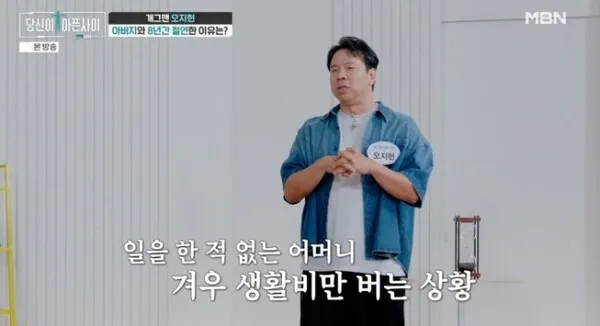
Appearing on the MBN overcoming story program 'While You Are Hurting' broadcast on the 9th, Oh Ji-heon looked back on his life from childhood to his debut as a comedian, speaking honestly about the long-standing wounds caused by his family and the process of reconciliation.
Oh Ji-heon first recalled a childhood that others would have envied.
He stated, "My father was a top-tier history instructor in the early 90s. At that time, a house in Apgujeong was worth about 20 to 30 million won, but my father's monthly income was around 50 million won."
At the time, Oh Ji-heon's family lived in a 100-pyeong house with a yard and a swimming pool, and there was even a separate driver at the house. From an outward appearance, it was an environment that lacked nothing.
However, the 'rich house' in Oh Ji-heon's memory was not a synonym for happiness.
"I thought I would be happy enough as a son of a rich family, but in reality, I was not happy."
This single remark he made shows the fact that childhood abundance and emotional deprivation are not necessarily inversely proportional.
According to Oh Ji-heon, his father prioritized work over the family. On the other hand, his mother wanted her husband to be more devoted to the home, and the gap between the two grew larger as time passed.
He revealed, "My mother wanted my father to be faithful to the family, and as mutual dissatisfaction accumulated, the frequency of parental fights increased. My parents divorced when I was in my senior year of high school."
The problem was that the parents' divorce did not end simply with the separation of family members.
After the divorce, Oh Ji-heon lived with his father, and his mother left the house. However, he was shocked once again when he later personally confirmed the reality of his mother's situation, which he did not know at the time.
Oh Ji-heon confessed, "My grades weren't bad originally, but because I was in a difficult state with severe depression, my grades didn't come out well."
In particular, his father's words at the time remained as a wound to the young Oh Ji-heon, regardless of his intention.
"Because my father saw many top-class instructors as a lecturer, he probably didn't say those things to look down on me, but at the time, they sounded very much like he was looking down on me, so my heart was heavy."
It was a collision between the standards of a successful father and the self-consciousness of a son who felt he did not meet those standards. Given that words meant as advice to parents can sound like a denial of oneself to a child, Oh Ji-heon's confession makes one reflect on the duality of language within a family.
Eventually, after taking the college entrance exam, he left home without telling anyone and went to find his mother.
The reality he faced there was much harsher than expected.
Oh Ji-heon stated, "My mother's situation was very different from what I thought. After the divorce, she left the house without a single penny and lived at my aunt's house."
His mother was not someone who engaged in economic activities to begin with, and at the same time as the divorce, she had lost almost all her foundation for living. Because she was in a situation where she had to survive day by day, she did not even have the capacity to take care of her son directly.
In the end, Oh Ji-heon had to spend a year at a dormitory-style preparatory academy.
Nevertheless, his mother supported his education within the limits of what she could do. Thanks to his mother providing education expenses with the money she earned with great difficulty, Oh Ji-heon was able to devote himself to studying again and eventually succeeded in entering university.
However, university life was not smooth either.
He had to work part-time jobs to provide for his tuition and living expenses, and a chance encounter turned his life in a different direction.
Upon learning that the prize money for an impression contest at the time was 10 million won, Oh Ji-heon participated in the contest to raise tuition. And unexpectedly, he won the grand prize.
The challenge he started out of economic necessity eventually became his profession.
After debuting as a KBS open recruitment comedian in 2003, Oh Ji-heon began to make a name for himself as a broadcaster. However, even after his success, his relationship with his father was not easily restored.
He confessed, "Even then, I didn't feel like calling my father."
In that way, the disconnection between the two lasted for a full eight years.
The turning point was his grandmother.
One day, his father called the comedy department and said, "Grandmother is in critical condition. Even if you don't see me, shouldn't you see her?"
Those words moved the son's heart, which had been closed for eight years. Thus, Oh Ji-heon faced his father again after a long time.
Following this, with the persuasion of his wife, the relationship between father and son began to recover bit by bit.
Oh Ji-heon said that it was only after becoming a father himself that he could finally look at his father through a different lens.
"Through various experiences in society, I began to understand my father to some extent. I realized that it wasn't that he wasn't paying attention to me, but I only understood that once I became a father myself."
Looking back, the most paradoxical thing in Oh Ji-heon's life was 'money.'
In his childhood, his house was overflowing with money, but the emotional distance within the family could not be closed. Conversely, after the divorce, his mother left home without a single penny, yet she supported her son's future in every way she could.
Beyond the simple premise that money cannot replace love, this story shows that love is not always delivered in the way the recipient desires.
His father may have worked for the family, but to a young son, it was perceived as a signal that work was more important than he was. His mother also loved her son, but in a situation where she had lost her economic foundation, it was difficult to express that love fully in the form of care.
Ultimately, as time passed, Oh Ji-heon began to view his parents' lives through the lens of his own. Especially the moment he became a father, the choices his father made—which he once couldn't understand—began to take on a different meaning.
The wounds of his childhood have not disappeared. However, as time passed, he stopped interpreting those wounds solely through the language of 'resentment.'
Perhaps this is why Oh Ji-heon's story resonates.
The most difficult reconciliation in life may not be with others, but with one's past self and one's parents at that time.
The boy who grew up in a house where his father once earned 50 million won a month eventually rebuilt his life through his own strength and reunited with his father after an eight-year estrangement.
And only after becoming a father did he realize: his father, too, was perhaps just a man experiencing fatherhood for the first time.
Oh Ji-heon's life story is ultimately a tale of human growth that cannot be explained by the term 'silver spoon' alone. Having passed through abundance and deprivation, resentment and understanding, and disconnection and reconciliation, he now stands before another question: what kind of father will he be to his own children?
Related articles