
Chef Jung Ji-sun expresses frustration over generational gap with MZ employees
Veteran Chinese cuisine chef Jung Ji-sun revealed her struggles with communicating with younger "MZ generation" employees, noting significant differences in their views on career goals and professional passion.
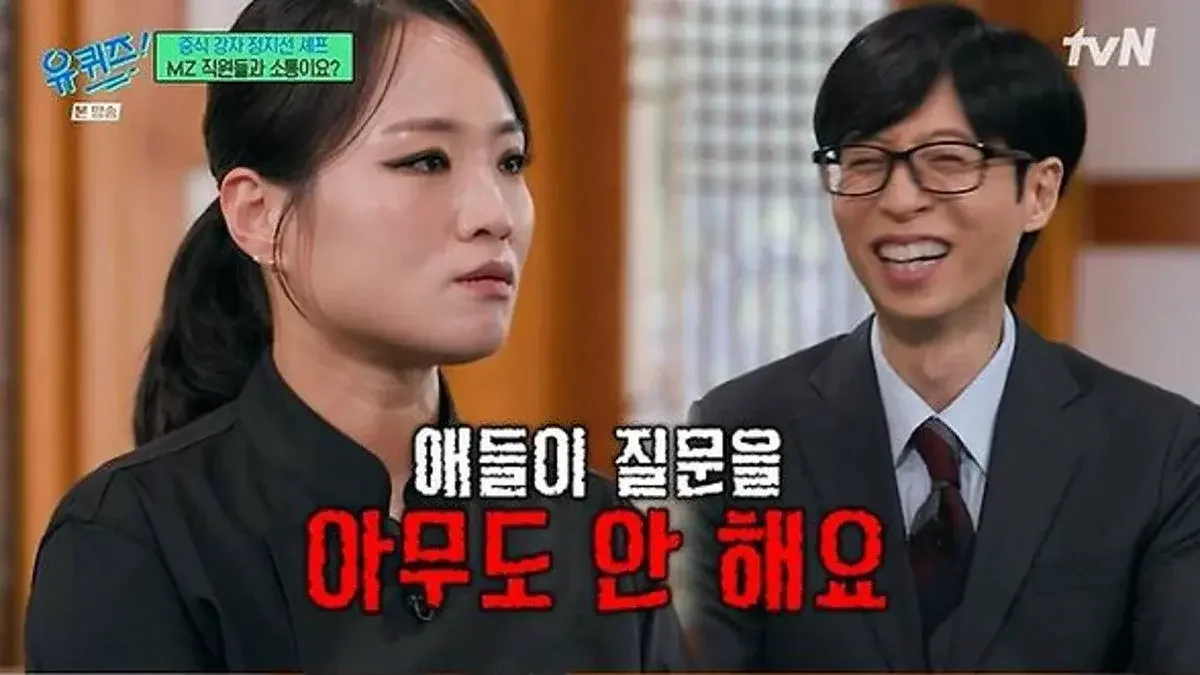
During a broadcast of 'You Quiz on the Block' on the 4th, 24-year veteran Chinese cuisine chef Jung Ji-sun shared her bewilderment regarding the differing career perspectives of her MZ generation staff. While Jung emphasizes professional depth and overseas training, some employees expressed interests in woodworking or simply smoking after work.
Chinese cuisine chef Jung Ji-sun has candidly expressed her bewilderment regarding the communication process with employees from the MZ generation. When she asked her staff about their dreams, the responses she received were not about culinary growth or a future in cooking, but rather "smoking chains of cigarettes after work." Additionally, one employee among those cooking expressed a desire to do woodworking instead. While attempting to understand their perspectives, she revealed her frustration with a reality that differed so greatly from the answers she had expected.
During the broadcast of the tvN entertainment program 'You Quiz on the Block' on the 4th, 24-year veteran Chinese cuisine chef Jung Ji-sun appeared to discuss her experiences leading a kitchen and her relationships with her staff. Having observed the culinary field for a long time, she disclosed not only her culinary philosophy but also the generational gaps she encounters while working with young employees.
Jung shared an anecdote where she asked her employees about their dreams, stating, "When I asked about their dreams, they said 'smoking chains of cigarettes after work.' I was very bewildered." She explained that she was surprised by the reactions, which were entirely different from the answers she anticipated. She noted that the scope of her answers differed from theirs, realizing that perspectives on dreams and work can vary significantly depending on the generation.
She also mentioned that another employee expressed an interest in doing woodworking instead of cooking. "One employee who cooks said they would do woodworking," Jung said candidly, adding, "I wondered, 'Then why are you here?'" For Jung, who expects those who choose cooking as a profession to set goals and build expertise in that field, this was a point that was not easily understood.
She also felt a difference in attitudes toward cooking. "However, none of the kids ask questions. So instead, I ask them questions in reverse. I ask them what kind of dish they are making," Jung revealed. Her intention is to ensure they understand the background and characteristics of the dishes they are in charge of, prompting them to think about the essence of food rather than simply learning recipes.
Regarding this teaching method, she drew laughter by saying, "It's not that I'm a 'kkondae' (old-fashioned/bossy person); who else would teach them like this?" While being conscious that her efforts to convey her experience and knowledge might sometimes be perceived as nagging or interference by young employees, she expressed that she cannot give up teaching the basics and depth of cooking.
Listening to the story, Yoo Jae-suk pointed out the generational gap, saying, "Nowadays, if you hear stories like this, you might think, 'Work is busy enough, why are they telling me to study history too?'" He explained that a gap in perception can exist between a chef who believes one must learn the history and context of food and employees who view cooking simply as a given task. This highlights how perspectives on a profession and expectations for growth can differ even when working in the same kitchen.
While feeling regret over the attitude of her employees, Jung emphasized that she actively supports their welfare and educational opportunities. "I believe they must go to the source to eat, feel, and learn directly, so I take employees with me when going abroad," she stated. She revealed, "I cover all costs, from airfare to accommodation, meals, and personal items." She decided to provide overseas training opportunities because she believes the process of experiencing local food firsthand is important for broadening a chef's perspective and improving their skills.
Since employees participate in these overseas schedules using their personal leave, she said she provides separate compensation for it. "Since the employees are using their own leave, I give them the cost of the leave separately. These days, it is an era where you get criticized if you make people use their personal time, so I make sure to follow that strictly," Jung added. She made it clear that even for training to improve professional capabilities, one should not take an employee's private time for granted.
Upon hearing Jung's story, Yoo Jae-suk offered meaningful advice, saying, "Not everyone can become the best. But someone does become the best." It is interpreted to mean that while not everyone can have the same goals and passion, those who dream of being the best in their field and work steadily will eventually make a difference.
This conversation revealed a difference in perception regarding work, growth, and professional spirit across generations, moving beyond a simple conflict between a supervisor and employees. Jung attempts to teach more in-depth cooking based on her experience, while employees attempt to establish their own standards between work and personal life. Jung's explanation of personally taking care of overseas training and leave compensation also showed that communication with the younger generation cannot be achieved through one-sided demands alone.
Oh Seo-yoon reports for Mediafine Global, mainly covering K-Variety and also writing on K-drama, K-pop and K-movie.

Comments 0
Comments are currently disabled.