Kim Gyu-ri transforms into Silla Buddha statue for museum event
Actress Kim Gyu-ri delights fans with a playful transformation inspired by Silla artifacts for the 2026 National Museum of Korea event.
Actress Kim Gyu-ri provided unexpected laughter by transforming overnight into a figure reminiscent of a Silla Buddha statue. Unlike her serious image in various works, she revealed another side of herself by willingly embracing playful makeup based on cultural heritage to connect with fans.
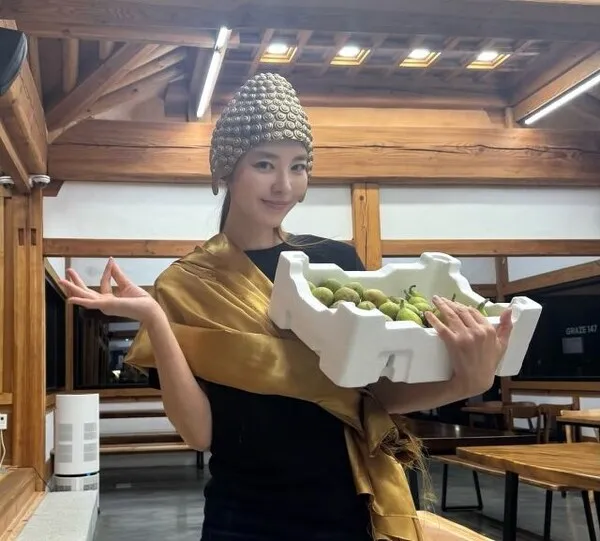
Recently, Kim posted photos on her social media with the caption, “Today was the finals for the National Museum of Korea event. This ingenious item was born through the hard work of the talented PD and writer.” She added that a prop delivered via express shipping from Seoul arrived during her live broadcast, noting, “I laughed a lot thanks to it.”
In the photos, Kim appeared in a completely different light than usual. Wearing a headpiece that seemed to embody a Buddha, she held a box full of figs in one hand while making a hand gesture reminiscent of Avalokiteshvara with the other. Rather than the glamorous styling typical of an actress, the look featured a playful reinterpretation of the artifacts' forms without caricaturing them.
Her expression and posture were particularly exquisite. While appearing to mimic the static atmosphere of a Buddha statue, the sight of her holding a box of figs created a collision of solemnity and humor within a single scene. It effectively transformed cultural heritage from something confined within museum glass cases into an object that today's public can directly engage with and play with.
While sharing this look, Kim did not overpackage herself as a “funny person.” She spoke to her fans, saying, “Come play when you feel lonely. Isn't it wonderful and surprising to suddenly receive a gift while playing? For the record, I am not a funny person. Let's just play together like children in a playground.”
Her approach of expressing the relationship between an actress and fans not as a one-sided dynamic of star and audience, but as a relationship of playing together, also drew attention. Kim added that she enjoys chatting about daily life and cheering for people who live their days to the fullest.
This “Buddha transformation” is linked to the finals of the “2026 National Museum of Korea Costume Play: Nationwide Edition,” held on the 19th at the National Museum of Korea in Yongsan District, Seoul. This year, the event expanded beyond the scope of previous museum activities to a nationwide scale, designed as a participatory cultural event where participants dress up using museum artifacts as motifs and perform.
The scale of participation increased significantly this year. According to the National Museum of Korea, 275 teams and 643 individuals participated in this event, which was centered around 14 national museums across the country. This is more than triple the size of last year's 83 teams, signifying that the attempt to expand cultural heritage from objects of observation to objects of creation and play received a substantial response.
In the finals, representative Korean artifacts, including the Royal Seal related to the restoration of King Danjong, the Pensive Bodhisattva, and the Gilt-bronze Incense Burner of Baekje, were recreated in new forms through the participants' costumes and performances. The museum also describes this event as a festival that connects regions and generations through the medium of artifacts.
In this context, Kim's participation is read as something more than a celebrity's simple attendance at an event. Because a familiar actress directly donned makeup inspired by artifacts and expanded it into her own SNS content, the very way of approaching museums and cultural heritage has become lighter and more friendly.
If traditional culture is only delivered to the younger generation as difficult and rigid knowledge, the threshold of interest will inevitably rise. Conversely, if the formative characteristics of artifacts are linked to fashion, cosplay, performance, and SNS content, there is a higher possibility that visitors will accept them not as “cultural properties that must be studied,” but as “cultural material that can be directly interpreted.”
The image shown by Kim lies on that same continuum. An actress who has played numerous roles on screen has now become a “character of play” inspired by our cultural heritage, rather than a specific character. The fact that she prioritized joy, saying she “laugled a lot” rather than assigning heavy meaning, aligns well with the purpose of this event.
Recently, Kim has been communicating with fans in a relatively close manner through SNS and live broadcasts, as well as her acting work. In these photos, she briefly set aside her professional image and showed a natural side as a person who plays and chats with her fans.
Ultimately, the reason Kim's Buddha transformation evokes laughter is not simply because the makeup is funny. There is a peculiar charm in seeing serious cultural heritage and the everyday play of the public meet in a single scene, with the actress herself at the center.
As museums expand from spaces that merely display artifacts to spaces where visitors can reinterpret them, Kim's brief “Buddha experience” has become a symbolic moment. By saying “I am not a funny person” while creating a playground for her fans, Kim has demonstrated a way to translate cultural heritage into the language of today.
 Up next
Ministry of Culture, Sports and Tourism to audit National Museum of Korea over Blackpink event
Related articles