Netflix brings K-drama 'Thank You' to global stage two years later
Two years after its hit run on tvN, the corporate investigative thriller 'Thank You' arrives on Netflix for a global audience.
The tvN drama 'Thank You' is stepping onto a new stage two years after its original broadcast. Although it did not receive massive attention initially during its 2024 airing, the work eventually gained popularity through its solid narrative and the dense acting of its cast, reaching a peak viewership rating of 11.7%. Now, it meets global viewers through Netflix.
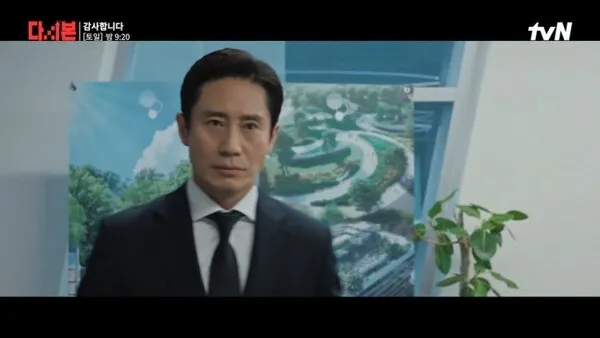
At the time of its first broadcast, the atmosphere was quiet. Starting with a 3.5% viewership rating among nationwide paid households, 'Thank You' took a different path from the 'explosive early success' commonly seen in the recent drama market. However, as the episodes progressed, the true value of the work was revealed. It rose to 5.9% by the second episode and recorded 7.2% in the fourth, showing a steady upward curve.
Notably, it demonstrated its strength by maintaining its viewership even amidst strong competition from the Paris Olympics broadcasts. The final episode concluded on a high note, recording a nationwide average of 9.5% and a peak instantaneous viewership rating of 11.7%. In the recent drama environment where first-week performance often determines survival, 'Thank You' was a rare 'late-blooming hit' that slowly accumulated strength before exploding.
-'Thank You' is not a warm greeting... but a cold audit drama targeting corrupt organizations
While the title might look like a human drama delivering warm emotions, the 'audit' in the work does not mean 'gratitude.' It refers to an 'audit' that investigates corruption and malpractice within an organization.
'Thank You' begins when Shin Cha-il, a cold-blooded audit team leader, is appointed to JU Construction, where embezzlement and corruption are rampant. Various incidents occur within the company, such as tower crane accidents, embezzlement of project funds, corruption in cafeteria operating rights, and technology leaks. Shin Cha-il pursues the truth using only evidence and logic, rather than emotions or personal relationships.
The interesting point of this work is that it is not a simple workplace drama, but rather chooses the structure of an investigative thriller set against the backdrop of a corporation. The process of new incidents and suspects appearing every episode and hidden truths being revealed creates the tension of a detective procedural.
However, what the work ultimately looks at is not mere crime-solving. It asks how the most important foundation of an organization—'trust'—is exploited by someone.
“I will do my best to show how great the crime of exploiting trust truly is.”
This line from Shin Cha-il encapsulates the core message of 'Thank You.' Within the massive system of a company, the most dangerous crime is not just the act of stealing money, but the act of stealing people's trust.
-Shin Ha Kyun completes the 'God of Auditing'... the charm of a cold principle-oriented man
At the center of the work is, of course, actor Shin Ha Kyun.
Shin Cha-il, played by Shin Ha Kyun, is different from the typical righteous protagonist. He believes in objective evidence rather than warm consolation or human persuasion. He is a character for whom the logic of relationships, such as emotions, school ties, or blood ties, does not work.
However, Shin Ha Kyun did not let this coldness become mere frigidity. Through his characteristic restrained acting, subtle facial expressions, and short, intense lines, he convinced the audience 'why this person must be the audit team leader.'
On the opposite side is the new employee Gu Han-su, played by Lee Jung-ha. As a character who trusts people and empathizes with the weak first, he constantly clashes with the strict principle-oriented Shin Cha-il.
The relationship between the two is another axis of the work. One views the world through facts and evidence, while the other views the world through people and emotions. The process of these two characters with different values solving incidents and changing creates the human warmth of 'Thank You.'
Vice President Hwang Dae-woong, played by Jin Gu, is also not consumed as a simple villain. He is portrayed as a complex character possessing both a desire for power and an attachment to his family, heightening the tension of the drama. Supporting actors such as Jo Ah-ram, Jo Han-chul, Jung Moon Sung, Shin Jae-ha, and Jung Jin-young also fulfilled their respective roles faithfully, increasing the density of the work.
-'A new workplace investigative drama for the 'Easy Viewing' era... Will it work again on Netflix?
The greatest strength of 'Thank You' is that it unravels an unfamiliar subject using popular genre conventions.
While it deals with the somewhat specialized field of corporate auditing, it utilizes familiar structures such as incident tracking, twists, and interpersonal conflicts to make it easily accessible to viewers.
This aligns with an important trend in the content market. Viewers no longer want simple good-versus-evil stories; they want genre-driven entertainment that touches upon real-world injustices while remaining immersive.
'Thank You' aimed exactly at that point. Within the familiar setting of a company, it unraveled power struggles, organizational silence, and the betrayal of trust through an investigative format.
The Netflix release is expected to provide another opportunity for the series. Based on its proven quality and word-of-mouth popularity in Korea, it has the potential to showcase the charm of a 'Korean-style workplace investigative drama' to global audiences.
A drama that rose from a 3.5% viewership rating to a peak of 11.7%. 'Thank You' was not a work that grabbed attention from the start, but one that proved its value over time.
And now, two years later, it poses the question once again on the larger stage of Netflix:
“Are you a person who protects an organization's trust, or one who exploits it?”
Related articles