Dayoung: "My biological father left billions in debt, forcing me to grow up at age 7"
Singer Dayoung opens up about her childhood on Jeju Island, her family's financial struggles, and her determination to succeed through music.
Singer Dayoung revealed her family history, explaining that she was forced to grow up prematurely due to her parents' divorce and the massive debt left by her biological father. She shared that at the young age of seven, she was already worrying about "how to not become a burden to my mother," prompting her to make a promise to herself to pursue a career in music and change her family's life.
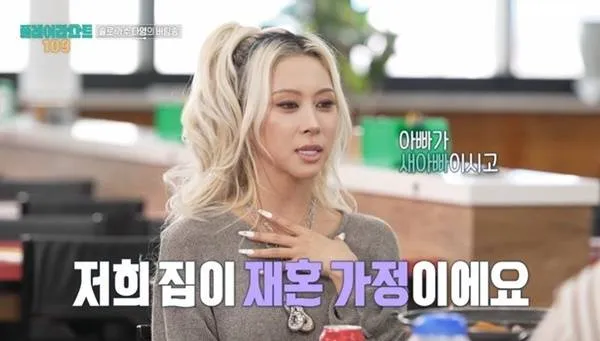
Appearing on the 5th episode of the MBC entertainment program "Songs That Survived Today - Playlist 109" broadcast on the 18th, Dayoung shared stories of her childhood on Jeju Island and her family's struggles.
Originally from Jeju Island, Dayoung explained that she naturally developed her dream of becoming a singer by singing and dancing for customers at a mountain hagfish restaurant operated by her mother. She added that she helped her mother with basic restaurant setup and cleaning starting in elementary school.
The decisive factor in her gaining a sense of responsibility earlier than her peers was her home environment.
"When I was young, I thought every day about how I could be helpful and not be a burden to my mom," Dayoung confessed. "It is a remarried family. My dad is my stepdad. My parents divorced when I was very young."
Referring to the economic burden left by her biological father, she recalled, "My biological father left too much debt at home. The debt in my mother's name was in the billions of won. It is a huge amount of money even now, and it felt so overwhelming. Experiencing it at age 7, I felt like I became an adult at that very moment."
Facing a reality that was difficult to handle at the age of seven, she essentially began to view the world through the eyes of an adult worrying about her family's livelihood.
Dayoung said that watching her mother's life instilled in her an even stronger sense of responsibility.
"From a certain day, my mom started going out at dawn. She worked other jobs during the day and ran the business in the evening," she said. "Since she lived like that when I was in elementary school, I wanted to help her."
As an only daughter, Dayoung eventually made a promise to her mother.
"I promised my mom. I told her I would succeed by a certain age and lift our family up. I talked with her," she said. "Looking at my eyes, my mom said, 'Okay, do it.'"
The deprivation of her childhood instead became the driving force that allowed Dayoung to endure life. The sense of responsibility, which started from the thought of not being a burden to her family, led to a strong will to carve out her own life later on.
At the center of this was her mother's positive attitude.
When DinDin asked, "Is your mother also positive?", Dayoung boasted about her, saying, "She is the ultimate positive person. I am like a mini-me version of her."
In particular, mentioning the period when the number of Chinese tourists visiting Jeju Island surged, she explained, "My mom studied Chinese every day. She didn't go to an academy but taught herself, obtained an HSK certificate, and now speaks almost like a Chinese person."
Watching her mother create opportunities for herself rather than blaming her environment, Dayoung also made studying and self-development a part of her daily life.
"My mom always said, 'Opportunities come to everyone, but if you try to grab them only after they arrive, they will run away, so always be prepared and grab them when they come,'" Dayoung said. "So I study every day."
The responsibility toward her family and constant preparation were clearly reflected in her musical activities.
The most difficult period for Dayoung was about five years ago when she decided to challenge herself as a solo singer. While undergoing group contract renewals, she expressed her desire to do solo music to her agency, but faced opposition from the company.
"I said I wanted to do solo music. I said I could do this kind of music too, but the company said, 'No. Do you know how hard the solo market is?'" Dayoung said. "I said 'I understand' and immediately asked for a three-month leave. The next day, I left for LA."
The time given was only three months. During that time, Dayoung invested almost all the money she had saved to prepare an independent solo project in Los Angeles.
However, the process of collaborating with local music professionals while being unknown was not easy.
"It was hard to catch people I wanted to work with. Since I didn't have a clear track record, they were betting on me," she explained, describing the situation at the time. "I just told them to meet me first."
The song completed during this process was 'body.' Although the initial demo was quite different in atmosphere from the current version, Dayoung created her own musical color by revising the song dozens of times.
And in that process, a song symbolizing her life was born.
Dayoung identified 'number one rockstar,' included in the same album as 'body,' as her "survival song."
The original title was 'Flopstar.' She recalled, "It meant a failed star. It was a very depressing and sad song. When I listened to it, I felt like I would burst into tears at any moment. So I thought, 'Should I change the lyrics? Let's change it to Rockstar.'"
Ultimately, she flipped the direction of the song. Changing 'Flopstar,' which signified failure, into 'Rockstar' served as a declaration of herself and a new beginning.
"I flipped the whole song. I changed it into a manifesto about myself," Dayoung recalled. "During the period I was recording and preparing for my solo debut, I listened to this song while waiting for the day it would be released to the world."
The girl who faced the overwhelming reality of billions of won in debt and felt like an adult at age seven has finally grown into an artist who designs her own destiny.
Related articles