Heo Jin: From Kim Il-sung's villa chef's son to master of North Korean paste
Master Heo Jin shares how his mother's legacy as a chef at Kim Il-sung's villa inspired his 20-year journey to recreate authentic North Korean flavors.
Heo Jin, a master of soybean paste and the first North Korean defector to achieve such status, revealed how his 20-year research into recreating the flavors of his hometown has established itself as a unique tradition. As his unique family history—including his experience preparing meals for high-ranking officials in North Korea and the fact that his biological mother was a chef at Kim Il-sung's villa—came to light, attention has also turned to the background of the flavors contained in his earthenware jars.
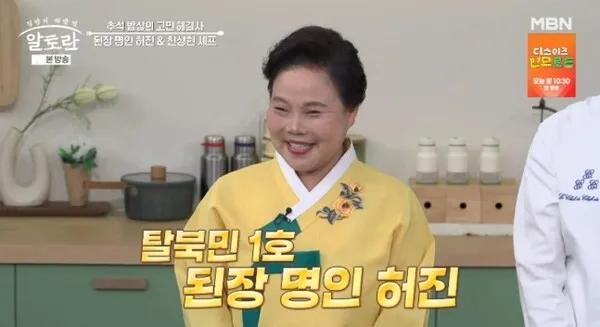
The 611th episode of MBN's 'Altoran', aired on the 20th, was presented as a 'Korean People's Chuseok Table' special ahead of the Mid-Autumn Festival. In this broadcast, Heo appeared alongside Chef Cheon Sang-hyeon, who has a career working at the Blue House since 1998, to share stories regarding the fermented paste culture and holiday foods of North and South Korea.
Heo's story began with a single spoonful of soybean paste. After defecting in 2006 and settling in South Korea, he first encountered Korean foods at Hanawon, the settlement support office for North Korean defectors. He revealed that among them, the soybean paste soup felt unusually sweet compared to the taste he had eaten in his hometown. The sense of alienation caused by food that was entirely different from the familiar flavors actually became the motivation for him to personally create the fermented paste of his hometown.
Heo recalled that period, saying, "If there was one thing I had to do in the future, I thought it had to be making fermented paste." Although the choice started from simple nostalgia, it ultimately became a new profession and identity that represents his life after defection.
However, Heo did not follow the path of a professional chef from the very beginning. He explained that while working in railway-related duties as a train conductor in North Korea, he was tasked with preparing meals for more than 600 soldiers in the Railway Shock Troops. He was selected by those who noticed his culinary skills and ended up working in the officers' cafeteria. Although he did not receive formal culinary training, he naturally gained cooking experience through the process of being responsible for large-scale meals.
This was further enhanced by an extraordinary family lineage. Heo stated that he acquired his culinary sense by watching his mother cook during his childhood, and it was revealed that his mother worked as a chef at Kim Il-sung's villa in North Korea. When this story was shared on the broadcast, the cast members expressed surprise, noting that it was similar to the role of the Blue House in South Korea, and Chef Cheon also reacted that the position and responsibility of a chef at Kim Il-sung's villa must have been significant.
To Heo, his mother's food was not merely a family memory. Growing up watching her handle ingredients that were difficult to come by in North Korea, the experience of observing her hand-made flavors closely became the foundation for making fermented paste later in life. In the soybean paste he chose after defecting, his personal memories, the cooking experience inherited from his family, and his longing for his hometown food are all melted together.
In particular, the North Korean-style fermented paste made by Heo differs in its manufacturing method from the typical soybean paste in South Korea. He introduced methods such as the North Korean-style meju (fermented soybean blocks) being large, weighing about 10kg per block, being dried for a long period in cold weather, and then aged in the warm floor area of a room under a blanket. He explained that because of this, the color is a much deeper dark brown, unlike the light yellowish-brown of South Korean soybean paste.
The aging period is also a crucial element in explaining Heo's paste. Among the pastes revealed that day, there was soybean paste that had been aged for as many as 7 years. Heo was introduced as someone who continues to care for his paste as part of his daily life, such as wiping the jars every day while managing about 200 earthenware pots.
The fact that Chef Cheon appeared to evaluate the taste of his paste is also highly meaningful. Cheon is a person with a career of being responsible for the President's table at the Blue House for 20 years since 1998, and he also has experience making traditional fermented paste himself. However, he confessed that making paste is not easy even for professional chefs and that he himself has many memories of failing while making it.
As much as that, Cheon's evaluation of Heo's paste was of a different caliber than simple television admiration. In the 7-year aged North Korean-style paste tasted by Cheon, a lingering sweetness was felt following the salty and savory flavors, and for the North Korean-style fish-infused soybean paste (eodaejang), the evaluation was that it possessed a distinct umami flavor different from typical soybean paste.
In particular, eodaejang is a unique item among Heo's pastes. It is made by aging fish in the paste for a long time; Heo explained that the fish must be aged for at least 5 years to achieve the proper flavor. Cheon also noted the deep aroma that differed from regular soybean paste after tasting it.
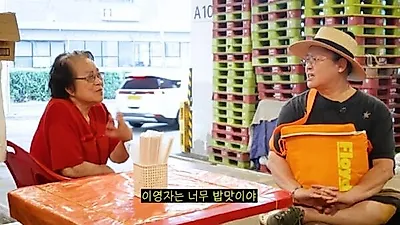
Master Lee Yeon Bok also expressed interest after tasting the eodaejang, noting, "It would go perfectly with rice mixed in water, topped with just this eodaejang." The unique character of Heo's paste was highlighted by the fact that chefs with different culinary backgrounds all mentioned its deep umami and richness.
Heo also puts significant effort into the soybeans used to make the paste. After 20 years of settling in South Korea and testing various types, he found Taebaek soybeans to be the closest variety to those used in North Korea. He revealed that he grows the beans himself and continues the process of making meju and soybean paste. A farm spanning approximately 3,700 pyeong was also shown on the broadcast.
At this point, Heo's paste goes beyond a simple reproduction of traditional food. For a North Korean defector, the taste of home can serve as a sensory medium that calls forth memories. In that the past lifestyle and culture, which are difficult to fully restore through words or records, are revived through smell and taste, Heo's soybean paste exists on two levels: personal nostalgia and the preservation of food culture.
In fact, Heo gained public recognition after appearing as the representative for North Korea on the culinary survival program 'Korean Food Battle 3,' and since then, he has expanded his culinary world around fermented paste. This appearance on 'Altoran' served to reaffirm that he has not merely remained a 'chef from a defector background,' but has built his own professional domain in North Korean-style fermented paste.
The timing of Chuseok adds special meaning to this story. Holiday food is not just something to fill the stomach; it is a cultural device that connects families, hometowns, and generations. While North and South Korea have developed different food cultures under different systems and environments, the act of fermenting beans and aging paste to bring to the table shares a common root in food culture.
Ultimately, what 'Altoran' showed was not a simple cooking competition over who has the better taste. The meeting itself—between Heo, who inherited culinary sense from his mother, a chef at Kim Il-sung's villa, and Cheon, who was responsible for the Blue House table—showed a cross-section of North and South Korean food culture.
The sense of unfamiliarity felt by one person at Hanawon 20 years ago, when he thought the soybean paste soup was "too sweet," has ultimately led to a tradition involving hundreds of earthenware jars and years of aging. As Heo's choice to capture his hometown in a single spoonful of paste expands into a meeting point for North and South Korean food culture, his soybean paste carries a story far deeper than a mere condiment.
 Up next
Kim Seung-hyun worries for father's health amid grueling work schedule
Related articles