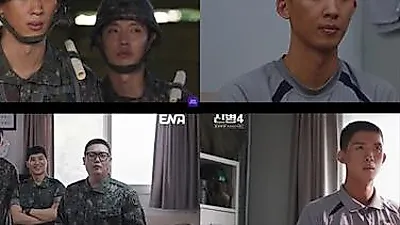
'New Recruit 4: Sabotage' hits 4.6% rating with AI and military realism
ENA's 'New Recruit 4: Sabotage' achieves high viewership and topicality by blending AI technology with the authentic military experience of its actors.
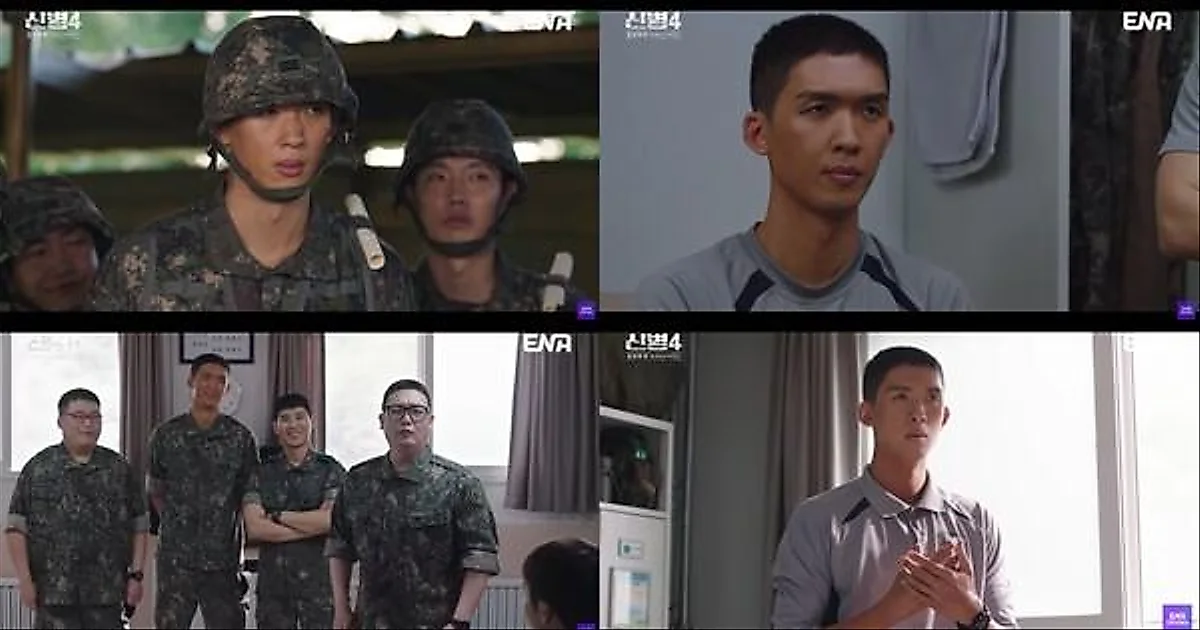
ENA's Monday-Tuesday drama 'New Recruit 4: Sabotage' is continuing the successful legacy of military-themed dramas by simultaneously boosting both viewership ratings and topicality. After securing first place in its time slot with a nationwide viewership rating of 4.6%, the series maintains its position at the top of trending charts across both TV and OTT platforms. Behind-the-scenes production details that enhanced the work's immersion have now been revealed.
Particularly eye-catching is the combination of scenes utilizing Artificial Intelligence (AI) and the on-site recreation led by actors with actual military experience. While using realistic military life as comedic material, the production employed different strategies: actively utilizing AI technology for specific scenes, while maximizing the 'raw reality' of the actors and filming locations in others.
Episode 8 of 'New Recruit 4: Sabotage,' which aired on the 15th, recorded a nationwide viewership rating of 4.6% (based on Nielsen Korea paid households). This figure maintained the series' upward momentum by securing first place in its time slot.
Topicality remains steady as well. In the FUNdex integrated TV-OTT drama topicality rankings, it has maintained 2nd place for three consecutive weeks, and on the OTT platform TVING, all previous seasons, including 'New Recruit 4,' have trended within the TOP7. As the popularity of the latest season extends to past seasons, consumption of the entire 'New Recruit' IP is becoming active again beyond just a single work.
The background of this success lies not only in the original work's unique military humor and character play but also in a detailed directing strategy that varied production methods depending on the nature of the scene.
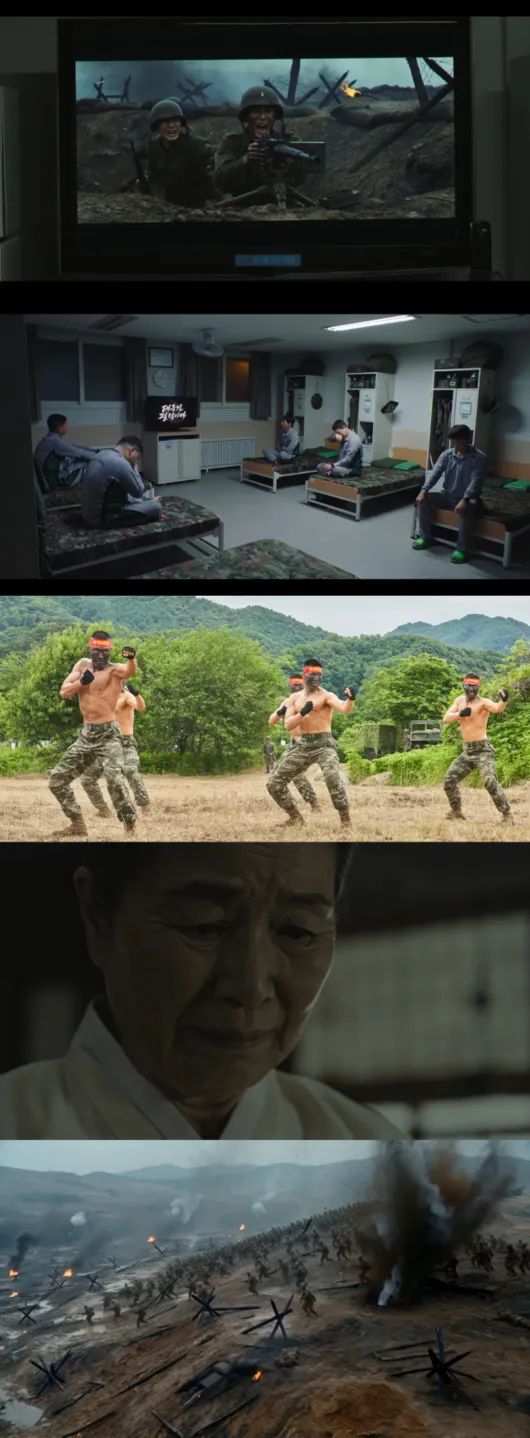
A representative example is Moon Bit-na-ri's 'grass cutter imagination scene' in Episode 2. To visually expand the psychology of a character who is clumsy in reality but acts like a hero roaming a battlefield in his mind, AI technology was utilized.
The production team implemented explosions and battlefield images using AI and combined them with the actors' actual performances. By intentionally widening the gap between the real barracks scenes and the imaginary combat scenes, they expressed the character's exaggerated heroic narrative through comedy.
The role of AI here is not merely special effects. It functioned as a device to quickly visualize imaginary spaces that are difficult to implement realistically, pulling the character's inner world into the external world. As the actual actors' performances combined with digital images, the boundary between reality and fantasy blurred, becoming a source of laughter itself.
In Episode 8, the direction of AI usage changed. In the scene where unit members watch the movie 'Waving the Taegeukgi,' war scenes were implemented via AI to connect the video on the TV with the characters' emotional lines.
What is important in this scene is not flashy spectacle, but emotional connection. The goal was to visually assist the emotions of the unit members as they watched a video about war while in the space of military life, reminding them of their families and parents. In this way, AI was transformed from a tool that exaggerates comedy into a visual medium that strengthens emotional immersion.
'New Recruit 4' serves as an interesting production case because the same technology was used in entirely different ways depending on the purpose of the scene. In imagination scenes, it provided exaggeration that transcends physical limits, while in emotional scenes, it performed a supporting role by connecting existing footage with the actors' expressions.
Conversely, in scenes where reality is the core, more effort was put into the people and the spaces themselves rather than digital technology. A representative example is the episode featuring the Republic of Korea Marine Corps.
To implement the unique speech, movements, physique, and atmosphere of the Republic of Korea Marine Corps on screen, the production team conducted auditions centered on actors who are actual veterans of the Republic of Korea Marine Corps. This was based on the judgment that simply putting them in military uniforms would make it difficult to recreate the atmosphere of a specific military organization.
The selected actors prepared their appearance with 'landing assault' hairstyles even before filming began and underwent Mujeokdo training as well as separate physical training. This was preparation to secure a texture close to actual soldiers, not just in character dialogue and actions, but in physical movements themselves.
In military-themed works, an actor's body is not just an external element. This is because a military organization is a space where physical discipline—such as posture, gait, speed of movement, and response to commands—operates strongly. The realism of a scene depends heavily on how naturally actors can implement these movements.
The training scenes also did not rely on studio sets. To utilize actual terrain and outdoor spaces, the production team conducted all-location filming, traveling between Geoje Island and Pocheon.
The filming locations themselves became a narrative device beyond just a background. By recreating military training in actual outdoor spaces, the production reduced the spatial limitations often found in artificial sets and increased the sense of realism by capturing the soldiers' movements alongside their environment.
Thus, 'New Recruit 4' features an interesting contrast in its production methods. While actively utilizing AI for scenes that are difficult to implement realistically, it opted for actual veterans and real locations for scenes that required authentic military atmosphere. Rather than viewing technology and realism as competing forces, the production utilized each differently depending on the scene's purpose.
This aligns with the unique nature of the military subject matter. One reason the 'New Recruit' series has consistently received positive responses is its ability to capture minor situations, human relationships, rank structures, and awkward hierarchies within the barracks through comedy, rather than focusing on grand war heroics. Because small details dictate realism, the production team must invest significant effort into character dialogue, behavior, and the texture of the space.
As the title 'New Recruit 4: Sabotage' suggests, this season also centers on incidents and character conflicts occurring within the closed organization of the barracks. The success of the comedy depends on whether viewers can accept the characters' actions as things they 'might have seen once in the real military.'
In that sense, the use of AI is not a choice to abandon realism, but rather a device to intentionally distinguish the boundary between reality and imagination. The production captures reality through actual spaces and actor movements, while expanding into realms difficult to implement directly—such as a character's thoughts or movie scenes—through digital technology.
Ultimately, the success of 'New Recruit 4' is not supported by viewership numbers alone. The 4.6% nationwide rating, the three consecutive weeks at 2nd place in topicality, and the fact that all previous seasons have entered the TOP7 on TVING demonstrate that interest in the work is expanding to the existing seasons.
This is further bolstered by the detailed application of different production methods for each scene. From the exaggerated battlefields and imaginary scenes created by AI to the war footage that supports emotional arcs, the physical training of veteran actors, and the all-location filming in Geoje Island and Pocheon, each element builds a different layer of the work.
For a drama dealing with military stories to create new entertainment while repeating familiar themes, it must simultaneously achieve 'believability' and 'unexpected twists.' 'New Recruit 4' finds this balance by drawing on real military experience and locations on one hand, and utilizing cutting-edge AI technology to exaggerate or expand reality on the other.
While these may only be fleeting moments for viewers, the preparation undertaken by the production team and actors is immense. Behind the 4.6% figure lies the relentless attention to detail from a crew that goes far beyond mere dialogue and acting.
Attention is now focused on how 'New Recruit 4: Sabotage' will continue to twist familiar military landscapes in upcoming episodes, and how the combination of AI and on-site realism will further expand the series' immersion.
 Up next
Jeon Seung-hun steals scenes in 'New Recruit 4: Sabotage' with deadpan humor
Related articles