King Jeongjo's devotion: The 60 million won feast for his mother
TV CHOSUN's 'What Did the King Eat?' explores King Jeongjo's grand 60th birthday banquet for Lady Hyegyeong, a testament to his profound filial piety.
The 60th birthday celebration for Lady Hyegyeong, the mother of King Jeongjo, is being spotlighted once again as one of the most magnificent banquets in Joseon history. Viewers have expressed admiration, seeing it not merely as a royal event, but as an unprecedented act of filial piety through which a son, who endured childhood tragedies, expressed lifelong gratitude and love for his mother.
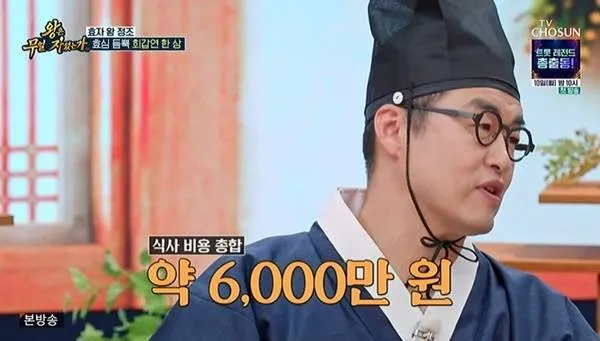
In the fifth episode of the TV CHOSUN entertainment program 'What Did the King Eat?' aired on the 5th, the details of the banquet prepared by Jeongjo for Lady Hyegyeong and the culinary culture of the era were revealed.
The broadcast first highlighted Jeongjo's extraordinary devotion to his mother.
During his childhood, Jeongjo witnessed the tragedy of his father, Crown Prince Sado, who died after being trapped in a rice chest. Carrying wounds that were difficult to bear at the age of only 10, he ascended the throne at age 24, declaring, "I am the son of Crown Prince Sado," thereby seeking to restore his father's honor and demonstrate his filial piety to his mother.
He moved Crown Prince Sado's tomb to Suwon to establish Huryungwon and later organized a special event to celebrate the 60th birthday of his mother, Lady Hyegyeong.
Notably, because Lady Hyegyeong and Crown Prince Sado were born in the same year, Jeongjo arranged the meaningful banquet to honor them both together.
The 'Hwaseong Wonhaeng Banchado,' a painting recording Jeongjo's procession to Hwaseong, depicts as many as 6,300 people. The scale was massive, with the procession stretching approximately 1km in length.
History instructor Choi Tae Sung explained that the procession was a national event rather than a simple royal movement, stating, "There is no record of such a large parade since the era of Dangun. It is an enormous scale."
However, the most surprising aspect was the food prepared for his mother.
During the eight-day procession to Hwaseong, a total of 315 different dishes were prepared. More than 70 of these were served specifically to Lady Hyegyeong. Furthermore, the cost of the meal prepared for her 60th birthday was estimated to be worth approximately 60 million won in today's value.
This expenditure was not intended to flaunt luxury; rather, the menu was designed with meticulous care for the health and stamina of his elderly mother to ensure she could endure the long journey.
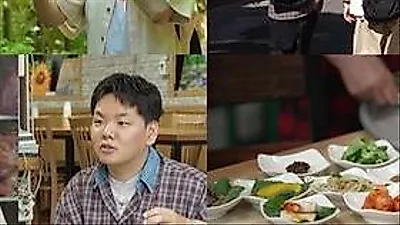
The broadcast featured representative dishes from the banquet, such as Byeol-jap-tang, Gilgyeong-japchae, and Hwayang-jeok.
Byeol-jap-tang was a restorative dish containing special cuts of beef, abalone, sea cucumber, and medicinal herbs. Choi Tae Sung marveled, saying, "You can feel it was prepared with great sincerity so that an elderly mother could eat it without strain."
Yang Sang-guk also noted, "It seems he considered his mother's stamina even for the return journey. It is a dish containing ingredients that are all good for the body."
Gilgyeong-japchae was equally special. It was a Joseon-style japchae that utilized bellflower roots instead of the glass noodles commonly used today, offering a crunchy texture alongside various vegetables.
Choi Tae Sung explained, "The crunchy texture comes alive in the mouth. It is a dish that provides the joy of eating while giving strength to a weary mother."
Another representative dish, Hwayang-jeok, was a quintessential Joseon-era banquet food that harmoniously incorporated five colors, reflecting the philosophy of Yin-Yang and the Five Elements. It embodied the essence of Joseon royal food culture, embedding health, philosophy, and harmony into every dish.
Actor Lee Chang Hoon, appearing as a guest, expressed deep emotion while viewing the banquet menu.
He remarked, "It seems like a healthy and interesting taste. Coincidentally, I am also 61, which is the age of a 60th birthday in Korean age. It feels like a reward I am receiving from my own son."
He continued, "Everything feels strangely fitting today. I feel as if I am having a 60th birthday banquet with a king's menu at this very spot."
Jeongjo's banquet was more than a luxurious royal feast; it was a moment where a son returned the love to his mother, healing the wounds he had carried his entire life.
While history remembers Jeongjo as a reformist monarch, he was first a man who experienced family tragedy more deeply than anyone else. Beyond the figure of 60 million won, what remains most significant is the heart of a son who prioritized his mother's health and happiness.
 Up next
King Sejong's Royal Table: The Hidden Health Culture of the Joseon Dynasty
Related articles